


Page 68 - EW may 2026
P. 68
Cover Story
         INDIA’S TOP-RANKED


         NON-AUTONOMOUS ASC COLLEGES


         Even though autonomous colleges are widely perceived as           percent of the education budgets of
         the best and first choice of school-leavers signing up for        the Central and state governments at
                                                                           the expense of public primary-sec-
         undergrad Arts, Science & Commerce courses, some non-             ondary education which is bedeviled
         autonomous colleges which teach beyond the prescribed             with crumbling classrooms, inad-
         curriculum and have a tradition of high-quality co-curricular     equate and ill-trained teachers and
                                                                           almost total deficit of labs, librar-
         and extra-curricular education, are highly venerated              ies and lavatories. School students
                                                                           routinely promoted upward through
                                                                           the 1 million-strong government
                                                                           school system are deprived of strong
                                                                           foundations to avail the full benefit of
                                                                           higher education. Unsurprisingly, as
                                                                           reported by the State of Working In-
                                                                           dia 2026 of Azim Premji University,
                                                                           Bangalore, 40 percent of graduates of
                                                                           India’s HEIs are unemployed for 12
                                                                           months or more.
                                                                             Control and command of HEIs has
                                                                           resulted in the vast majority of ASC
                                                                           undergraduate colleges countrywide
                                                                           being classified as ‘non-autonomous’.
                                                                           Even though autonomous colleges
                                                                           are widely perceived to be the best
                                                                           and first choice of school-leavers
                                                                           signing up for ASC courses, under
                                                                           the country’s complex higher educa-
                                                                           tion system some non-autonomous
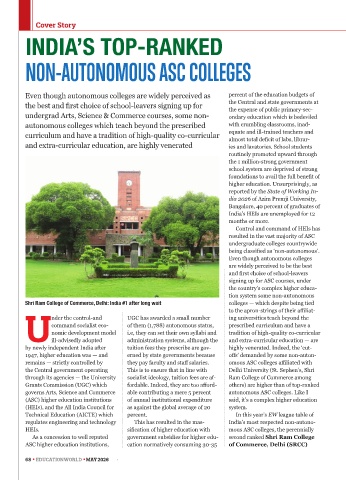
         Shri Ram College of Commerce, Delhi: India #1 after long wait     colleges — which despite being tied
                                                                           to the apron-strings of their affiliat-
                  nder the control-and    UGC has awarded a small number   ing universities teach beyond the
                  command socialist eco-  of them (1,788) autonomous status,   prescribed curriculum and have a
                  nomic development model   i.e, they can set their own syllabi and   tradition of high-quality co-curricular
         Uill-advisedly adopted           administration systems, although the   and extra-curricular education — are
         by newly independent India after   tuition fees they prescribe are gov-  highly venerated. Indeed, the ‘cut-
         1947, higher education was — and   erned by state governments because   offs’ demanded by some non-auton-
         remains — strictly controlled by   they pay faculty and staff salaries.   omous ASC colleges affiliated with
         the Central government operating   This is to ensure that in line with   Delhi University (St. Sephen’s, Shri
         through its agencies — the University   socialist ideology, tuition fees are af-  Ram College of Commerce among
         Grants Commission (UGC) which    fordable. Indeed, they are too afford-  others) are higher than of top-ranked
         governs Arts, Science and Commerce   able contributing a mere 5 percent   autonomous ASC colleges. Like I
         (ASC) higher education institutions   of annual institutional expenditure   said, it’s a complex higher education
         (HEIs), and the All India Council for   as against the global average of 20   system.
         Technical Education (AICTE) which   percent.                        In this year’s EW league table of
         regulates engineering and technology   This has resulted in the mas-  India’s most respected non-autono-
         HEIs.                            sification of higher education with   mous ASC colleges, the perennially
           As a concession to well reputed   government subsidies for higher edu-  second ranked Shri Ram College
         ASC higher education institutions,   cation normatively consuming 30-35   of Commerce, Delhi (SRCC)

         68    EDUCATIONWORLD   MAY 2026

