


Page 254 - [Uma_Sekaran]_Research_methods_for_business__a_sk(BookZZ.org)
P. 254
238  DATA COLLECTION METHODS

            Figure 10.1
            Principles of Questionnaire Design.


                                 1
                              Principles  Content and  Wording  Type and           Classification data
                              of wording  purpose of   and     form of  Sequencing       or
                                           question  language  questions          personal information
                          Observation
                Data                                                      Testing
              collection  Questionnaire                  Questionnaire  goodness of
              methods                                    administration    data

                           Interview       Categorization
                                 2            Coding
                              Principles
                                 of           Scales
                             measurement       and
                                              scaling

                                           Reliability and
                                              validity
                                                            Appearance of questionnaire

                                 3                            Length of questionnaire
                               General
                               "getup"                      Introduction to respondents
                                                             Instructions for completion


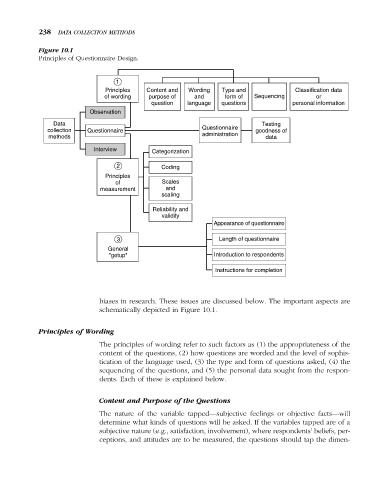
                             biases in research. These issues are discussed below. The important aspects are
                             schematically depicted in Figure 10.1.


            Principles of Wording
                             The principles of wording refer to such factors as (1) the appropriateness of the
                             content of the questions, (2) how questions are worded and the level of sophis-
                             tication of the language used, (3) the type and form of questions asked, (4) the
                             sequencing of the questions, and (5) the personal data sought from the respon-
                             dents. Each of these is explained below.


                             Content and Purpose of the Questions
                             The nature of the variable tapped—subjective feelings or objective facts—will
                             determine what kinds of questions will be asked. If the variables tapped are of a
                             subjective nature (e.g., satisfaction, involvement), where respondents’ beliefs, per-
                             ceptions, and attitudes are to be measured, the questions should tap the dimen-

