


Page 10 - Demo
P. 10
Bell Equipment has evolved from a global supplier to a global manufacturer with the 17 million Euro expansion of its Eisenach-Kindel assembly plant in Germany. The project attracted a grant from the state development agency Thuringia LEG for its contribution towards the improvement of the regional economic structure.
LEADING GLOBAL SUPPLIER OF SMART ELECTRICITY METERS INVESTS R110 MILLION IN NEW FACTORY LOCATED
AT DUBE TRADEPORT SPECIAL ECONOMIC ZONE
FACT
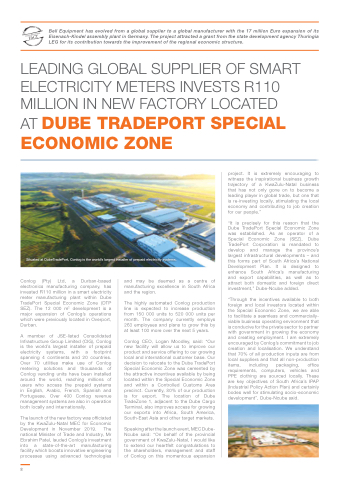
Conlog (Pty) Ltd, a Durban-based electronics manufacturing company, has invested R110 million in a smart electricity meter manufacturing plant within Dube TradePort Special Economic Zone (DTP SEZ). The 12 000 m2 development is a major expansion of Conlog’s operations which were previously located in Overport, Durban.
A member of JSE-listed Consolidated Infrastructure Group Limited (CIG), Conlog is the world’s largest installer of prepaid electricity systems, with a footprint spanning 4 continents and 20 countries. Over 70 utilities make use of Conlog metering solutions and thousands of Conlog vending units have been installed around the world, reaching millions of users who access the prepaid systems in English, Arabic, French, Spanish and Portuguese. Over 400 Conlog revenue management systems are also in operation both locally and internationally.
The launch of the new factory was officiated by the KwaZulu-Natal MEC for Economic Development in November 2019. The national Minister of Trade and Industry, Mr Ebrahim Patel, lauded Conlog’s investment into a state-of-the-art manufacturing facility which boosts innovative engineering processes using advanced technologies
and may be deemed as a centre of manufacturing excellence in South Africa and the region.
The highly automated Conlog production line is expected to increase production from 150 000 units to 520 000 units per month. The company currently employs 263 employees and plans to grow this by at least 100 more over the next 5 years.
Conlog CEO, Logan Moodley, said: “Our new facility will allow us to improve our product and service offering to our growing local and international customer base. Our decision to relocate to the Dube TradePort Special Economic Zone was cemented by the attractive incentives available by being located within the Special Economic Zone and within a Controlled Customs Area precinct. Currently, 80% of our production is for export. The location of Dube TradeZone 1, adjacent to the Dube Cargo Terminal, also improves access for growing our exports into Africa, South America, South-East Asia and other target markets.
Speaking after the launch event, MEC Dube- Ncube said: “On behalf of the provincial government of KwaZulu-Natal, I would like to extend our heartfelt congratulations to the shareholders, management and staff of Conlog on this momentous expansion
project. It is extremely encouraging to witness the inspirational business growth trajectory of a KwaZulu-Natal business that has not only gone on to become a leading player in global trade, but one that is re-investing locally, stimulating the local economy and contributing to job creation for our people.”
“It is precisely for this reason that the Dube TradePort Special Economic Zone was established. As an operator of a Special Economic Zone (SEZ), Dube TradePort Corporation is mandated to develop and manage the province’s largest infrastructural developments – and this forms part of South Africa’s National Development Plan. It is designed to enhance South Africa’s manufacturing and export capabilities, as well as to attract both domestic and foreign direct investment,” Dube-Ncube added.
“Through the incentives available to both foreign and local investors located within the Special Economic Zone, we are able to facilitate a seamless and commercially- viable business operating environment that is conducive for the private sector to partner with government in growing the economy and creating employment. I am extremely encouraged by Conlog’s commitment to job creation and localisation. We understand that 70% of all production inputs are from local suppliers and that all non-production items, including packaging, office requirements, computers, vehicles and PPE clothing are sourced locally. These are key objectives of South Africa’s IPAP (Industrial Policy Action Plan) and certainly bodes well for stimulating socio-economic development”, Dube-Ncube said.
8


