


Page 11 - Demo
P. 11
The clothing and textile industry is collectively responsible for the majority of employment (90%) and value add (80%) in the Cut, Trim, Footwear and Leather (CTFL) sector in South Africa. It employs 95 000 workers and contributes 8% to manufacturing GDP and 9% to the country’s overall GDP3.
A TEAM EFFORT KEEPS KING SHAKA INTERNATIONAL AIRPORT FLYING HIGH
FACT
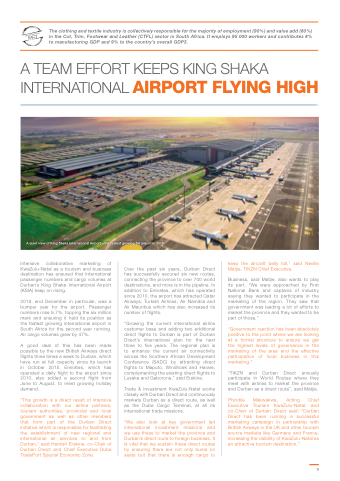
A quiet view of King Shaka International Airport – the fastest growing SA airport in 2019.
Intensive collaborative marketing of KwaZulu-Natal as a tourism and business destination has ensured that international passenger numbers and cargo volumes at Durban’s King Shaka International Airport (KSIA) keep on rising.
2019, and December in particular, was a bumper year for the airport. Passenger numbers rose 9,7%, topping the six million mark and ensuring it held its position as the fastest growing international airport in South Africa for the second year running. Air cargo volumes grew by 47%.
A good deal of this has been made possible by the new British Airways direct flights three times a week to Durban, which have run at full capacity since its launch in October 2018. Emirates, which has operated a daily flight to the airport since 2010, also added a second flight from June to August, to meet growing holiday demand.
“This growth is a direct result of intensive collaboration with our airline partners, tourism authorities, provincial and local government as well as other members that form part of the Durban Direct initiative which is responsible for facilitating the establishment of new regional and international air services to and from Durban,” said Hamish Erskine, co-Chair of Durban Direct and Chief Executive Dube TradePort Special Economic Zone.
Over the past six years, Durban Direct has successfully secured six new routes, connecting the province to over 700 world destinations, and more is in the pipeline. In addition to Emirates, which has operated since 2010, the airport has attracted Qatar Airways, Turkish Airlines, Air Namibia and Air Mauritius which has also increased its number of flights.
“Growing the current international airline customer base and adding two additional direct flights to Durban is part of Durban Direct’s international plan for the next three to five years. The regional plan is to enhance the current air connectivity across the Southern African Development Conference (SADC) by attracting direct flights to Maputo, Windhoek and Harare, complementing the existing direct flights to Lusaka and Gaborone,” said Erskine.
Trade & Investment KwaZulu-Natal works closely with Durban Direct and continuously markets Durban as a direct route, as well as the Dube Cargo Terminal, at all its international trade missions.
“We also look at key government led international investment missions and we use these to market the province and Durban’s direct route to foreign business. It is vital that we sustain these direct routes by ensuring there are not only bums on seats but that there is enough cargo to
keep the aircraft belly full,” said Neville Matjie, TIKZN Chief Executive.
Business, said Matjie, also wants to play its part. “We were approached by First National Bank and captains of industry saying they wanted to participate in the marketing of the region. They saw that government was leading a lot of efforts to market the province and they wanted to be part of those.”
“Government reaction has been absolutely positive to the point where we are looking at a formal structure to ensure we get the highest levels of governance in the marketing of the area and the effective participation of local business in this marketing.”
“TIKZN and Durban Direct annually participate in World Routes where they meet with airlines to market the province and Durban as a direct route”, said Matjie.
Phindile Makwakwa, Acting Chief Executive Tourism KwaZulu-Natal, and co-Chair of Durban Direct said: “Durban Direct has been running a successful marketing campaign in partnership with British Airways in the UK and other tourism source markets like Germany and France, increasing the visibility of KwaZulu-Natal as an attractive tourism destination.”
9


