


Page 460 - JoFA_2022
P. 460
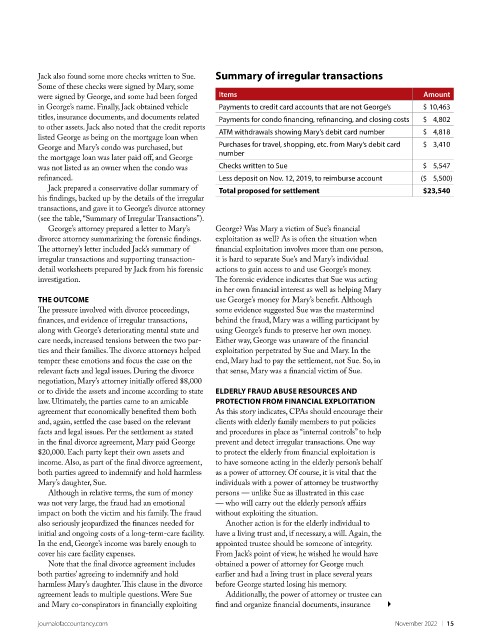
Summary of irregular transactions
          Jack also found some more checks written to Sue.
          Some of these checks were signed by Mary, some
                                                     Items                                           Amount
          were signed by George, and some had been forged
          in George’s name. Finally, Jack obtained vehicle   Payments to credit card accounts that are not George’s  $ 10,463
          titles, insurance documents, and documents related   Payments for condo financing, refinancing, and closing costs  $ 4,802
          to other assets. Jack also noted that the credit reports
                                                     ATM withdrawals showing Mary’s debit card number  $ 4,818
          listed George as being on the mortgage loan when
                                                     Purchases for travel, shopping, etc. from Mary’s debit card   $ 3,410
          George and Mary’s condo was purchased, but
                                                     number
          the mortgage loan was later paid off, and George
                                                     Checks written to Sue                           $ 5,547
          was not listed as an owner when the condo was
          refinanced.                                Less deposit on Nov. 12, 2019, to reimburse account  ($ 5,500)
            Jack prepared a conservative dollar summary of   Total proposed for settlement           $23,540
          his findings, backed up by the details of the irregular
          transactions, and gave it to George’s divorce attorney
          (see the table, “Summary of Irregular Transactions”).
            George’s attorney prepared a letter to Mary’s   George? Was Mary a victim of Sue’s financial
          divorce attorney summarizing the forensic findings.   exploitation as well? As is often the situation when
          The attorney’s letter included Jack’s summary of   financial exploitation involves more than one person,
          irregular transactions and supporting transaction-  it is hard to separate Sue’s and Mary’s individual
          detail worksheets prepared by Jack from his forensic   actions to gain access to and use George’s money.
          investigation.                            The forensic evidence indicates that Sue was acting
                                                    in her own financial interest as well as helping Mary
          THE OUTCOME                               use George’s money for Mary’s benefit. Although
          The pressure involved with divorce proceedings,   some evidence suggested Sue was the mastermind
          finances, and evidence of irregular transactions,   behind the fraud, Mary was a willing participant by
          along with George’s deteriorating mental state and   using George’s funds to preserve her own money.
          care needs, increased tensions between the two par-  Either way, George was unaware of the financial
          ties and their families. The divorce attorneys helped   exploitation perpetrated by Sue and Mary. In the
          temper these emotions and focus the case on the   end, Mary had to pay the settlement, not Sue. So, in
          relevant facts and legal issues. During the divorce   that sense, Mary was a financial victim of Sue.
          negotiation, Mary’s attorney initially offered $8,000
          or to divide the assets and income according to state   ELDERLY FRAUD ABUSE RESOURCES AND
          law. Ultimately, the parties came to an amicable   PROTECTION FROM FINANCIAL EXPLOITATION
          agreement that economically benefited them both   As this story indicates, CPAs should encourage their
          and, again, settled the case based on the relevant   clients with elderly family members to put policies
          facts and legal issues. Per the settlement as stated   and procedures in place as “internal controls” to help
          in the final divorce agreement, Mary paid George   prevent and detect irregular transactions. One way
          $20,000. Each party kept their own assets and   to protect the elderly from financial exploitation is
          income. Also, as part of the final divorce agreement,   to have someone acting in the elderly person’s behalf
          both parties agreed to indemnify and hold harmless   as a power of attorney. Of course, it is vital that the
          Mary’s daughter, Sue.                     individuals with a power of attorney be trustworthy
            Although in relative terms, the sum of money   persons — unlike Sue as illustrated in this case
          was not very large, the fraud had an emotional   — who will carry out the elderly person’s affairs
          impact on both the victim and his family. The fraud   without exploiting the situation.
          also seriously jeopardized the finances needed for   Another action is for the elderly individual to
          initial and ongoing costs of a long-term-care facility.   have a living trust and, if necessary, a will. Again, the
          In the end, George’s income was barely enough to   appointed trustee should be someone of integrity.
          cover his care facility expenses.         From Jack’s point of view, he wished he would have
            Note that the final divorce agreement includes   obtained a power of attorney for George much
          both parties’ agreeing to indemnify and hold   earlier and had a living trust in place several years
          harmless Mary’s daughter. This clause in the divorce   before George started losing his memory.
          agreement leads to multiple questions. Were Sue   Additionally, the power of attorney or trustee can
          and Mary co-conspirators in financially exploiting   find and organize financial documents, insurance

          journalofaccountancy.com                                                            November 2022    |   15

