


Page 16 - Demo-1
P. 16
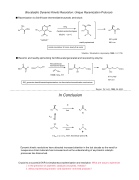
Biocatalytic Dynamic Kinetic Resolution: Unique Racemization Protocols ! Racemization via Schiff base intermediate/enzymatic aminolysis
Ph
NH2 N Me NH O OMe NH2 3
OMe HO OH Candida antarctica lipase Ph N Ph NH2 OO
OH
"catalytic"
tBuOH, —20 °C
Ar H
readily epimerized
amide racemizes 30 more slowly than ester
Sheldon, Tetrahedron: Asymmetry, 1999, 10, 1739. ! Racemic and readily epimerizing hemithioacetal generated and resolved by enzyme
85% yield 88% ee
O
Pseudomonas fluorescens lipase
OAc TBME, SiO2, RT
OO SS
H MeO
SH
TESO O
MeO
OTES
MeO
OTES
OH
OAc
87% yield 90% ee
SiO2 promotes hemithioacetal epimerization via dissociation/recombination mechanism
Rayner, Tet. Lett., 1995, 36, 8493.
In Conclusion
OH kF X
R2 R1 fast R2 R1
krac
OH
A
kS X
R2
R1
R1 If krac > kF >> kS 100% theoretical yield of A
slow R2
Dynamic kinetic resolutions have attracted increased attention in the last decade as the need for inexpensive chiral materials has increased and as the understanding of asymmetric catalytic processes has blossomed.
Crucial to a succesful DKR is simultaneous epimerization and resolution: What are ways to epimerize i. in the presence of asymetric catalysts (enzymes, metals)?
ii. without epimerizing enantio- and diastereo- enriched products?
B


