


Page 3226 - Cote clinical veterinary advisor dogs and cats 4th
P. 3226
How to Monitor Blood Glucose Levels at Home


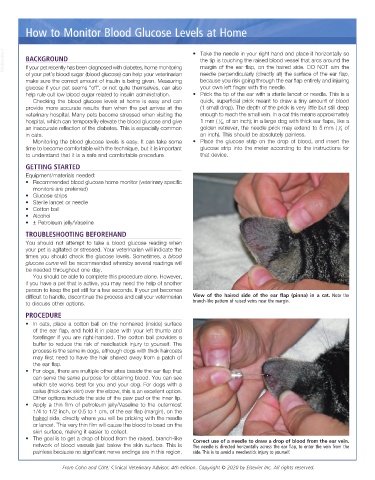
  VetBooks.ir  BACKGROUND                                       •  Take the needle in your right hand and place it horizontally so
                                                                  the tip is touching the raised blood vessel that arcs around the
                                                                  margin of the ear flap, on the haired side. DO NOT aim the
         If your pet recently has been diagnosed with diabetes, home monitoring
         of your pet’s blood sugar (blood glucose) can help your veterinarian   needle perpendicularly (directly at) the surface of the ear flap,
         make sure the correct amount of insulin is being given. Measuring   because you risk going through the ear flap entirely and injuring
         glucose if your pet seems “off”, or not quite themselves, can also   your own left finger with the needle.
         help rule out low blood sugar related to insulin administration.  •  Prick the tip of the ear with a sterile lancet or needle. This is a
            Checking the blood glucose levels at home is easy and can   quick, superficial prick meant to draw a tiny amount of blood
         provide more accurate results than when the pet arrives at the   (1 small drop). The depth of the prick is very little but still deep
         veterinary hospital. Many pets become stressed when visiting the   enough to reach the small vein. In a cat this means approximately
         hospital, which can temporarily elevate the blood glucose and give   1 mm ( 16  of an inch); in a large dog with thick ear flaps, like a
                                                                        1
         an inaccurate reflection of the diabetes. This is especially common   golden retriever, the needle prick may extend to 5 mm (  1 4  of
         in cats.                                                 an inch). This should be absolutely painless.
            Monitoring the blood glucose levels is easy. It can take some   •  Place the glucose strip on the drop of blood, and insert the
         time to become comfortable with the technique, but it is important   glucose strip into the meter according to the instructions for
         to understand that it is a safe and comfortable procedure.  that device.
         GETTING STARTED
         Equipment/materials needed:
         •  Recommended blood glucose home monitor (veterinary specific
            monitors are preferred)
         •  Glucose strips
         •  Sterile lancet or needle
         •  Cotton ball
         •  Alcohol
         •  ± Petroleum jelly/Vaseline
         TROUBLESHOOTING BEFOREHAND
         You  should not  attempt  to take  a blood  glucose reading  when
         your pet is agitated or stressed. Your veterinarian will indicate the
         times you should check the glucose levels. Sometimes, a blood
         glucose curve will be recommended whereby several readings will
         be needed throughout one day.
            You should be able to complete this procedure alone. However,
         if you have a pet that is active, you may need the help of another
         person to keep the pet still for a few seconds. If your pet becomes
         difficult to handle, discontinue the process and call your veterinarian   View of the haired side of the ear flap (pinna) in a cat. Note  the
         to discuss other options.                              branch-like pattern of raised veins near the margin.
         PROCEDURE
         •  In cats, place a cotton ball on the nonhaired (inside) surface
            of the ear flap, and hold it in place with your left thumb and
            forefinger if you are right-handed. The cotton ball provides a
            buffer to reduce the risk of needlestick injury to yourself. The
            process is the same in dogs, although dogs with thick haircoats
            may first need to have the hair shaved away from a patch of
            the ear flap.
         •  For dogs, there are multiple other sites beside the ear flap that
            can serve the same purpose for obtaining blood. You can see
            which site works best for you and your dog. For dogs with a
            callus (thick dark skin) over the elbow, this is an excellent option.
            Other options include the side of the paw pad or the inner lip.
         •  Apply a thin film of petroleum jelly/Vaseline to the outermost
            1/4 to 1/2 inch, or 0.5 to 1 cm, of the ear flap (margin), on the
            haired side, directly where you will be pricking with the needle
            or lancet. This very thin film will cause the blood to bead on the
            skin surface, making it easier to collect.
         •  The goal is to get a drop of blood from the raised, branch-like
            network of blood vessels just below the skin surface. This is   Correct use of a needle to draw a drop of blood from the ear vein.
                                                                The needle is directed horizontally across the ear flap, to enter the vein from the
            painless because no significant nerve endings are in this region.  side. This is to avoid a needlestick injury to yourself.

                     From Cohn and Côté: Clinical Veterinary Advisor, 4th edition. Copyright © 2020 by Elsevier Inc. All rights reserved.

