


Page 1412 - Small Animal Internal Medicine, 6th Edition
P. 1412
1384   PART XIII   Hematology


                                                       HYPOCELLULAR
  VetBooks.ir                              Normal cells                                      Abnormal


                                                                                               cells


                 Increased                           Normal                           Neoplasia     Dysplasia
                  reticulin                          reticulin

                                                                                        HL
                Myelofibrosis     Normal                                                              Toxic
                                 cellularity               Hypoplasia                 neoplasia
                                                                                     Metastatic
                                 Disorders        Estrogen            Non-            neoplasia       Viral
                                 in release                          estrogen

                                  E. canis        Iatrogenic         E. canis                         MDS

                                                    SCT
                                                                    Drug-related
                                               Hyperestrogenism
                                                                  Immune-mediated


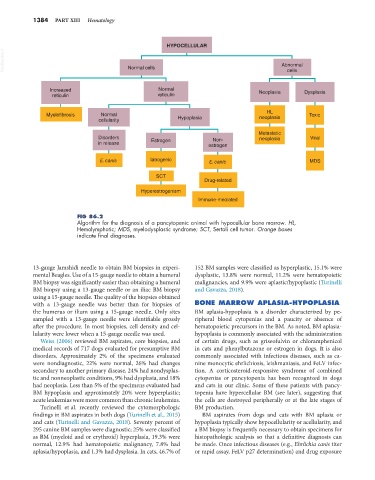
                          FIG 86.2
                          Algorithm for the diagnosis of a pancytopenic animal with hypocellular bone marrow. HL,
                          Hemolymphatic; MDS, myelodysplastic syndrome; SCT, Sertoli cell tumor. Orange boxes
                          indicate final diagnoses.


            13-gauge Jamshidi needle to obtain BM biopsies in experi-  152 BM samples were classified as hyperplastic, 15.1% were
            mental Beagles. Use of a 15-gauge needle to obtain a humeral   dysplastic,  13.8%  were  normal,  11.2%  were hematopoietic
            BM biopsy was significantly easier than obtaining a humeral   malignancies, and 9.9% were aplastic/hypoplastic (Turinelli
            BM biopsy using a 13-gauge needle or an iliac BM biopsy   and Gavazza, 2018).
            using a 15-gauge needle. The quality of the biopsies obtained
            with a 13-gauge needle was better than for biopsies of    BONE MARROW APLASIA-HYPOPLASIA
            the humerus or ilium using a 15-gauge needle. Only sites   BM aplasia-hypoplasia is a disorder characterized by pe-
            sampled  with  a  13-gauge  needle  were  identifiable  grossly   ripheral blood cytopenias and a paucity or absence of
            after the procedure. In most biopsies, cell density and cel-  hematopoietic precursors in the BM. As noted, BM aplasia-
            lularity were lower when a 15-gauge needle was used.  hypoplasia is commonly associated with the administration
              Weiss (2006) reviewed BM aspirates, core biopsies, and   of  certain  drugs,  such  as  griseofulvin  or  chloramphenicol
            medical records of 717 dogs evaluated for presumptive BM   in cats and phenylbutazone or estrogen in dogs. It is also
            disorders. Approximately 2% of the specimens evaluated   commonly associated with infectious diseases, such as ca-
            were nondiagnostic, 22% were normal, 26% had changes   nine monocytic ehrlichiosis, leishmaniasis, and FeLV infec-
            secondary to another primary disease, 24% had nondysplas-  tion. A corticosteroid-responsive syndrome of combined
            tic and nonneoplastic conditions, 9% had dysplasia, and 18%   cytopenias or pancytopenia has been recognized in dogs
            had neoplasia. Less than 5% of the specimens evaluated had   and cats in our clinic. Some of these patients with pancy-
            BM hypoplasia and approximately 20% were hyperplastic;   topenia have hypercellular BM (see later), suggesting that
            acute leukemias were more common than chronic leukemias.  the cells are destroyed peripherally or at the late stages of
              Turinelli et al. recently reviewed the cytomorphologic   BM production.
            findings in BM aspirates in both dogs (Turinelli et al., 2015)   BM aspirates  from dogs  and cats with BM  aplasia or
            and cats (Turinelli and Gavazza, 2018). Seventy percent of   hypoplasia typically show hypocellularity or acellularity, and
            295 canine BM samples were diagnostic; 25% were classified   a BM biopsy is frequently necessary to obtain specimens for
            as BM (myeloid and or erythroid) hyperplasia, 19.3% were   histopathologic analysis so that a definitive diagnosis can
            normal, 12.9% had hematopoietic malignancy, 7.8% had   be made. Once infectious diseases (e.g., Ehrlichia canis titer
            aplasia/hypoplasia, and 1.3% had dysplasia. In cats, 46.7% of   or rapid assay, FeLV p27 determination) and drug exposure

