


Page 25 - aruba-today-20170311
P. 25
BUSINESS                 Saturday 11 March 2017
                                                                                                                           A25


               An aging bull market gets some birthday love                                            Don’t fear your mobile wallet


            STAN CHOE                    stock  mutual  funds  and  at the least no longer looks     LAUREN SCHWAHN
            AP Business Writer           ETFs  than  they  put  in,  ac-  cheap. Analysts along Wall   NerdWallet
            NEW YORK (AP) — It took a  cording  to  the  Investment  Street  also  say  optimism     Smartphones  have  replaced  lots  of  other  acces-
            while, but investors are be-  Company  Institute.  In  the  may  actually  be  too  high,   sories — cameras, flashlights, calculators. But many
            ginning  to  believe  this  bull  first 10 months of last year,  with  expectations  over-  people are still reluctant to swap the wallets in their
            can fly.                                                                                 pockets for their digital counterparts.
            One of the greatest runs for                                                             A key reason consumers are hesitant to adopt mo-
            the  stock  market  in  history                                                          bile payments like Apple Pay and Android Pay, sur-
            is  marking  its  eighth  anni-                                                          veys  say,  is  fear  over  security:  High-profile  retailer
            versary, and this time inves-                                                            data breaches have made buyers wary of sharing
            tors  are  joining  the  party.                                                          credit card information. But while there’s cause not
            They’re  putting  more  dol-                                                             to rely 100 percent on your mobile wallet just yet —
            lars  into  mutual  funds  and                                                           lack of widespread acceptance by merchants, for
            exchange-traded      funds                                                               one thing — security concerns shouldn’t be holding
            that  invest  in  U.S.  stocks,                                                          shoppers back, experts say.
            a  turnaround  from  earlier                                                             “I think some people get nervous about this idea of
            years,  even  though  critics                                                            ‘This thing is sending telepathic waves to that ma-
            see a long list of reasons for                                                           chine  to  say  that  I’m  paying,’”  says  Mark  Ranta,
            caution.                                                                                 head of digital banking solutions at ACI Worldwide,
            It was on March 9, 2009 that                                                             a payment systems company.
            stocks  finally  hit  bottom  in                                                         But your mobile wallet is arguably the safest way to
            the financial crisis, after the                                                          pay, and it offers a few benefits to boot. Here’s why
            Standard & Poor’s 500 index                                                              this payment method is worth considering.
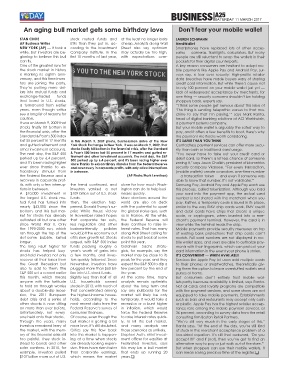
            lost 55 percent in 17 months   In  this  March  9,  2009  photo,  businessmen  arrive  at  the  New   IT’S SAFER THAN YOU THINK
            and gutted retirement and    York Stock Exchange in New York. It was on March 9, 2009, that   Contactless payment services can offer more secu-
            other investment accounts.   stocks finally hit bottom in the financial crisis, after the Standard   rity than cash or traditional card usage.
            The next day, the S&P 500    & Poor’s 500 index lost 55 percent in 17 months and gutted re-  “You  never  have  to  take  out  your  credit  card  or
            perked up by 6.4 percent,    tirement and other investment accounts. The next day, the S&P   debit card, so there’s a lot less chance of someone
                                         500 perked up by 6.4 percent, and it’s been racing higher ever
            and it’s been racing higher   since thanks to extraordinary stimulus from the Federal Reserve   seeing it,” says Jason Chaikin, president of biometrics
            ever  since  thanks  to  ex-  and a recovery in corporate profits, with only a few interruptions   security company Vkansee. “For every transaction,
            traordinary  stimulus  from   in between.                                                (mobile wallets) create a random, one-time number
            the Federal Reserve and a                                    (AP Photo/Mark Lennihan)    — a transaction token — and even if someone was
            recovery in corporate prof-                                                              able to know that number, it’s not valid later.”
            its, with only a few interrup-  the  trend  continued,  and  done for how much Wash-     Samsung Pay, Android Pay and Apple Pay each use
            tions in between.            investors  yanked  a  net  ington can do to help busi-      this process, called tokenization. Although you load
            A  $10,000  investment  in  $109 billion out of U.S. stock  nesses quickly.              your  card  into  the  payment  app,  the  actual  card
            the  largest  U.S.  stock  mu-  funds.                    More elections around the      number is not shared with the merchant when you
            tual  fund  has  turned  into  Then,  the  election  hap-  world  are  also  on  deck    pay. Rather, a temporary code is issued in its place,
            nearly  $42,000  since  the  pened. Donald Trump’s sur-   with the potential to upset    similar to the way EMV chip cards work. EMV credit
            bottom,  and  this  bull  mar-  prise  White  House  victory  the global status quo, such   and  debit  cards  have  chips  that  create  a  unique
            ket  for  stocks  has  already  in  November  raised  hopes  as  in  France.  All  the  while,   code,  or  cryptogram,  when  inserted  into  a  mer-
            outlasted all but one other  that  corporate  tax  cuts,  the  Federal  Reserve  will    chant’s  payment  terminal.  However,  the  card  is  in
            since  World  War  II.  Only  less  regulation  and  other  likely  continue  to  raise  in-  view while the terminal reads the chip.
            the  1990-2000  run,  which  business-friendly   policies  terest rates. That has many   Mobile payments provide security measures on top
            ran through the top of the  would jolt the economy out  along Wall Street calling for    of  existing  bank  protections  that  chip  cards  can’t
            dot-come  bubble,  lasted  of its slow-growth rut. Stocks  stocks to pull back at some   match. Full card numbers are not displayed in mo-
            longer.                      surged, with S&P 500 index  point this year.                bile wallet apps, and users are able to authorize pay-
            The  long  vault  higher  for  funds  packing  roughly  a  Goldman    Sachs   strate-    ments with their fingerprints, which can protect your
            stocks  has  helped  buy-    year’s  worth  of  gains  into  gists,  for  example,  say  the   card information in the event your phone is stolen.
            and-hold investors not only  a  few  months,  and  inves-  market may be close to its    IT’S CONVENIENT — WHEN AVAILABLE
            recover all their losses from  tors quickly followed. Since  peak for the year, and they   Services like Apple Pay let users add multiple cards
            the  Great  Recession  but  November,  investors  have  expect the S&P 500 to dip a      to  their  phones  or  smartwatches,  theoretically  giv-
            also  to  add  to  them.  The  plugged more than $60 bil-  few percent by the end of     ing them the option to leave overstuffed wallets and
            S&P 500 set a record earlier  lion into U.S. stock funds.  the year.                     purses at home.
            this  month,  which  means  Slightly  less  than  half  of  all  At  the  same  time,  many   But  consumers  don’t  entirely  trust  mobile  wal-
            anyone  with  the  fortitude  U.S.   households   owned  analysts  remain  optimistic    lets partly because availability is limited, says Ranta.
            to hold on through worries  stocks in 2013, with much of  about  the  long  term  and    Not all cards and loyalty programs are compatible
            about a double-dip reces-    that concentrated among  say  any  pullbacks  for  the      with the payment services, and some stores are not
            sion,  the  2011  European  the highest-income house-     market  will  likely  be  only   equipped to take mobile payments. Establishments
            debt  crisis  and  a  series  of  holds,  according  to  the  temporary. It would take a   such as bars and restaurants may accept only cash
            other  shocks  is  now  sitting  most recent data from the  recession or a burst higher   or plastic. Apple Pay has the highest retailer accep-
            on more than ever before.  Federal Reserve’s survey of  in  inflation,  which  would     tance rate among the mobile payment services, at
            Unfortunately,  not  every-  consumer finances.           force  the  Federal  Reserve   36 percent, according to survey data from the retail
            one held onto their stocks.  Of course, even though the  to raise interest rates quick-  consulting firm Boston Retail Partners.
            Through  the  years,  many  bull market is getting a bit  ly,  to  kill  the  bull  market,   “We’re  still  very  much  in  the  early  stages  of  this,”
            investors remained leery of  more love, it’s still doubted.  and  many  analysts  see    Ranta says. “At the end of the day, you’re still kind
            the market, with the mem-    Critics  say  this  flow  back  those scenarios as unlikely.  of stuck in this merchant acceptance problem of a
            ory of the financial crisis still  into the market is happen-  Stephen Auth, chief invest-  two-sided equation. It’s still that awkward, ‘Do you
            too  painful.  They  stuck  in-  ing  at  a  time  when  stocks  ment officer for equities at   accept it?’ and if (not), then you’ve got to find an
            stead  to  bonds  and  other  are already looking expen-  Federated  Investors,  says    alternative way to pay or just walk out of the store.”
            safer  confines.  In  2015,  for  sive. Prices have risen faster  this  may  be  a  bull  market   But  when  shoppers  can  use  their  mobile  wallets,  it
            example,  investors  pulled  than  corporate  earnings,  that  ends  up  running  20     can mean saving precious time at the register.q
            $107 billion more out of U.S.  which  means  the  market  years.q

