


Page 28 - AT
P. 28
A28 SCIENCE
Monday 12 noveMber 2018
Warming hurting shellfish, aiding predators, ruining habitat
farming, for the fisheries to
survive, Coffin said.
“Clammers aren’t the rea-
son there’s no clams,” he
said.
“We need to adapt, we
need to focus our efforts on
adapting to the environ-
ment we have.”
Some near-shore shellfish
harvests in the U.S. remain
consistently productive,
such as the Maine sea scal-
lop fishery, which takes
place in bays and coastal
areas in the winter.
The state’s scallop fishery
bottomed out at about
33,000 pounds in 2005,
but has climbed in recent
years, and its 2017 total of
almost 800,000 pounds was
the most since 1997.
Many in Maine attribute
the health of the fishery
to conservative manage-
ment, said Alex Todd, a
scallop fisherman who also
works the waters off Massa-
chusetts.
“Up and down the coast,
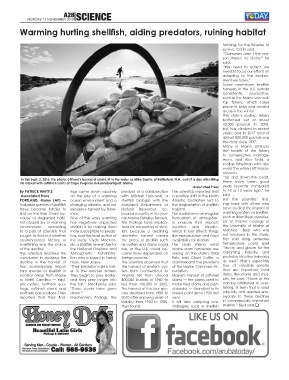
In this Sept. 2, 2016, file photo, a friend’s basket of clams sit in the water as Mike Suprin, of Rollinsford, N.H., calls it a day after filling
his basket with softshell clams at Cape Porpoise in Kennebunkport, Maine. there have been good
Associated Press years recently compared
By PATRICK WHITTLE ings came down squarely product of a collaboration The scientists reported that to 10 or 15 years ago,” he
Associated Press on the side of a warming with Mitchell Tarnowski, a a positive shift in the North said.
PORTLAND, Maine (AP) — ocean environment and a shellfish biologist with the Atlantic Oscillation led to But the scientists’ find-
Valuable species of shellfish changing climate, and not Maryland Department of the degradation of shellfish ings track with others who
have become harder to excessive harvest by fisher- Natural Resources, ap- habitat. have studied the impact of
find on the East Coast be- men. peared recently in the jour- The oscillation is an irregular warming waters on shellfish,
cause of degraded habi- One of the ways warming nal Marine Fisheries Review. fluctuation of atmospher- such as Brian Beal, a profes-
tat caused by a warming has negatively impacted The findings have implica- ic pressure that impacts sor of marine ecology at
environment, according shellfish is by making them tions for consumers of shell- weather and climate, the University of Maine at
to a pair of scientists that more susceptible to preda- fish, because a declining which in turn affects things Machias. Beal, who was
sought to find out whether tors, said the lead author of domestic harvest means like reproduction and food not involved in the study,
environmental factors or the study, Clyde MacKen- the prices of shellfish such availability for shellfish. has said rising seawater
overfishing was the source zie, a shellfish researcher for as oysters and clams could The study mirrors what temperature could spell
of the decline. the National Oceanic and rise, or the U.S. could be- Maine clam harvesters are “doom and gloom for the
The scientists reached the Atmospheric Administra- come more dependent on seeing on the state’s tidal clamming industry and
conclusion in studying the tion who is based in Sandy foreign sources. flats, said Chad Coffin, a probably for other industries
decline in the harvest of Hook, New Jersey. The scientists observed that clammer and the president as well.” That’s especially
four commercially impor- “Their predation rate is fast- the harvest of eastern oys- of the Maine Clammers As- true of valuable species
tant species of shellfish in er in the warmer waters. ters from Connecticut to sociation. that are important food
coastal areas from Maine They begin to prey earlier, Virginia fell from around Maine’s harvest of softshell items, like clams and mus-
to North Carolina — east- and they prey longer into 600,000 bushels in 1960 to clams — the clams used to sels, he said. “None of this
ern oysters, northern qua- the fall,” MacKenzie said. less than 100,000 in 2005. make fried clams and clam can be attributed to over-
hogs, softshell clams and “These stocks have gone The harvest of the four spe- chowder — dwindled to its fishing, a term that is used
northern bay scallops. They down.” cies declined from 1980 to lowest point since 1930 last willy-nilly and applied erro-
reported that their find- MacKenzie’s findings, the 2010 after enjoying years of year. neously to these declines
stability from 1950 to 1980, It will take adopting new in commercially important
they found. strategies, such as shellfish shellfish,” Beal said.q

