


Page 34 - Demo
P. 34
KNOW-HOW
Armaflex insulation materials minimize the risk of corrosion under insulation
Outstanding results in the TNO institute’s new CUI test
As the renowned Dutch TNO institute has confirmed, Armaflex insu- lation materials minimize the risk of corrosion under insulation (CUI). Even under the harshest offshore conditions, closed-cell Armaflex significantly reduces the danger of corrosion thanks to its integrated
Corrosion under insulation costs the global economy billions
Rust never sleeps – some 40 % of the world’s steel production is needed to replace parts destroyed by rust. The World Corrosion Organization estimates that corrosion damage costs the global economy 2.2 trillion US dollars annually. Some 45 % of the costs arise in the oil, gas and petrochemical industry every year. According to a study by the US American ExxonMobil Chemical Company, 40 to 60 % of maintenance costs for pipework are due to CUI.
Suitable insulation systems minimize the risk of corrosion
CUI is insidious: the processes occur hidden beneath the insulation and are often only discovered when extensive damage has already taken place. Insulation alone cannot safeguard plant components against corrosion, but appropriate insulation systems can effectively support corrosion protection. The choice of material decides whether the insulation minimizes the risk of corrosion or favours corrosion processes.
water vapour barrier. This confirms the excellent results which have been achieved with Armacell’s elastomeric insulation materials all over the world for decades.
Armaflex in the TNO-ENDURES CUI test
As yet international standards do not address the influence of insula- tion materials on the CUI risk. A test method developed by TNO- Endures (Den Helder, the Netherlands) for Shell, could provide a basis for a standard.
Test set-up
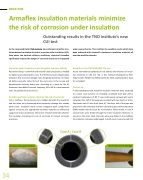
In the standardized test Armaflex insulation materials were subjected to a worst case scenario: an insulated, unalloyed steel pipe with a medium temperature of 80 °C was continuously sprayed with warm saltwater. One half of the pipe was insulated with two layers of Arma- flex sheets each 25 mm thick (case A). The other half of the pipe was prepared in the same way and then clad with a glass reinforced plastic (GRP) weather barrier (case B). To simulate a failure mode, in case A several holes were drilled through the entire insulation thickness. In case B, on the other hand, the holes were only drilled in the cladding, the insulation remained undamaged. In both cases it was ensured that
Case A  Case B
34
Corrosion only around drill hole
No corrosion on the steel pipe


