


Page 15 - EH72
P. 15
TEACHINGS  |  EASTERN HORIZON     13


                 “A bodhisattva is a person who lives by vow instead of by karma. As we grow up, we learn
                 a system of preferences and values from the culture around us, which we use to evaluate

                  the world and choose action. This is living by karma. In contrast, a bodhisattva lives by
                  vow. Vow is like a magnet or compass that shows us the direction toward the Buddha.”
                                           –Living by Vow, Shohaku Okumura


                                          The Four


                                          Bodhisattva Vows


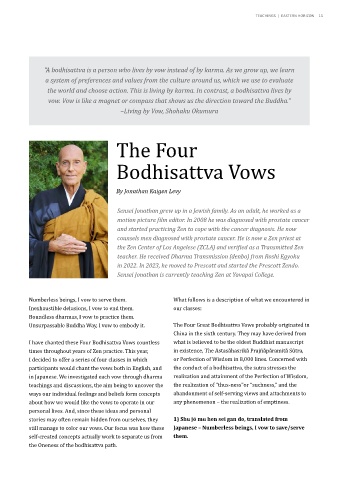
                                          By Jonathan Kaigen Levy


                                          Sensei Jonathan grew up in a Jewish family. As an adult, he worked as a
                                          motion picture film editor. In 2008 he was diagnosed with prostate cancer
                                          and started practicing Zen to cope with the cancer diagnosis. He now
                                          counsels men diagnosed with prostate cancer. He is now a Zen priest at
                                          the Zen Center of Los Angelese (ZCLA) and verified as a Transmitted Zen
                                          teacher. He received Dharma Transmission (denbo) from Roshi Egyoku
                                          in 2022. In 2023, he moved to Prescott and started the Prescott Zendo.
                                          Sensei Jonathan is currently teaching Zen at Yavapai College.


           Numberless beings, I vow to serve them.            What follows is a description of what we encountered in
           Inexhaustible delusions, I vow to end them.        our classes:
           Boundless dharmas, I vow to practice them.
           Unsurpassable Buddha Way, I vow to embody it.      The Four Great Bodhisattva Vows probably originated in
                                                              China in the sixth century. They may have derived from
           I have chanted these Four Bodhisattva Vows countless   what is believed to be the oldest Buddhist manuscript
           times throughout years of Zen practice. This year,   in existence, The Astasāhasrikā Prajñāpāramitā Sūtra,
           I decided to offer a series of four classes in which   or Perfection of Wisdom in 8,000 lines. Concerned with
           participants would chant the vows both in English, and   the conduct of a bodhisattva, the sutra stresses the
           in Japanese. We investigated each vow through dharma   realization and attainment of the Perfection of Wisdom,
           teachings and discussions, the aim being to uncover the   the realization of “thus-ness”or “suchness,” and the
           ways our individual feelings and beliefs form concepts   abandonment of self-serving views and attachments to
           about how we would like the vows to operate in our   any phenomenon – the realization of emptiness.
           personal lives. And, since these ideas and personal
                                                              1) Shu jō mu hen sei gan do, translated from
           stories may often remain hidden from ourselves, they
                                                              Japanese – Numberless beings, I vow to save/serve
           still manage to color our vows. Our focus was how these
                                                              them.
           self-created concepts actually work to separate us from
           the Oneness of the bodhisattva path.

