


Page 42 - Demo samer flip book
P. 42
Investopedia.com – the resource for investing and personal finance education.
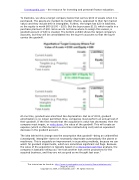
To illustrate, we show a target company below that carries $100 of assets when it is purchased. The assets are marked-to-market (that is, appraised to their fair market value) and they include $40 in intangibles. Further, the target has $20 in liabilities, so the equity is worth $80 ($100 – $20). But the buyer pays $110, which results in a purchase premium of $30. Since we do not know where to assign this excess, a goodwill account of $30 is created. The bottom exhibit shows the target company's accounts, but they will be consolidated into the buyer's accounts so that the buyer carries the goodwill.
At one time, goodwill was amortized like depreciation. But as of 2002, goodwill amortization is no longer permitted. Now, companies must perform an annual test of their goodwill. If the test reveals that the acquisition's value has decreased, then the company must impair, or write-down, the value of the goodwill. This will create an expense (which is often buried in a one-time restructuring cost) and an equivalent decrease in the goodwill account.
The idea behind this change was the assumption that goodwill--being an unidentified (unassigned) intangible--does not necessarily depreciate automatically like plants or machinery. This is arguably an improvement in accounting methods, because we can watch for goodwill impairments, which are sometimes significant red flags. Because the value of the acquisition is typically based on a discounted cash flow analysis, the company is basically telling you "we took another look at the projections for the acquired business, and they are not as good as we thought last year."
This tutorial can be found at: http://www.investopedia.com/university/financialstatements/ (Page 42 of 66)
Copyright © 2004, Investopedia.com - All rights reserved.


