


Page 7 - Empowerment Approach Training Explanation for Foster Carers
P. 7
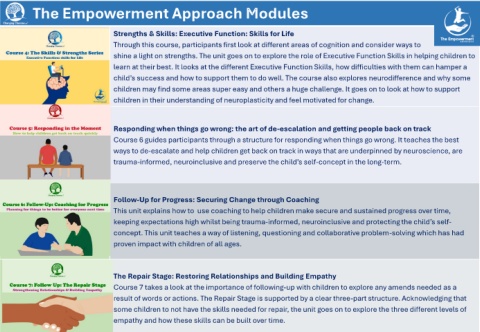
The Empowerment Approach Modules


                                      Strengths & Skills: Executive Function: Skills for Life
                                      Through this course, participants first look at different areas of cognition and consider ways to
                                      shine a light on strengths. The unit goes on to explore the role of Executive Function Skills in helping children to

                                      learn at their best. It looks at the different Executive Function Skills, how difficulties with them can hamper a
                                      child’s success and how to support them to do well. The course also explores neurodifference and why some
                                      children may find some areas super easy and others a huge challenge. It goes on to look at how to support
                                      children in their understanding of neuroplasticity and feel motivated for change.


                                      Responding when things go wrong: the art of de-escalation and getting people back on track

                                      Course 6 guides participants through a structure for responding when things go wrong. It teaches the best
                                      ways to de-escalate and help children get back on track in ways that are underpinned by neuroscience, are
                                      trauma-informed, neuroinclusive and preserve the child’s self-concept in the long-term.


                                      Follow-Up for Progress: Securing Change through Coaching
                                      This unit explains how to  use coaching to help children make secure and sustained progress over time,
                                      keeping expectations high whilst being trauma-informed, neuroinclusive and protecting the child’s self-
                                      concept. This unit teaches a way of listening, questioning and collaborative problem-solving which has had

                                      proven impact with children of all ages.


                                      The Repair Stage: Restoring Relationships and Building Empathy

                                      Course 7 takes a look at the importance of following-up with children to explore any amends needed as a
                                      result of words or actions. The Repair Stage is supported by a clear three-part structure. Acknowledging that
                                      some children to not have the skills needed for repair, the unit goes on to explore the three different levels of
                                      empathy and how these skills can be built over time.

