


Page 278 - Demo
P. 278
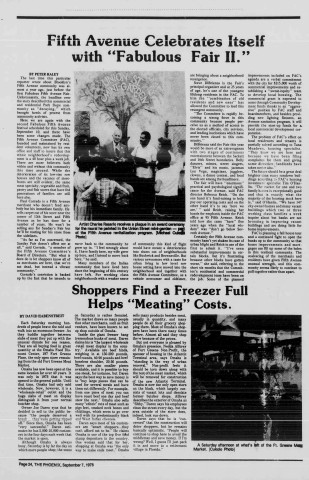
with %u201cFabulous Fair II.%u201dArtist Charles Rosario receives a plaque in an award ceremonyfor the mural he painted In the Union Street mini-garden %u2014 peelof the Fifth Avenue revitalization program. [Michael CufcwBPhoto]BY PETER HALEYThe last time this particular reporter wrote about Brooklyn%u2019s Fifth Avenue community was almost a year ago, just before the first Fabulous Fifth Avenue Fair. Unfortunately, the headline over the story described this commercial and residential Park Slope community as %u201c decaying,%u201d which brought howls of protest from community activists.Here we are again with the second Fabulous Fifth Avenue festival scheduled for this Sunday, September 10, and there have been some changes made. The Fifth Avenue Committee (FAC), founded and maintained by resident volunteers, now has its own office and staff to insure that this ethnic neighborhood%u2019s redevelopment is a 40 hour plus a week job. There are more believers both within and without this community this time around. While the deterioration of its low-rise row houses and the vacancy of storefronts are still evident, the same meat specialty, vegetable and fruit, pastry and fish stores that have fed generations of families are still here also.Paul Corrado is a Fifth Avenue merchant who doesn%u2019t feed anybody but his immediate family. He sells carpet out of his store near the corner of 13th Street and Fifth Avenue as he has done for a number of years. He won%u2019t be selling any for Sunday%u2019s Fair but he%u2019ll be rooting for his store from the sidelines.%u201c As far as I%u2019m concerned, the Sunday Fair doesn%u2019t affect me at all,%u201d said Corrado, %u201c a member of the Fifth Avenue Committee%u2019s Board of Directors. %u201c But what it does do is let shoppers know all of us merchants are here, that we%u2019re not dead, but instead a vibrant community.%u201dCorrado%u2019s conviction is backed up by the fact that he intends tomove back to the community he grew up in. %u201cI feel strongly about it, I have family here, my wife grew up here, and I intend to move back here,%u201d he said.Many members of the Italian community that have lived here since the beginning of this century have left. For working class neighborhoods with a weaker senseof community this kind of flight would have meant a deterioration into slums out of neighborhoods like Bush wick and Brownsville. But various newcomers with a taste for urban living in low level row house setting have moved into the neighborhood and together with the Fifth Avenue Committee, as a vehicle newcomer and oldtimer,are bringing about a neighborhood resurgence.Steve DiBrienza is the Fair%u2019s principal organizer and at 25 years of age, he%u2019s one of the youngest lifelong residents in the FAC. To him the %u201c combination of old residents and new ones%u201d has allowed the Committee to lead this resurgent community.%u201cThe Committee is rapidly becoming a strong force in this community because people perceive us as a method of access to the elected officials, city services, and lending institutions which have never been closed to this community.%u201dDiBrienza said the Fair this year would be more of an extravaganza with two stages of continuous entertainment between the Sackett and 16th Street boundaries. Belly dancers, mimes, street singers, %u201c Elvis%u201d and his music, jazzman Lou Vega, magicians, jugglers, clowns, a dance contest, and local bands are among the headliners.The fair will have %u201c enormous%u201d practical and psychological significance for the Avenue, said FAC director Rebecca Reich. %u201c On the one hand it%u2019s fund-raising to help pay our operating costs and on the other hand it%u2019s to say %u2018here we are,%u2019 %u201d said Reich, raising her hands for emphasis inside the FAC office at 95 Fifth Avenue. Reich told how she came %u201c here%u201d five years ago when the %u201c local wisdom%u201d was %u201c don%u2019t go below Seventh Avenue.%u201dCertainly the Fifth Avenue community hasn%u2019t yet shaken its case of urban blight and Reich is one of the first to admit it. %u201c I%u2019ve seen substantial improvements in certain blocks, but it%u2019s frustrating because other blocks have gotten worse,%u201d she said, referring to the short six months that the Committee%u2019s residential and commercial redevelopment team have been on the job. Some of the plannedimprovements included on FAC%u2019s agenda are a verbal commitment with the city for $215,000 worth of commercial improvements and establishing a %u201c sweat-equity%u201d team to develop local housing. The commercial grant is expected to come through Community Development funds thanks to an %u201c aggressive%u201d position by FAC staff and boardmembers, and besides providing new lighting fixtures, an , Avenue sanitation program, it will provide the start-up funds for a. local commercial development corporation.The problem of FAC%u2019s effect on local residences and tenants is partially solved according to Tana Meadows, housing specialist. %u201c They know wc are here and because we have been filing complaints for them and giving some direction; landlords have taken noti. e also.%u201dThe future should be a great deal brighter man many rundown buildings according to FAC%u2019s housing investmenr specialist Tim O%u2019Hanlin. %u201cThe market for one and two family homes is exceptionally good and that is exactly what the majority of the housing stock here is,%u201d said O%u2019Hanlin, %u201c We have 147 city-owned homes and many vacant buildings which two or three working class families a week inquire about but banks are not Investing in improving vacant buildings and are doing little for home improvements.FAC is planning a fall house tour and a continued fight to open the banks up to the community so that home improvements and m ortgages can fill up some of the holes in this resilient community. The coalescing of the merchants and residents have given Fifth Avenue unusual strength, and this community seems likely to continue to pull together rather than apart.Shoppers Find a Freezer FullHelps %u201cMeating%u201d Costs.BY DAVID HABENSTREITEach Saturday morning hundreds of people brave the cold and walk into an enormous freezer. As they huddle together between slabs of meat they put up with the unusual climate for one reason. They are all buying food in great quantity at the Omaha Food Discount Center, 197 Fort Greene Place, the only open store remaining from the old Fort Greene Meat Market.Omaha has now been open at the same location for over 40 years. It was only in 1973 that it was opened to the general public. Until that time, Omaha had only sold wholesale. Now, however, it is a %u201cwholesale-retail%u201d outlet and the huge slabs of meat on display distinguish it from your normal butchdr shop.Owner Joe Daren syas that he decided to sell to the public because %u201cthe people deserved aK n o o l r f %u r o r n ( r o H i n n r r i n n o / 1-------------- --------./ ------------ o - - ---------o - ~ r i --------off.%u201d Since then, Omaha has been %u201cvery successful.%u201d Daren estimates he has 5,000-10,000 customers in the four days each week that the market is open.Although Omaha is always busy, Saturday is by far the day on which more people shop; the sceneon Saturday is rather frenzied. The market draws so many people that other merchants, such as fruit vendors, have been known to set up shop outside of Omaha.Inside the giant freezer hang tremendous hunks of meat. Daren claims his is %u201cthe largest wholesale -retail meat display in the country.%u201d Available are beef hinds, weighing in at 150-200 pounds, beef rounds, 60-90 pounds and beef boneless shoulder, 20-50 pounds. There are also smaller pieces available, and it is possible to buy one steak, for instance, but Daren says the best way to save money is to %used for several meals and have them cut differently. For example, from one piece of meat you can have roast beef one day and beef stew the next.%u201d Omaha also sells many %u201cethnic%u201d cuts of meat such as pigs feet, smoked neck bones and chittlings, which seem to go over well with its predominantly black%u00ab n # f W a c f T n r lf n n p l i a n f o l aDaren says most of his customers are %u201csmart shoppers...they can%u2019t afford not to be.%u201d He claims Omaha is one of the top five fdbd stamp depositors in the country. One woman said that for her, shopping at Omaha was %u201cthe only way to make ends meet.\sells many products besides meat, usually in quantity, and many people do all their grocery shopping there. Most of Omaha%u2019s shoppers have been there many before. Almost ail said they shop the-e because of the prices.But not everyone is pleased by Omaha%u2019s presence. Nedda AUbrey of Fort Greene Non-Profit, the sponsor of housing in the Atlantic Terminal area, says Omaha is %u201cstanding in the way of urban renewal.%u201d Non-profit feels it should be torn down along with the rest of the meat market, which will be removed for construction of the new Atlantic Terminal. Omaha is now the only open store on the block, which largely consists of vacant lots and desolate former butcher shops. Allbrey describes the exterior of Omaha as %u201cfilthy.%u201d Daren says his employees clean the street every day, but the area outside of the store does, indeed, look run-down.cerned%u201d that the construction will deter shoppers, but he remains basically optimistic. %u201cPeople will continue to shop here to avoid the middleman and save money. If I%u2019m wrong? Well, I guess I%u2019ll just pack it in and move to a retirement village in Florida.%u201dA Saturday afternoon at what%u2019sMarket. [Culcclo Photo]of the Ft. Greene MSS8Page 24, THE PHOENIX, September 7,1978


