


Page 281 - Demo
P. 281
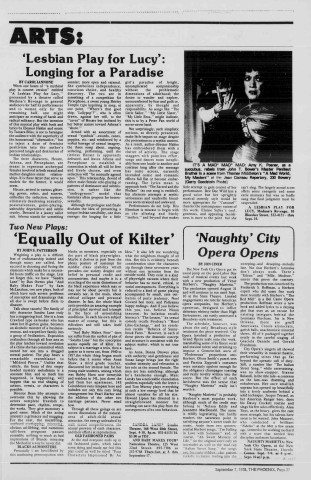
A R T S :\Longing for a ParadiseIT%u2019S A M AD* M A D * MAD: Amy K. Posner, as asuccubus, rebels from John T. Bower%u2019s Master PeniteutBrothel in a scene from Thomas Middleton's %u201c A Mad W orld,M y Masters%u201d ai ih%u00ab> Jean Cocteau Repertory, 330 Bowery[Gerry Goodsteln Photo]BY CAROL IAN NONEWhen one hears of %u201c a mythical play in concert version%u201d entitled %u2018%u2018A Lesbian Play for Lucy,%u201d presented by a theatre called M edusa%u2019s Revenge to general audiences for half its performances and to women only for the remaining half, one might anticipate an evening of harsh and radical militancy. But the intention of this musical play with book and lyrics by Eleanor Hakim and music by Tamara Bliss, is not to harangue the audience with the superiority of the homosexual %u2018%u2018alternative,%u201d but to inject a dose of feminist positivism into the author%u2019s perceived tangle and destruction of lesbian relationships.The three characters, Hecate, Athena, and Persephone, are meant to represent archetypal females involved in both sexual and mother-daughter-sister relationships. It is these latter that serve as models for the former, it would seem.Hecate, attired in various glittering gowns, robes, and scarves, embodies the seduction, mystery, ultimately deadening sexuality, possessiveness, game-playing, unhealthy dependence and subtle cruelty. Dressed in a jaunty sailor suit, Athena stands for somethingsunnier; more open and rational. She symbolizes independence, conscious choice, and healthy discovery. The two are in something of a competition for Persephone, a sweet young Shirley Temple type inquiring in song, at one point, %u2018%u2018Where%u2019s that good ship, %u2019Lollypop%u2019?%u201d , who is often drawn, against her will, to the %u201c caves%u201d of Hecate but inclined by her better nature toward Athena%u2019s %u201c shore.%u201dArmed with an assortment of sexual %u201c symbols%u201d -swords, canes, poppies, etc.-and reinforced by a verbal barrage of sexual imagery, the three romp about, arguing, seducing, performing, until the tireless Hecate is apparently defeated, and leaves Athena and Persephone to establish a connection in which all will be free and freely chosen, and even seduction will %u201c be mutually agreed upon.%u201d This relationship, devoid of either male/female role-playing or patterns of dominance and submission, is rather like the %u201c androgynous%u201d model that feminists often propose for heterosexuality.Although the prologue and finale disclaim the idea of presenting a unique lesbian sensibility, one does emerge: the longing for a littlegirl%u2019s paradise of bright, uncomplicated companionship without the problematic dimensions of adulthood; the desire to wander and explore, unencumbered by fear and guilt or, apparently, by thought and responsibility. As songs like %u201cThe Little Sailor,%u201d %u201c My Little Sister,%u201d %u201c My Little Eros,%u201d might indicate, this is to by a Peter Pan world of never-never land.Not surprisingly, such simplistic notions, so directly presented, make little impact on stage despite the pretensions to a mythic context. As a result, author-director Hakim has embroidered them with a clutter of activity. The stage staggers with pointless effort, songs and dances roam inexplicably from one locale to another and continue long after the message has come across, earnestly intended comic and romantic effects fall flat or become embarrassing. The lyrics mean to approach both %u201c The Sacred and the Profane%u201d (as one song is entitled), but alternate attempts at mythic seriousness and vaudeville broadness seem strained and awkward.Performances do not help. Rita Ebenhart is miscast to begin with as the alluring and bitchy %u201c mother,%u201d and beyond that makeslittle attempt to gain control of her performance. Dee Dee Wild has a good voice but her sprightly musical ^ comedy style would be more appropriate for %u201cCarousel%u201d than for the contemporary nature of ths work. Elaine Sulka%u2019s cool, generous, and appealing boyishness is more to the point, but shecan%u2019t sing. The largely atonal score offers some energetic and some eerie moments but was so badly sung that final judgment must be suspended.A LESBIAN PLAY FOR LUCY, Medusa's Revenge, 10 Bleecker Street, 532-4151 - thru Sept. 10.Two New Plays:\BY JOHNS. PATTERSONWrighting a play is a difficult feat of craftsmanship indeed and though many are called, few succeed in choosing and fusing the elements which make for a successful hours traffic on the stage. Lest we forget this, we have %u201c Sandra Lane%u201d by Dan Owens plus %u201c And Baby Makes Four%u201d by Sam McLanahan, two new plays, both of which have such severe problems of conception and dramaturgy that all else is swept before them to disaster.Talk about tsouris! The family of title character Sandra Lane truly has a staggering load. She is a Joan Crawford type ex-hooker who has taken her ill-gotten gains, becomes an alcoholic monster of a businesswoman, and warped her family into a group of bedlamites. Exposition avalanches through all four acts as the play lurches toward revelation of a crime she has committed which turned her son into a drugged mental patient. The play bears a remarkable resemblance to %u201c Mildred Pierce.%u201d Unlike that vehicle, the focus of this empty headed mystery melodrama is a constant blur, and so much has happened, is happening, will happen that no real shaping of actions, events, or characters is possible.Director Dean Irby attempts to overcome this by allowing the actors complete freedom to determine pace, rhythm, tempo, the works. They give monotony a good name. Much of the acting amounts vo grimaces and mugging. For the rest, the mumbling,r > A f %u00bb f n e p r l n v o r l a n n m n---------- - *obvious ad-libbing, and numerous still-born pregnant pauses resemble nothing so much as bad impressions of Brando misusing the Method in a way he never did.BLACKS AS MONSTERSPersonally 1 am bewildered by this continuing preoccupation withblacks as monsters, especially on the part of black playwrights. Maybe it derives in part from the phony posture of contempt for middle class stability which pervades our society despite our belief in personal credit and consumerism. And maybe it is a recycling of the racist distortions of the black experience which may or may not be about poverty but is certainly not, in the main, about ethical collapse and personal disaster. In fact, the whole black caste provides an amazing example of principled survival and triumph in the face of astonishing conditions. To each his own subject m atter of coursp, but this is ridiculous and still takes itself seriously.%u201c And Baby Makes Four%u201d does not suffer from the surfeit of plot of %u201c Sandra Lane%u201d but the conception seems equally out of kilter. Its subject is a marriage a trois, then a quatre as it turns out, from 1940 to 1957.the whole thing began much before that it seems when Anna Shaw, a third grade teacher, discovered her intense lust for her young male students, among whom was Bobby Horn now twentyish and resident in 14L, just down the hall from her apartm ent, 14S Coincidence runs rampant here and includes not only this cozy living arrangement but Pearl Harbor and the addition of the other two marriage partners. Never mind how.Through all these goings on are woven discussions of the naturalness of adult-child sexual attraction, the energy unleashed bymale sexual coiTipctitivCnCSo, llicsexual prowess of each character, and their efforts at reproduction.OLD FASHIONED PAIRSAt the end everyone ends up in old fashioned pairs, which takes some doing and made me feel this play could as well be titled %u201c Four Characters Imprisoned By AnIdea.%u201d It also left me wondering what the neighbors thought of all this. But this is evidently beneath consideration since the characters zip through these seventeen years without one intrusion from the outside world. They exist in a kind of playwright vacuum where their behavior has no moral, ethical, or social consequences. Everything is reduced to a kind of game playing accompanied by small, cute outbursts of petty jealousy, Noel Coward bon mots, and Pollyanna happy endings. And if you believe this you, too, believe Nixon innocent. Its isolation recalls Ionesco%u2019s %u201cThe Lesson,%u201d its sexual comedy recalls Feydeau%u2019s %u201c Hotel Libre-Exchange,%u201d and its resolution recalls %u201c Rebecca of Sunnybrook Farm.%u201d However, in each of these pieces the dramatic concept and structure is consistent with the subject matter, which is not true here.As Anna, Donna Drewes plays with authority and gentleness and Susan Lange brings just the right student intensity and relexation to her role as the second female. The men are less satisfying: although h e %u2019s handsome enough, Marc Lutsky has a noticeable enunciation problem especially with the letter s and Tom Murray plays everything at such a low energy level that he almost vanishes for all his size. Howard Lipson has directed in a straightforward manner but nothing can save this play from the consequences of its own behavious.SANDRA LANE-- Studio Theatre, 168 West 48th Street, Sept. 4-18, 8p.m. 831-6113/14. $3.00 or TDF.AND BABY MAKES FOUR* Namesless Theatre, 125 West 22nd Street. 695-7106 or 242-9768 Thurs-Sun at 8 thru September 17.%u2018N a u g h ty 9 C ityO p e ra O p e n sBY JON CINERThe New York City Opera got its usual jump on the post-Labor Day rush of musical events last week with a new production of Victor Herbert%u2019s %u201c Naughty Marietta.%u201d The production opened August 31 and will continue to run until Sept. 10 at the State Theatre. Limited engagements are rare for American opera companies, but Herbert%u2019s operettas, designed to inflict delerious whimsy rather than High Seriousness, can easily command a Broadway-style treatment.The schedule., however, was about the only Broadway-style treatment the piece received. City Opera lavished a production of Grand Opera scale onto the work, marshalling some of its finest vocal and musical talent and straining to impose a Gemeutlish aura of %u201c Fledermaus%u201d proportions onto Herbert. Oliver Smith%u2019s pastel sets and Patricia Zipprodt%u2019s costumes were certainly opulent enough for the obligatory champagne toasting and rustic revelry written into the score. But the effect of such lavishness was the sense that %u201c Naughty Marietta%u201d really isn%u2019t worth it.%u201c Naughty Marietta%u201d is probably H erbert%u2019s most popular work, although much of the credit may belong to %u2018Nelson Eddy and Jeannette MacDonald. The score is mildly ingratiating but hardly reaches the saturation point in satisfying anyone%u2019s sweet tooth for music. Aside trom two quintessential Herbert songs, %u201c I%u2019m Falling in Love with Someone%u201d and, of course. %u201c Ah Sweet Mystery of Life,%u201d (in the original score only an interlude) as well as the mad-cap %u201c Italian Street Song,\a r s .. f os m u.1 a - r i d d e n;., t h e patent melodic recitative leading into thesweeping-and drooping-melodic line. Not that Herbert%u2019s formulas don%u2019t always work. T here%u2019s %u201c Eileen\scores that prove the contrary.The production was conceived by Frederick S. Roffman, a Herbert expert who did some fine work most recently with Herbert%u2019s %u201c The Red Mill%u201d in a Bel Canto Opera production. Roffman wrote a new book and added lyrics to a cloying plot that uses as an excuse for existing intrigues behind the Louisiana Purchase. Set in New Orleans, there are gruff Americans, Creole aristocrats, garish balls, anachronistic niinstral shows. All of it packaged together neatly in -the careful staging of Graciela Daniele and Gerald Freedman.City Opera%u2019s singers all showed their versatility in musical theatre, performing stints that go far beyond the operatic call of duty. Still, a number like %u201cThe Italian Street Song,%u201d while entertaining, was no show-stopper. Gianna Rolandi, in the title role-a contessa on the lam-was charming and exhuberant. Her once smallish soprano has opened up beautifully into a lovely soubrette behind a solid technique. Jacque Trussel, as her American Ranger hero, does his Davey Crockett routine and sings his few solos effectively. Alan Titus, as the heavy, gives the cast more strength, but his talents here seem to be wasted. John Mauceri, who conducted a brilliant \ago, seemed to be working too hard with a score that needed less discipline and more luxuriance.NAUGHTY MARIETTA: NewYork City Opera, at the NewYork State Theatre, LincolnCenter. Sept. -7-9, at 8 p ml.Sept. 10 at 7 p.sn. .BUSeptember 7,1978, THE PHOENIX, Pacia ??


