


Page 297 - Demo
P. 297
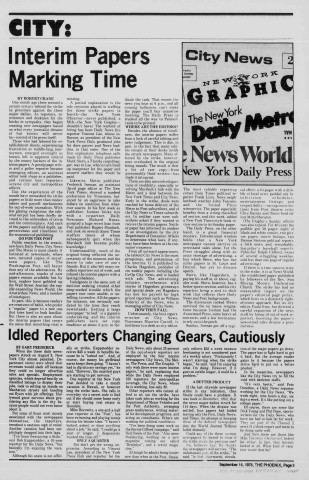
C I T Y :Interim PapersMarking Timecal effort: a 61-pager with a dribBY ROBERT CRANEOne month ago there seemed a certain ecstacy behind the strike by pressmen against the three major dailies. As reporters, rewritemen and deskmen hit the bricks in sympathy, they began creating new newspapers based on what every journalist dreams of but knows will never be%u2014control of the press itself.Those who had labored for establishment sheets, experiencing frustration as middle-rung journeymen, emerged overnight as bosses, left in apparent control by the money backers of the interim papers. A gossip page writer and a police reporter became managing editors, an assistant editor took shape as a publisher, and various beat reporters became city and metropolitan editors.B ut the experiences of the month have unmasked the strike papers as little more than money rakers and payroll mechanisms for out-of-work journalists. With few glaring exceptions, the editorial output has been chiefly devoted to the embroidery of trivia and the commonplace. And each of the papers sacrified depth, aggressiveness and timeliness' to the economics of publishing.GO FOR THE POSTPublic reaction to the erratic, new-born Daily Press, City News and The Metro is most clearly illustrated at newsstands, where torn, tattered copies of out-oftown papers, like The W ashington Post, sell faster than any of the alternatives. By m id-afternoon, stacks of new papers remain available, but by then, readers have gobbled up the Wall Street Journal, the rapidly-expanding News World, the Amsterdam News, and a number of interlopers.In part, this is because readers are creatures of habit, who prefer a %u201cregular\that tries hard to look familiar. But there is also an aura about the interim papers that create the sense that something vital ismissing.A partial explanation is the role croynism played in staffing the three strike papers (a fo u rth %u2014the New YorkO bserver%u2014never published: a fifth%u2014the New York Graphic%u2014 shouldn't have.) The warlord of hiring has been Daily News fire reporter Vincent Lee, whose influence, as president of the New York Press Club, produced jobs for dues payers and News buddies, in that order. One of the first exploratory telephone calls made by Daily Press publisher Mark Stern, a Florida carpetbagger, was to Lee, who in turn lined up manpower for the paper and assured staffers they would be paid.Likewise, M etro publisher Frederick Iseman, an assistant Op-ed page editor at The New York Times, showed a marked preferrence for Timesmen, balanced by an eagerness to take dollars on condition from whatever source. In his first week as publisher, Isem an broke ties with a co-partner, Daily Newsman Richard Brass, accepted a huge secret loan from Post publisher Rupert Murdoch, and took on several dozen Times staffers (most of whom subsequently quit when the M urdoch link became public knowledge.)Understandibly, much of the original hiring reflected the uncertainty of the moment and the desire to take care of one's friends. But it also left many excellent reporters out of work, and infused the interim papers with a lasting inbalance.Indulgence in the same sort of decision making created other deep-seeded trouble which the papers now seem unable, or unwilling, to resolve. All the papers, for instance, are seriously outdated by the time they reach new sstands. G etting a large newspaper %u201c to bed%undertaking, and the interim publishers have set copy deadlines at about 2 p.m. to facilitate the task. That means the news you hear at 6 p.m., and all evening ballscores, can't make the paper you'll buy tomorrow morning. The Daily Press is trucked all the wav to Pennsylvania to be printed.WHERE ARE THE EDITORS?Besides the absence of timeliness, the interim papers suffer from a lack of careful editing and news judgement. This is due, in part, to the fact that many editors remain at their desks inside the struck newspapers. Many effected by the strike, however, were overlooked in the original hiring rounds. The result is that a lot of raw copy%u2014from presumably fluid w riters%u2014has made it into print.There are also unresolved questions of credibility, especially involving Murdoch's link with the Metro and a deal between the New York Times and City News Early in the strike, deals were reached for home delivery of the Metro to Post subscribers, and of the City News to Times subscribers. In neither case were subscribers asked if they wanted to receive the interim papers. Neither paper has informed its readers of an investigation by the city Department of Consumer Affairs to determine what laws, if any, may have been broken at the consumer's expense.From all outward appearances, the tabloid City News is the most prosperous, and pretentious, of the interims. It is published by Charles Hagedorn, publisher of six weekly papers including the Co-Op City News, and is loaded with ads. The advertising industry reverberates with stories of Hagedorn giveaways and special deals; yet Hagedorn has met his payroll for high priced reporters such as William Federici of the News, who is managing editor of City News.HOW THEY FALLUnfortunately, the best reporter-w riter at City News, Timesman Maurice Carroll, is tied down to a desk as city editor.The most reliable reporting comes from Times political reporter Frank Lynn, News neighborhood watcher John Toscano, and the United Press wireservice. The paper especially benefits from a strong classified ad section, and this week, added a New York Times-style book review section to its Sunday paper.The Daily Press, on the other hand, is a great financial mystery. Conventional wisdom holds that a New York newspaper cannot survive on newsstand sales alone. Yet the Press struggles along with an acute shortage of advertising, a feat which Stern, who has run strike papers in St. Louis and D etroit, has yet to discuss openly.Stern, like Hagerdorn, is paying his staff at, or above, regular scale. Stern, however, has a better sports section, and his city reporters bring a zest to their work that reflects their Daily News and Post backgrounds.The dissension racked Metro survived the en masse resignations because Iseman had the Associated Press, some heavy ad contracts, and a few rewritemen to rely on in the pinch.Sunday, Iseman got off a tvpibie of local news padded out by te le v is io n s c h e d u le s , entertainm ent listings, and respectibility %u2014 saving contributions from Post theatre critic Clive Barnes and Times food editor Mimi Sheraton.(The Graphic s Sunday edition was also typical. For 40 cents the gullible got 30 pages: eight of black and white comics, two picture pages, movie listings, two Damon Stetson political reports, a little news, and, remarkably, S atu rd ay 's baseball reports. Publisher Ralph Clifford, owner of several struggling weeklies, sold less than one page of regular advertising.)If there is a true success story in the strike, it is at News World, the established paper published by followers of the Rev. Sun M yung M oon's Unification Church. The strike has had no m easurable impact on the paper's editorial page policy, which hews to a distinctly rightof-eenter approach. But its city editor, Paula Gray, has directed a careful expansion of the news staff by hiring of out-of-work reporters, boosting the paper%u2019s newsstand sales despite a price increase.Idled Reporters Changing Gears, CautiouslyBY GARY FREDERICKWhen the three daily newspapers struck on August 9, New York City almost panicked. Department stores were afraid that revenues would slack off because they could no longer advertise sales and specials. Employment agencies, which depend heavily on classified listings to display their jobs, took to setting up stands on Manhattan streets and handing out flyers with job offerings. Hollywood grew nervous about premiering any film in the city because people would not even know about it.But some of those most closely associated with the newspapers them selves, the reporters, breathed a cautious sigh of relief. Another vacation had been surprisingly dropped into their laps.%u201cI%u2019ve been freelancing a little,%u201d said Bob Kappstedder, a 10-year reporter for the Daily News, %u201cbut basically I%u2019m enjoying the vacation.%u201dAlthough his union is not officially on strike, Kappstedder receives $45 a week in benefits because he is %u201clocked out%u201d. And, of course, the money his girlfriend earns keeps them going. %u201cI haven%u2019t had to dip into my savings yet,\said, %u201cHowever, the married guys are starting to get nervous.%u201dOne reporter at the New York Post decided to take a month vacation in Hawaii, or however long the strike lasts. She calls in everyday via a secret code to find out if she should come home early or start buying real estate in Honolulu.Mike Horowitz, a one-and-a-halfyear reporter at the %u201cPost\been swimming and playing tennis during: his leisure time. %u201cI haven%u2019t looked, asked, or done anything about a job,%u201d he said. %u201cI could go a year or longer. I desperately w-anted the time off.%u201dONLY A QUARTER But don%u2019t get the wrong impression. According to Vincent Lee, president of the New' York Press Club and reporter for theDaily News, only about 25 percent of the out-of-work reporters are employed by the four interim newspapers: City News, The Metro, The Press, and The Graphic. %u201cI only wish there were more interim papers,%u201d he said, explaining that while the Daily News employed 150 reporters for metropolitan coverage, the City News, where he is working, has only 30.Other reporters who cannot afford to sit out the strike, have taken such jobs as working for the Department of Motor Vehicles and the Port Authority, arranging press conferences, writing material for development programs, and acting as consultants, Others are working for political candidates.%u201cI%u2019ve been doing some work on the Bernie Gifford campaign,%u201d said Ned Steele of the Post. %u201cAlso some freelancing, working on a new' magazine coming out called %u201cBrooklyn\zine.\Although he admits being busier now than when at the Post, Steeleonly collects $45 a week because freelancing is not considered part of a weekly salary. \wasn%u2019t starving when the strike began,\what I'm doing. However, if it goes on awhile longer, it could be a problem.%u201dA BETTER PRODUCTIf the last citywide newspaper strike is any indication, then Steele could have a problem. It was back in December, 1962, that the seven major dailies struck for 114 days. When the dispute was settled, four papers had folded leaving only the Post, Daily News, and Times. An attempt at mergingthrpp of tho Hpfnnrt npwenanpre r - i %u2014 -into the World Journal Tribune failed dismally.Could any of the three current newspapers be forced to dose if the strike rivals the previous one?No, believes Lee. He thinks the newspapers will survive. %unfortunate part of the strike,%u201d he said, %u201cis that afterwards, circulation of the major papers go down. The paper has to fight hard to get it back. But the average reader gains by it because the papers strive hard to put out a better product.\In the meantime, newspapers like the City News try to fill the void with skeleton staffs.%u201cIt%u2019s very hectic,%u201d said Pete Donohue, a Daily News reporter working for the City New's. \work eight, nine hours a day, six days a week. It%u2019s like putting out a college paper.\Of course, there are some like Dick Young and Phil Pepe, sportswriters for the Daily News, who have not had to look far for work.r P L r > %u00bb > o v%u00bb%u00ab-\\ *%u25a0> n r%C t l i n C L n ^ n n l O-*%u25a0 W * V. V V / * V I I V V ' l i u i i u u Ldnews 11 o'clock report and seem to be doing quite well.And then there are those like Mike Horowitz who haven%u2019t looked far either. In fact, they haven't looked at ail. What kind of vacation would that be?September 1 4 ,197%u20198, THE PHOENIX, Page 3


