


Page 315 - Demo
P. 315
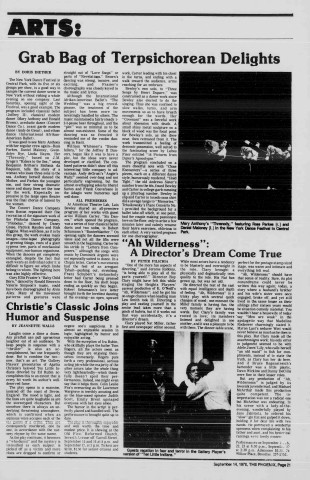
A R T S )Grab Bag of Terpsichorean DelightsBY DORIS DIETHERThe New York Dance Festival in Central Park, with its five or six groups per show, is a good way to sample the current dance scene in New York without risking a whole evening on one company. Last Saturday, opening night of the Festival, was a good example. The program included classical ballet (Joffrey II), classical modern dance (Mary Anthony and Ronald Brown), acrobatic dance (Concert Dance Co.), avant garde modern dance (Andy de Groat), and ethnic dance (International AfrikanAmerican Ballet).It was good to see Mary Anthony with her regular crew again%u2014Ross Parkes, Daniel Maloney, Gwendolyn Bye, Linda Hayes. Her %u201c Threnody,%u201d based on J.M. Synge%u2019s %u201cRiders to the Sea,%u201d using Benjamin Britten%u2019s Sinfonia da Requiem, tells the story of a woman who loses three sons to the sea. Anthony herself danced the Mother, and Parkes the youngest son, and their strong dramatic sense and sharp lines set the tone for the work. Especially impressive in the large open theater was the final chorus of lament by the women.The Concert Dance Company from Boston repeated their fine recreation of the signature work of the Pilobolus Dance Company, %u201cPilobolus,%u201d danced by Danny Grose, Patrick Hayden and Rick Higgins. When well done, as it is by this group, the work evokes many images%u2014time-lapse photography of growing things, roots of a giant cypress tree, parts of mechanical equipment, non-human organisms. When the dancers get completely entangled, despite the fact that each wears an individual color it is difficult to figure out which limbs belong to whom. The lighting here was also highly effective.Gary Ellis Frazier%u2019s %u201cBaby Child Born,%u201d danced by Ronald Brown to Valerie Simpson%u2019s music, could have been choreographed by Alvin Ailey. Many of the movement patterns and gestures werestraight out of %u201cLove Songs%u201d or parts of %u201cRevelations.%u201d. Brown%u2019s dancing was strong, incisive, and exciting, and F razier%u2019s choreography was closely keyed to the music and lyrics.Although the International Afrikan-American Ballet%u2019s %u201cThe Wedding%u201d was a big crowdpleaser, the treatment of the subject has been more interestingly handled by others. The music maintained a fairly steady I2-3-pause beat throughout, and the %u201cplot%u201d was so minimal as to be almost non-existent. Some of the dancing was so frenzied it reminded me of the voodoo dancing in Haiti.William W hitener%u2019s %u201c Boomfellera,%u201d for the Joffrey II Dancers, began like it was to have a plot, but the ideas were never developed or clarified. The confused patterns didn%u2019t show off this interesting little company to advantage. Andy deGroat%u2019s %u201cAngie%u2019s Waltz%u201d seemed over-long and not particularly engrossing, but the almost overlapping solos by Sheryl Sutton and Frank Conversano in the Adagio were humorous and well-done.ALL PREMIERESAt American Theatre Lab, Lois Bewley shared an all-premiere program of her works with guest artist William Carter. %u201cSix Dances,%u201d which opened the program, was a series of four classical ballet duets and two solos, to Robert Schumann%u2019s %u201cBunterblaetter.%u201d On opening night the dancers seemed tense and not all the lifts were smooth in the beginning. Carter hit his stride in %u201cLetters from Composers,%u201d although the songs with music by Dominick Argento were not especially suited to dance. In a Chopin letter, Carter%u2019s movements had the feel of an arrogant Tybalt%u2014pushing out, stretching. Franz Schubert%u2019s melancholy letter had Carter being pressed down to the floor, his short leaps ending as quickly as they began. Robert Schumann%u2019s love letter brought forth the loveliest dancing of the evening%u2014an open, upwardBY JEANNETTE WALLSLaughs come a dime a dozen. Any pratfall can pull uproarious laughter out of an audience. To keep people in suspense with a %u201c th riller%u201d is also an accomplishment, but one frequently done. But to combine the tw onow, that%u2019s an art. The Gallery Players%u2019 presentation of Agatha Christie%u2019s beloved Ten Little Indians directed by Ed Rubin accomplishes this to an extent that is every bit worth its author%u2019s welldeserved fame.The play opens in a mansion, isolated off the coast of Devon England The mood is light, and the lines are quite laughable as are the stereotyped characters. But somehow there is always an underlying threatening atmosphere, which is confirmed when an ominous voice accuses each of theconsequently murdered, one by one, in accordance with the nursery rhyme by the same name.As the play continues, it becomes a %u201cwho dunnit%u201d and the mystery is intensified as each suspect is picked off as a victim and more clues are dropped to confirm orwork, Carter leading with his chest in the turns, and ending with a walk toward the audience, arms reaching for an embrace.Bewley%u2019s own solo, to %u201cThree Songs by Henri Duparc,%u201d was constrained as a dance work since Bewley also elected to do the singing. Thus she was confined to slow walks, turns, and arm movements so as to have breath enough for the words. Her %u201cCovenant%u201d was a forceful work about obsession with death. A small shiny metal sculpture on a block of wood was the focal point for Bewley%u2019s solo, as she drew near, then retreated from it. The work transmitted a feeling of demonic possession, well suited to the fascinating score by Lubos Fiser entitled %u201c16 Pictures from Durer%u2019s Apocolypse.%u201dThe program concluded on a more cheerful note with %u201cClose Encounters%u201d%u2014a series of three pieces, each on a different dance style, humorously rendered. %u201cHold Tight,%u201d the old Andrews Sister%u2019s number from the 40s, found Bewley and Carter in college garb messing up a jitterbug number. Bewley in slip and Carter in tuxedo sans shirt did a savage tango to %u201cMemories.%u201d Tchaikowsky%u2019s Piano Concerto No. 1 provided the background for a ballet take-off which, at one point, had the coupie making passionate love on the floor, only to arise a few minutes later and calmly resume their barre exercises, oblivious to each other. A very varied program for one choreographer.J %u2018Threnocfy, %u2019 %u2019 f<^tudng Ross Parkm [r.j andPark.%u201cAh W ilderness%u201d:A Director%u2019s Dream Come TrueChristie%u2019s Classic JoinsHumor and Suspensenegate one%u2019s suspicions. It is almost an enjoyable session in logic, highlighted by humor and enjoyable acting. %u2019With the exception of Ira Rubin, who skillfully plays the butler Tom Rogers, all the actors seem as though they are enjoying themselves immensely. Rogers puts forth a very professional, serious acting job while the majority of the pther actors take the whole thing very lightheartedly%u2014which thankfully doesn%u2019t spoil their performances. Indeed, one might even say that it helps them. Colin Leslie Fox%u2019s overacting as Sir Lawrence Wargrave is terribly amusing and as the blue-nosed spinster Judith Scott, Em ily Brent upstaged everyone with her eyes alone.The humor in the script is perfectly placed and handled well. The performance is brought quite up to date.* * * v . j ^ %u00bb u j %u00bb u v / tand well worth modest price. It is showing at the Old First ' Reformed Church, Seventh Avenue off Carroll Street, September 15 and 16 at 8 p.m. and September 17, at 3 p.m. Tickets are $2.50, $1.50 for senior citizens and students.BY PETER FILICHIA%u201cOne of the more fun aspects of directing,%u201d said Jerome Robbins, %u201cis being able to play all of the parts yourself.%u201d D irector Roy Clary might have felt this while staging the Heights P lay ers%u2019 current production of E. O%u2019Neill%u2019s %u201cAh, Wilderness%u201d ; and he got his on-stage chance when leading man Lew Smith took ill. Directing a play and casting yourself in the senior lead takes more than a pinch of hubris, but if it works out that way accidentally, it%u2019s a director%u2019s dream.Clary played Nat Miller, father first and newspaper editor second,While most actors have a tendency to be blusterly and overweight in the role, Clary brought a physically and dogmatically trim quality to the role. His Nat has grown up, but was not old.He directed the rest of the cast with equal intelligence and depth of feeling. %u201cAh, Wilderness%u201d is a tricky play with several quick changes of mood; one moment the Miller family is having fun, the very moment they are having words. But Clary%u2019s family was rooted in love; its members listened and delighted in one another, and it was a pleasure to be with them. The dinner-table scene,v m W - %u2122 i ; M %u201d',rror'n #w Ga\perfect for the postage-stamp sized stage, was warm and intimate and everything felt real.\that sense of reality. Sure, its plot conundrums could never be written this way again; today, a story where a husband%u2019s brother and his wife%u2019s sister were once engaged, broke off, and yet still lived in the same house as their siblings after sixteen years would be situation comedy material. You wouldn%u2019t hear a housewife of today say %u201c Men are weak%u201d in the apologetic way that Madeline Rockower charmingly stated it. Myron Last%u2019s seducer Wint would never believe as much as he does in this play. But Clary made all the anachronisms work; his only error in judgment seemed to be with Adele Jones%u2019 Lily, who calls herself %u201can old maid%u201d to fish for compliments, instead of to state the truth, as Clary has her do here. And if Bruce R egenstreich%u2019s bartender was a little plastic, Dawn Wicklow and Danny DeCillis were fine in their lesser roles.But any production of %u201cAh, W ilderness%u201d is judged by its lovesick juvenile lead, and Michael McArthur made this production quite competent. The interpretation was not a radical one but McArthur was endearing. In his scene with a lady-of-theevening, wonderfully played by Jane Jakimetz, he ordered his %u201cslow%u201d gin fizz and gulped it down, holding it for dear life with two He portrayed a wonderful openness when complaining to his father and aunt, and his hysterical rantings wore lovely nonsoirPerformances on September 1;, *6, 22, 23 at 8:30 p.m., Septemln.. 17 at 2:30 p.m. Admission $3.SO. Willow Place, Brooklyn. 237-27S2.September 14,1978, THE PHOENIX, Page 21


