


Page 41 - Demo
P. 41
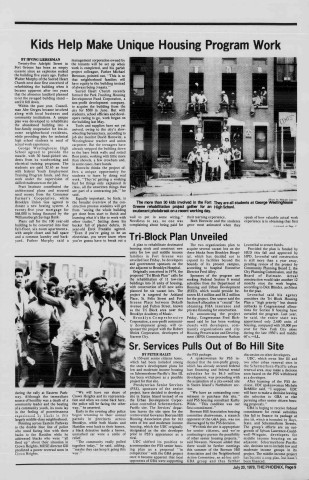
Kids Help Make Unique Housing Program WorkBY IRVING LIEBERMANTwenty-five Adelphi Street in Fort Greene has been an empty eyesore since an explosion rocked the building five years ago. Father Walter Murphy of the Sacred Heart Church next door first conceived of refurbishing the building when it became apparent after two years that the absentee landlord planned to let the ravaged building stand -- until it fell down.Within the past year, Councilman Abe Gerges became involved along with local business and community institutions. A unique plan was developed to rehabilitate the abandoned building into a four-family cooperative for low-income neighborhood residents, while providing jobs for technical high school students in need of actual work experience.George Westinghouse High School agreed to provide the muscle, with 30 hand-picked students from its woodworking and electrical training programs. The students are paid $2.65 an hour with federal Youth Employment Training Program funds, and they work under the supervision of skilled tradesmen on the job.Pratt Institute contributed the architectural plans and secured seed money from the Consumer Farm er%u2019s Cooperative, while Brooklyn Union Gas agreed to donate a new heating system. A twenty-five year mortgage for $68,000 is being financed by the Williamsburgh Savings Bank.Plans call for the 100 year-old building to be converted into four full-floor, six-room apartm ents, with ample closet and hall space and a common laundry and backyard. Father Murphy said amanagement corporation owned by the tenants will be set up when work is completed, and his parish project colleague, Father Michael Brennan, pointed out, %u201cThis is so that neighborhood families will have equity in the building instead of always being tenants.%u201dSacred Heart Church recently formed the Park Flushing Housing Development Fund Corporation, a non-profit development company, to acquire the building from the city for $500 in June. But with students, school officials and developers raring to go, work began on the building last May.Tools and supplies have not yet arrived, owing to the city%u2019s slowwheeling bureaucracy, according to job site monitor David Horowitz, a Westinghouse teacher and union carpenter. But the teenagers have already stripped the building down to the bare brick walls and rotted floor joists, working with little more than shovels, a few crowbars and, in some cases, bare hands.Horowitz thinks the project offers a unique opportunity for students to learn by doing real work. %u201cThey%u2019re* getting a working feel for things only explained in class, all the unwritten things that are part of a contracting job,%u201d he said.Equally important, he feels, is the broader overview of the construction process students will get from %u201c seeing the whole building get done from start to finish and learning what it%u2019s like to work with other trades.%u201d Setting down his bucket full of plaster debris, 16 year-old Errol Franklin agreed. %u201c Even if you%u2019re going to be an electrician, you never know when you%u2019re gonna have to break out aduring the rally at Eastern Parkway. Although the immediate source of hostility was a death of a community leader and the beating of a community youth, its roots lay in the feeling of powerlessness expciiciiccd by blacks m thrs largely middle-class neighborhood.Pointing across Eastern Parkway to the double blue line of police who stood facing him with their backs to the Hasidim while he addressed blacks who were %u201c all fired up%u201d about their situation in Crown Heights, MUSE director Gill predicted a power reversal soon in%u201c We will have our share of Crown Heights and its representation and when we come back here, the police will be facing the other w'ay,%u201d he asserted.Early in the evening after police hpoan returning to their normal patrols in precincts across Brooklyn, while both blacks and Hasidim went back to their homes, a black detective inside a brown, unmarked car wore a smile of relief.%u201cThe community really pulled together today,%u201d he said, adding, %u201c maybe they can keep it going this wav.%u201dwall to put in some wiring.%u201d Needless to say, no one was complaining about being paid fortheir learning experience.Both Horowitz and the students grow most animated when theyspeak of how valuable actual work experience is in obtaining that firstContinued on Page 2?The more than 30 kids involved in the FortGreene rehabilitation project gather for anexuberant photobreak on a recent working day.(Photo by Michael Cuiccio)They are all students at George WestinghouseHigh School.Tri-Block Plan UnveiledA plan to rehabilitate decimated housing stock and construct new units for low and middle income families in Fort Greene was unveiled last Friday, be developers and government sponsors on the site adjacent to Brooklyn Hospital.Originally conceived in 1974, the proposed %u201cTri Block Plan%u201d calls for the rehabilitation of 11 low-rise buildings into 33 units of housing, with construction of 65 new units planned for six vacant lots. The project is targeted for Ashland Place, St. Felix Street and Fort Greene Place between Dekalb Avenue and Fulton Street, known as the Tri Block area near the Brooklyn Academy of Music.B rooklyn C o m p re h e n siv e Corporation, a non-profit community development group, will cosponsor the project with the Robert Olnick Corporation, developers of Starrett City.The two organizations plan to acquire several vacant lots on the three blocks from Brooklyn Hospital, which has decided not to expand its facilities beyond the bounds of its present campus, according to hospital Executive Director Fred Alley.Sponsors of the program are seeking Federal Section 8 rental subsidies from the Department of Housing and Urban Development (HUD), which would provide between $3.4 million and $4.2 million for the project. One source said the Section 8 allocation is %u201ccrucial%u201d for obtaining FHA insurance and private financing for construction.In announcing the project Friday, Congressman Fred Richmond said he has been working closely with developers, community organizations and city Housing Preservation and Development (HPD) Commissioner NathanLeventhal to secure funds.Provided the plan is funded by HUD this fall and approved by HPD, Leventhal said construction is still more than a year away, pending review of the project by Community Planning Board 2, the City Planning Commission, and the Board of Estimate. Actual construction would take another 12 months once the work begins, according to Dick Blinder, architect for the plan.Leventhal said his agency considers the Tri Block Housing Plan a %u201c high priority%u201d but drastic cutbacks in Congressional allocations for Section 8 housing have curtailed the program. Last year, he said, the entire state was apportioned only 2,600 units of housing, compared with 50,000 per year for New York City alone during the late 1950%u2019s and middle 60%u2019s.%u2014I.L.Sr. Services Pulls Out of Bo Hill SiteBY PETER HALEYA 150-unit senior citizens home, which had been included among the state's development plans for low and moderate income housing on Schermerhorn-Pacific%u2019s Site 111, has been withdrawn as a possible project for that site.Presbyterian Senior Services (PSS), sponsors of the senior project, have decided to develop a site in Staten Island instead of on the Urban Development Corporation controlled SchermerhornPacific site. The Services%u2019 departure leaves the site open for the controversial Gowanus Boerum Hill Housing Association plan for 163 units of low and moderate income housing, which the UDC originally designated as the site developer prior to PSS%u2019s appearance as a rival.UDC shifted its position to accommodate the PSS senior housing plan as a proposal %u201c in competition%u201d with the GBA project once it became apparent that iocai opponents of GBA were supportingthe PSS package.A spokeswoman for PSS indicated that the non-profit group, which has already secured federal loan financing and federal rental subsidies for its $6.5 million development, was proceeding with the acquisition of a city-owned site in Staten Island%u2019s Northshore section.%u201c We have an outstanding commitment to purchase this site,%u201d said PSS housing consultant Kathy Wilde. %u201c This condition was our first commitment.%u201dBoerum Hill Association housing committee chairwoman, a staunch opponent ot the UbA plan, was not discouraged by the PSS decision.%u201c We think the site is appropriate for senior citizens, and we%u2019re continuing to pursue the possibility of other senior housing projects,%u201d said Newsom. Newsom added that there would be further meetings this summer of the Boerum Hill Association and the Neighborhood Action Committee, an au-hoc antiGBA group and thus furtherdiscussion on other developers.UDC, which owns Site III and two other urban renewal sites in the Schermerhorn-Pacific urban renewal area, may make a decision soon based on the PSS withdrawal as a developer.After learning of the PSS decision, UDC spokeswoman Michele DeMillie said, %u201c I suppose UDC will have to make a decision leaving site selection to GBA or else pursuing other senior citizen housing proposals.%u201dGBA is hoping to receive federal commitment for rental subsidies this fall to finance its package at Site Hi, which is bounded by Hoyt, State, and Schermerhorn Streets. The group%u2019s efforts are an outgrowth of Sylvan Lawrence-Cauldwell-Wingate, developers for middle income housing on an adjacent Schermerhorn-Pacific site, decision not to include low and moderate income groups in its project. The middle-income project1 t~ A ~ _ 1 %u201e _ >, llcta ucluiuc a coup piatii uut nuon ibeen financed.July 20,1978, THE PHOENIX, Page 9


