


Page 43 - Demo
P. 43
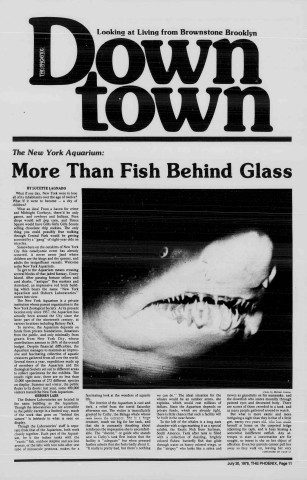
The New York Aquarium:More Than Fish Behind GlassBY LUCETTE LAGNADOWhat if one day, New York were to lose all of its inhabitants over the age of twelve? What if it were to become -- a city of children?What an idea! From a haven for crime and Midnight Cowboys, there%u2019d be only games, and cowboys and Indians. Porn shops would sell pop corn, and Times Square would have Girls Girls Girls Scouts selling chocolate chip cookies. The only thing you could possibly fear walking through Central Park would be getting accosted by a %u201c gang%u201d of eight-year olds on tricycles.Somewhere on the outskirts of New York City this cataclysmic event has already occurred. A never never land where children are the kings and the queens, and adults the insignificant vassals. Welcome to the New York Aquarium.To get to the Aquarium means crossing several blocks of that jaded fantasy, Coney Island. After passing fortune tellers and card sharks, %u201c antique%u201d flea markets and Astroland, an impressive red brick building which bears the name %u201c New York Aquarium and Osborn Laboratories%u201d comes into view.The New York Aquarium is a private institution whose parent organization is the New York Zoological Society. At its present location only since 1957, the Aquarium has actually been around the City since the latter part of the nineteenth century, at various locations including Battery Park.To survive, the Aquarium depends on funds from private foundations, donations from the public, and only minimally from grants from New York City, whose contributions amount to 26% of the overall budget. Despite financial difficulties, the Aquarium manages to maintain an impressive and fascinating collection of aquatic creatures gathered from all over the world. Several times a year, expeditions made up of members of the Aquarium and the Zoological Society set out to different areas to collect specimens for the exhibits. The result: right now, there are no less than 13,000 specimens of 272 different species on display. Summer and winter, the public flocks to its doors: last year, some 400,000 visitors toured the New York Aquarium.OSBORN LABSThe Osborn Laboratories are located in the same building as the Aquarium. Though the laboratories are not accessible to the public except in a limited way, much nf the work that goes on %u201cbehind the scenes%u201d is intrinsic to what is seen on display.Though the Laboratories%u2019 staff is separate from that of the Aquarium, both work closely together. Each part of the Aquarium, be it the indoor tanks with the %u201cexotic%u201d fish, outdoor dolphin and sea lion arenas, or the labs with test tube after test tube of minuscule protozoa, makes for afascinating look at the wonders of aquatic life.The interior of the Aquarium is cool and dark, a relief from the torrid Saturday afternoon sun. The visitor is immediately greeted by Cathy, the Beluga whale whose tank fai.cs the entrance. She is ?. hyg%u00bb* creature, much too big for her tank, and that she is constantly thrashing about reinforces the impression she is uncomfortable. The %u201c docent,%u201d or guide who stands next to Cathy%u2019s tank first insists that the facility is %u201c adequate%u201d but when pressed further admits that she feels badly about it. %u201c It really is pretty bad, but there%u2019s nothingwe can do.%u201d The ideal situation for the whales would be an outdoor arena, she explains, which would cost millions of dollars. Since the Aquarium depends on private funds, which are already tight, there is little chance that such a facility will hp hnilt in the near future.To the left of the whales is a long dark chamber with a sign marking it as a special exhibit, the Exotic Fish from Suriman, South America. Tank after tank is filled with a collection of dazzling, brightly colored fishes: butterfly fish that glide through water on honey colored wings, or the %u201c stripey%u201d who looks like a zebra andiPiloto by Michael Cuiccto;moves as gracetully as his namesake, and the clownfish who stares moonilly through painted eyes and decorated body. There are scores of them crowded in a tank, and as many people gathered around to watch.But what is more exotic and more intriguing a sight than they is that of a little girl, Dareiy two years oiu, who ImS made herself at home on the carpeted ledge adjoining the tajik, and is busy kissing a somewhat indifferent catfish. Any attempts to start a conversation are for nought, so intent is she on her object of affection. Even her parents cannot pull her away so they walk on, leaving her veryCONTINUED ON PAGE 12July 20,1978, THE PHOENIX, Page 11


