


Page 413 - Demo
P. 413
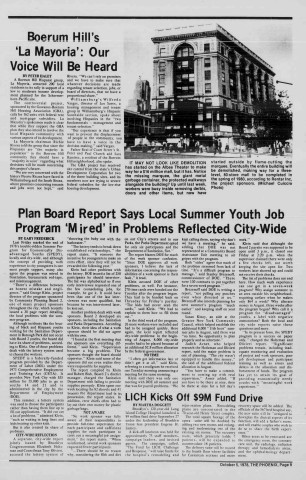
Boa rum Hill's%u2018La Mayoria%u2019: OurVoice WillBY PETER HALEYA Boerum Hill Hispanic group, La Mayoria, attracted 200 local residents to its rally in support of a low to moderate income development planned for the Schermerhorn-Pacific site.The controversial project, sponsored by the Gowanus-Boerum Hill Housing Association (GBA), calls for 162 units with federal rent and mortgage subsidies. La Mayoria's spokesmen made it clear that while they support the GBA plan they also intend to involve the local Hispanic community with various aspects of its development.La Mayoria chairman Richie Rivera told the group that since the Hispanics are %u201cthe majority in population%u201d in the Boerum Hill community they should have a %u201c majority in voice%u201d regarding what decisions will be made concerning this project%u2019s future.%u201c We are very concerned with the history Puerto Ricans have faced in Williamsburg and the South Bronx, where promises concerning tenants and jobs were not kept,%u201d saidBe HeardRivera. %u201c We can%u2019t rely on promises and we have to make sure that whatever decisions are made regarding tenant selection, jobs, or board of directors, that we have a proportional share.%u201dW illia m s b u r g %u2019s W ilfre d o Vargas, director of Los Sures, a housing management and tenant group in Williamsburg%u2019s Hispanic Southside section, spoke about involving Hispanics in the %u201ctwo fundamentals - management and tenant selection.%u201d%u201c Our experience is that if you want to prevent the displacement of people in the community, you have to have a voice in the decision-making,%u201d said Vargas.Father Real of Court Street%u2019s St. Peter and Paul Church arid Sara Ramirez, a resident of the Boerum Hill neighborhood, also spoke.The GBA project has received site control from the state%u2019s Urban Development Corporation for two of the three building sites, and its members now are trying to secure federal subsidies for the low-rise housing development.IT MAY NOT LOOK LIKE DEMOLITIONhas started on the Albee Theater to makeway for a $16 million mall, but it has. Noticethe missing marquee, the giant metalgarbage container, the protected walkwaysalongside the building? Up until last week,workers were busy inside removing derbis,doors and other items, but now havestarted outside by flame-cutting themarquee. Eventually the entire building willbe demolished, making way for a threelevel, 80-store mall to be completed inthe spring of 1980, according to Rentar Inc,the project sponsors. (Michael CuiccioPhoto)Plan Board Report Says Local Summer Youth JobProgram %u2018M ired%u2019 in Problems Reflected City-WideBY GARY FREDERICKLast Friday marked the end of 1978%u2019s trouble-ridden Summer Program for Economically Disadvantaged Youths (SPEDY), locally and city-wide, and although the concept of providing work experience to city youngsters is one most people support, many also agree the program was mired in frustration, bureaucratic red-tape, and mismanagement.%u201cThere%u2019s a difference between an honest mistake and negligence,%u201d said George Klein, project director of the program sponsored by Community Planning Board 2, one of many project sponsors throughout the city, which recently issued a 30 page report detailing the local problems with the summer program.Although incidents like the beating of black and Hispanic youths working for the Sanitation Department in Borough Park did not occur with Board 2 youths, the board did have its share of problems, according to Klein. One of those problems dealt with the lottery system used to choose the workers.SPEDY is a federally-funded program provided by the Department of Labor (DOL) under the 1973 Comprehensive Employment and Training Act (CETA). It provides New York City with $35 million for 55,000 jobs to go to youths 14 and 21 and is administered in the city by the Department of Employment fDOE).This summer, a lottery system was used to choose the participants rather than having them line up to fill out applications. %u201c It did cut out a lot of problems,%u201d admitted Klein, %u201c such as waiting in long lines and kids beating up other kids.But it also created its share of problems.CITY-WIDE REFLECTIONA separate, city-wide report jointly issued by Brooklyn Congresswoman Elizabeth Holtzman and Councilman Tony Olivieri, accused the lottery system of%u201cthrowing the baby out with the bathwater.%u201d%u201cThe lottery tends to break down established relationships,%u201d the report states. %u201c It removes the incentive for youngsters to make an extra effort, since they will not be rewarded the following year.%u201dKlein had other problems with the lottery. DOE issued a list of 250 participants he should interview. The list was alphabetical so if one early interviewee requested one of the few counseloring jobs, for example, he got it. It could have been that one of the last interviewees was more qualified, but because he was interviewed later, he lost out.Another problem dealt with work sponsors. Board 2 developed six sponsors, including the Sanitation and Parks Departments. According to Klein, their idea of what a work sponsor should be did not agree with his own.%u201c I found at the first meeting that the sponsors saw everything different,%u201d said Klein. %u201c Supervision became a big problem. The sponsors thought the board should supervise.%u201d Klein said some of the sponsors did not even realize they were responsible for supplies.The report compiled by Klein and Robert Bish, Board 2%u2019s district manager, charged the Sanitation Department with failing to provide supplies promptly. Klein spent one week locating the 82 shovels and 41 brooms the department had in its possession, the report states. In addition, crew chiefs often had to lay out their own money for plastic garbage bags.NOT AWARE%u201c No work sponsor was fully aware of their responsibility to provide full-time supervision for each participant and sufficient supplies for each participant to carry out a meaningful job assignment,\so informed, several work sponsors requested fewer participants.\why, considering the filth and dirton our City%u2019s streets and in our Parks, the Parks Department opted for only six participants and the Department of Sanitation, five.%u201dThe report blames DOE for much of the work sponsor confusion. %u201c Since DOE approves all work sponsors, I believe the lack of information concerning the responsibilities of a work sponsor is their fault,%u201d it read.Klein accused DOE of other problems, as well. For instance, 270 time cards were handed out the Tuesday after the program began. They had to be handed back on Thrusday for Friday's payday. \cards,%u201d said Klein. %u201c We had to explain to them how to fill them out.%u201dIn the third week of the program, 26 more workers were included and had to be assigned quickly. Here again, the local report reflected city-wide problems: in the beginning of August, 8,000 city-wide youths had to be placed because of an additional $2.8 million allocation by the federal government.NO TIME%u201c I often got information late or didn%u2019t get it at all,%u201d said Klein, referring to a mailgram he received one Tuesday morning announcing a meeting for the same morning.Klein said there was only one meeting with DOE all summer and that was for payroll problems. %u201c Wekept calling them, saying why don%u2019t we have a meeting,%u201d he said, adding that DOE was not represented at a Community Board Assistance Unit meeting to air gripes with the program.Both %u201c sides%u201d agree that much of the problem stemmed from lack of time. %u201c It%u2019s a difficult program to manage,%u201d said Stanley Brezenoff, commissioner of DOE. %u201c There were 130 contracts to put together for a seven week program.%u201dBrezenoff said DOE is writing a report, %u201c not pulling any punches even when directed at u s .%u201d Brezenoff also intends planning for next summer%u2019s program %u201c much earlier%u201d and keeping staff on year round.Susan Kinoy, an aide at the Greater New York Community Council, which helped establish the additional 8,000 %u201c 11th hour%u201d summer jobs in August, said there was %u201c no time. No opportunity to plan properly and no structure.%u201dJudith Avner, who helped research the Hotlzman and Olivieri report, said the major problem is one of planning. %u201c The city wasn't equipped to handle this money,%u201d she said of the additional federal allocation in August.%u201c You have to make a commitment to coming up with real supervision,\you have to be there at nine, then be there at nine for a full day%u2019swork.%u201dKlein said that althought the Board 2 paysite was supposed to be open until 3 p.m., it closed one Friday at 2:20 p.m. when the supervisor claimed there were only a few checks left, not worth keeping the site open for. Two workers later showed up and could not receive their checks.The list of problems does not end here. How much work experience can one get in a seven-week program? Why assign someone to an area outside his neighborhood, requiring carfare when he makes only $64 a week? Why allocate money in August, three weeks after the program began? Why call it a program for %u201c disadvantaged%u201d youths, a label with negative connotations? Both the local and city wide reports raise these questions and more.%u201c In its present form, the SPEDY program is a success on paper only,%u201d charged the Holtzman and Olivieri report. %u201c Significant problems remain, including inadequate monitoring and evaluation of project and work sponsors, poor job development and participant training as well as errors and delays in the allocation and disbursement of funds. The program has yet to attain its goal of providing economically needy youths with %u201c meaningful work experience.\LICH Kicks Off $9M FundBY MARTHA DOGGETTBrooklyn%u2019s 120-year-old Long Island College Hospital launched a $9 million fund drive September 27 under the leadership of Brooklyn Union Gas president Eugene H. Luntey.A kick-off luncheon was held for approximately 75 staff members, campaign leaders, and invited guests. The campaign, called, %u201cThe Fund for LICH: Challenge and Response,\the hospital's remodeling andrejuvenation plans. Remodeling plans are concentrated in the 70-year-old Henry Street complex.The total square footage of the opera suite' will be doubled by adding two new rooms and enlarging and modernizing two of the existing six rooms. The recovery room, which presently holds 7 patients, will be expanded to accommodate 18 patients.The delivery suite will be moved to the fourth floor where facilities' for Caesarean sections and moreDriverecovery space will be added. The officials of the 567 bed hospital say, the new suite will be %u201c designed to downplay the clinical aspects of its function, will add a father%u2019s room, and will enable couples who wish to do so to share the birth experience.%u201dOther areas to be renovated are the emergency room, the coronary care unit, the radiology, radiation therapy and hemodialysis areas, and the ophthalmology department.October 5,1978, THE PHOENIX, Page 9


