


Page 417 - Demo
P. 417
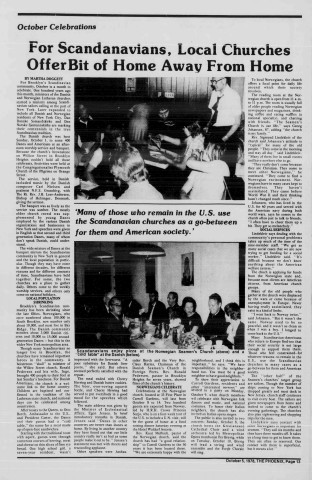
October Celebrationsto r b c a n d a n a v ia n s , L ocal C h u rc h e s O ffer Bit of Home Away From HomeBY MARTHA DOGGETTFor Brooklyn%u2019s Scandinavian community, October is a month to celebrate. One hundred years ago this month, ministers of the Danish and Norwegian Lutheran churches started a ministry among Scandinavian sailors calling at the port of New York. Later expanded to include all Danish and Norwegian residents of New York City, Dan Danske Somandskirke and Den Norske Sjomannskirke are marking their centennials in the true Scandinavian tradition.The Danish church was host Sunday, October 1, to some 400 Danes and Americans at an afternoon worship service and banquet. Because the church%u2019s brownstone on Willow Street in Brooklyn Heights couldn%u2019t hold all those celebrants, festivities were held at the Congregationalist Plymouth Church of the Pilgrims on Orange Street.The service, held in Danish included music by the Danish composer Carl Nielsen and psalmist N.F.S. Grundtivg, with The Rt. Rev. J.B. Leer-Andersen, Bishop of Helsingor, Denmark, giving the sermon.The banquet was as lively as the service was somber. The mostly older church crowd was supplemented by young Danes employed by the various Danish organizations and businesses in New York and speeches were given in English so that second and third generation Danes, many of whom don%u2019t speak Danish, could understand.The wide mixture of Danes at the banquet mirrors the Scandinavian community in New York in general and the local population in particular. Though they may have come in different decades, for different reasons and for different amounts of time, Scandinavians have held together. For some, the two churches are a place to gather daily. Others come to the weekly worship services, and others only come on national holidays.LOCAL POPULATIONSHRINKINGBrooklyn%u2019s Scandinavian community has been shrinking since the late fifties. Norwegians, who once numbered about 100,000 in South Brooklyn, now number only about 10,000, and most live in Bay Ridge. The Danish community includes about 3,000 Danish citizens and 10,000 to 15,000 second generation Danes - but this in the wider New York metropolitan area.Though many Scandinavians no longer live in Brooklyn, the churches have remained important forces in the community. A boisterous %u201c skall%u201d to minister of the Willow Street church, Ronald Pedersen and his wife, Inge, brought 400 people to their feet at last Sunday%u2019s luncheon. For Danish Americans, the church is a welcome link to the home country: Children are baptized and confirmed in the tradition of the Lutheran state church, and national days can be celebrated among countrymen.After toasts to the Queen, to Otto Borch, Ambassador to the U.S., and President Carter, the Danes and their guests had a %u201c cold table,%u2019%u2019 the name for a meal made up of open-face sandwiches.Starting with the traditional toast with aqavit, guests went through numerous courses of herring, meat and cheese on thin slices of firm rye bread. One high school girl, a seven-year resident, w asn%u2019t%u2018Manv of those who remain in the U.S. usethe Scandanavian churches as a go-betweenfor them and American society. %u2019Scandanavians enjoy izza at the Norwegian Seamen%u2019s Church (above) and acold table%u201d at the Danishimpressed with the liverwurst. %u201c A poor substitute for Danish liver p aste,%u2019%u2019 she said. But others seemed perfectly satisfied with the repast.The meal ended with Cherry Herring and Danish butter cookies. The beer, ever-roving aquavit bottle, and Cherry Herring had served to put everybody in a good mood for the speeches which followed.The main address was given by the Minister of Ecclesiastical Affairs, Egon Jensen. In brief introductory remarks in Danish, Jensen said %u201c Danes in other countries are oetter tnan Danes at home. By living in another country they have found out that our little country really isn%u2019t as bad as some people make it out to be.%u201d Jensen%u2019s statement was met with cheers and resounding applause.Other speakers were Ambassador Borch and the Very Rev. Claus Harms, Chairman of the Danish Seamen%u2019s Church in Foreign Ports. Rev. Ronald Pedersen, pastor in Brooklyn Heights for seven years, showed films of the church%u2019s history.NORWEGIANS CELEBRATECelebrations at the Norwegian church, located at 33 First Place in Carroll Gardens, will last from October 8 to 14. Two hundred guests are expected from Norway, led by H.R.H. Crown Princess Sonja, who is on a four-week tour of the U.S. to include a U.N. visit, will be the guest of honor at a fund raising dinner Saturday evening at the Hotel Waldorf Astoria.Rev. Knut Molbach, pastor of the Norwegian church, said the church has had %u201c a good relationship%u2019%u2019 to Carroll Gardens in the 50 years it has been located there. %u201c We are extremely happy with theneighborhood, and 1 think this is important,%u201d he says. %u201c We have responsibilities in the neighborhood too. You must be a good neighbor to have good neighbors.%u201dTo show their appreciation to Carroll Gardens, residents and other %u201c interested nersons%u201d are invited to a party on Monday,October 9, when church members wil celebrate with Norwegian folk dances and music, and national costumes. To honor their Italian neighbors, the church has also invited an Italian opera singer.The public is also invited to two concerts: Sunday, October 8, the church hosts the tvristiansana Cathedral Choir and a wind orchestra led by Metropolitan Opera trombonist Per Brevig, while on Tuesday, October 10, Brevig will lead a string and wind ensemble and the Forde Chorale will sing.To local Norwegians, the church offers a focal point for daily life around which their societyrevolves.The reading room at the Norwegian church isopen from 11 a.m. to 11 p.m. The room is usually full of older people reading Norwegian newspapers and magazines, drinking coffee and eating waffles (a national specialty), and chatting with friends. %u201c The Seam en%u2019s Church is our life,%u201d says Georg Johansen. 87, adding %u201c the church is my family.\Rev. Sigmund Lindekleiv of the church said Johansen%u2019s attitude is %u201ctypical\people. %u201c They come in the morning and stay all day,\%u201c Many of them live in small rooms and have nowhere else to go.%u201c They really don%u2019t come because they are Christian. They come to meet other N orwegians,\continued. %u201c They come to find a Norwegian environment. Norwegians have in many cases kept to themselves. They haven%u2019t assimilated. They came before World War II and their thinking hasn't changed much since.%u201dJohansen, who has lived in the U.S. for 60 years and served with the American navy during both world wars, says he comes to the church often just to talk to friends. %u201c I often have to cheer them up a bit. They get so melancholy.\SOCIAL SERVICESLindekleiv says dealing with the community%u2019s personal problems takes up much of the time of the nine-member staff. %u201c We get so many social cases that we are now trying to get funding for a social worker,%u201d Lindekleiv said. %u201c It%u2019s difficult because we don't know anything about the American welfare system.\The chuch is applying for funds from the Norwegian state and, because most clients are American citizens, from American church groups.Many of the old people who gather at the church were displaced by the wars or came because of unemployment in Europe. Never having really assimilated, they exist in a kind of limbo.%u201c I went back to Norway twice,%u201d said Johnasen. %u201c But it wasn%u2019t the same. Norway used to be so peaceful, and it wasn%u2019t as clean as when I was a boy. I longed to come back to the U.S.%u201dMany Scandinavian-Americans who return to Europe find too that their social security is not large enough to support them there. Those who feel constrained-for whatever reasons--to remain in the U.S., use the Scandinavian churches in many cases as a go-between for them and American society.The %u201c other half\of the Seamen%u2019s churches%u2019 target group are sailors. Though the number of ships coming to New York has dropped greatly and most dock in New Jersey, church staff continues to visit every boat. The sailors are given newspapers from home and invited to come to the church's evening gatherings. The churches also plan sightseeing and shopping trips for the men.Lindekleiv says contact with other Norwegians is important fot seamen. %u201cThey sail six months and then have three months off. It takes us a long time to get to know them. They are often so reserved. Our contact with them is superficial, but it means a lot.%u201dOctober5,1978, THE PHOENIX, Page 13


