


Page 453 - Demo
P. 453
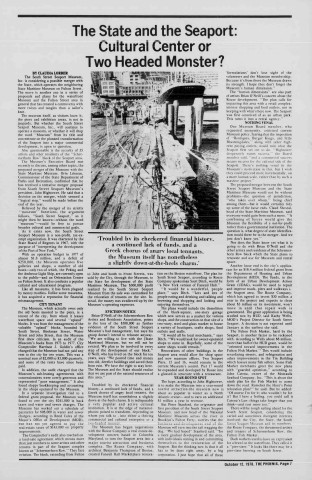
The State and the Seaport:Cultural Center orTwo Headed Monster?BY CLAUDIA LORBERThe South Street Seaport Museum,Inc. is considering a possible merger withthe State, which operates the neighboring State Maritime Museum on Fulton Street. The move is another one in a series of proposals and plans for the waterfront Museum and the Fulton Street area in general that has created a controversy with more twists and tangles than a sailor%u2019s knot.The museum itself, as visitors know it, the piers and exhibition areas, is not in jeopardy. But whether the South Street Seaport Museum, Inc., will continue to operate a museum, or whether it will drop the word %u201c Museum%u201d from its title and concentrate on the planned transformation of the Seaport into a major commercial development, is open to question.Also questionable is the security of 35 artists and other residents of the %u201c Schermerhorn Row%u201d block of the Seaport area.The Museum's Executive Board met recently to discuss, among other topics, the proposed merger of the Museum with the State Maritime Museum. Orm Lehman, Commissioner of the State Department of Parks and Recreation, confirmed that he has received a tentative merger proposal from South Street Seaport Museum%u2019s president, John Hightower. He said that a decision on the merger, which seemed a %u201c logical step,%u201d would be made before the end of the year.Relieved by the merger of its strictly %u201c museum \follows, %u201c South Street Seaport,%u201d as it might then be known%u2014without the word %u201c museum%u201d%u2014would be free to pursue broader cultural and commercial goals.As it exists now, the South Street Seaport Museum is a non-profit, tax-exempt organization. It was chartered by the State Board of Regents in 1967, with the purpose of %u201cinterpreting the development of the Port of New York.%u201dWith an operation budget in 1977 of almost $1.8 million, and a deficit of $250,000, the Museum operates five galleries and shops, a number of old boats%u2014only two of which, the Peking and the Ambrose Light Ship, are currently open to the public%u2014-and an Orientation Center on Fulton Street. It also conducts a popular cultural and educational program.Like all museums, it has been plagued by money troubles. Unlike some museums, it has acquired a reputation for financial mismanagement.CITY TENANTThe Museum, which actually owns only the old boats moored to the piers, is a tenant of the city, from whom it leases waterfront space and several %u201c upland%u201d blocks. It was from the management of the valuable %u201c upland%u201d blocks, bounded by South Street, Beekman Street, Water Street and John Street, that the Museum first drew criticism. In an audit of the Museum%u2019s books from 1973 to 1977, City Comptroller Harrison J. Goldin%u2019s office charged that the Museum had not paid any rent to the city for two years. This was a nominal sum of $2,000 to $3,000 quarterly, and some of the rents have since been paid.In addition, the audit charged that the Museum%u2019s sub-leasing agreements with concessionaires were overly-generous and represented %u201cpoor management.%u201d It also found sloppy bookkeeping and accounting in the shops operated by the Museum.In a separate investigation tied to a federal grant proposal, the Museum was found to owe the city $241,000 in back taxes and water and sewer charges. The Museum has worked out a schedule of payments for $98,000 in water and sewer charges, according to Reed Coles of the Mayor%u2019s Office of Development (MOD), out nas not yet agreed to pay the real-estate taxes of $143,000 on property improvements.The Comptroller%u2019s audit also touched on a land-sale agreement which means more than just numbers to some artists and other tenants in part of the Seaport complex known as %u201c Schermerhorn Row.%u201d They face eviction. The block, extending from Fulton%u2018Troubled bv its checkered financial history,a continued lack of funds, and aGreek chorus of angry local tennants,the Museum itself has nonethelessa slightly down-at-the-heels charm.%u2019to John and South to Front Streets, was sold by the City, through the Museum, to the State for development of the State Maritime Museum. The $300,000 profit realized by the South Street Seaport Museum from the sale was earmarked for the relocation of tenants on the site. Instead, the money was swallowed up by the Museum%u2019s operating expenses.EVICTION NOTICEBrian O%u2019Neill, of the Schermerhorn Row Artists and Residents Association, points to the loss of the $300,000 as further evidence of the South Street Seaport Museum%u2019s bad management, but says his group doesn%u2019t intend to relocate anyway. %u201c We are willing to live with the [State Maritime] Museum, but we will not be evicted. We plan to be involved in every step of the development of our block.%u201d O%u2019Neill, who has lived on the block for ten years, says %u201c We poured time and money into old, derelict buildings and saved them from ruin. We have the right to stay here. The Museum and the State should realize that we are part of the natural resources of this area.%u201dTroubled by its checkered financial history, a continued lack of funds, and a Greek chorus of angry local tenants, the Museum itself has nonetheless a slightly down-at-the-heels charm. It is indisputably a very popular and active cultural institution. It is at the edge of metamorphosis: poised to transform, depending on whom you talk to , into either a thriving commercial and cultural enterprise or ai - . . - l - ~ %u201e J ___ 1 ___ _____i v > u - u c u u c u m o u a i c i .The Museum has begun negotiations with the Rouse Company a real estate-development concern based in Columbia Maryland, to turn the Seaport area into a major tourist attraction and business complex. The Rouse Company, with architect Benjamin Thompson of Boston, created Faneuil Hall Marketplace restoration on the Boston waterfront. The plan tor South Street Seaport, according to Rouse Company spokesman Scott Ditch, would be %u201c a New York version of Faneuil Hall.%u201d%u201c It would be a wonderful, people place,%u201d says Ditch. %u201c Lots and lots of people eating and drinking and talking and browsing and shopping and looking and enjoying themselves.\The plans would include the demolition of the block-square, one-story garage which now serves as a market for various shops, and the construction on that site of a two-story, steel-and-glass market to house a variety of boutiques, crafts shops, food outlets and stalls.%u201c It would all be local merchants,%u201d says Ditch. %u201c We would look for owner-operated shops to come in. Hopefully, some of the same shops would remain.%u201dRenovations of other buildings in the Seaport area would allow for shop space and new museum offices. Two Seaport Piers, 15 and 16, would remain in the current Museum%u2019s control. Pier 17 would be expanded and developed by Rouse into a glassed-in structure with a restaurant.YEAR-ROUND SPOTThe hope, according to John Hightower, is to make the Museum into a year-round tourist attraction-the museum now is about as popular in winter as a North Atlantic cruise%u2014 and to earn an additional $1 million a year in revenue.But Peter Stanford, the originator and first president of the South Street Seaport Museum, and now head of the National Maritime Museum across the river in Brooklyn%u2019s Fulton Ferry, worries that the * - - - - %u2022 j -* %u00ab -----* %u2014 j - c *.l ~ U U 5 U U , 3 3 - f l U U - U t V U U | n i U . l U U I u i vMuseum will turn into the tail wagging the dog. %u201c We had hoped\a more gradual development of the area, with individuals coming in and committing themselves to the restoration of the Seaport. But the thinking now is that it all has to be done right away, by a big corporation. I just hope that all of these%u2018formulations' don%u2019t lose sight of the volunteers and the Museum membership. Because it's from there the Museum draws its strength. I hope they don%u2019t forget the Museum's human dimension.%u201dThe %u201c human dimensions%u201d are also part of artists Brian O%u2019Neill's concern about the Rouse development. %u201cThe plan calls for impacting this area with a retail complex: intense shopping and food outlets, not in keeping with what's here now. The Seaport was first conceived of as an urban park. This turns it into a rental agency.%u201d NOTHING VENALOne Museum Board member, who requested anonymity, criticized current Museum policy, fearing that the imposition of \Bloomingdales,%u201d along with other highrent paying outlets, would ruin what the Seaport first set out to do. %u201c Hightower desperately wants success,%u201d the Board member said, %u201c and a commercial success means success for the cultural side of the Seaport. There's nothing venal in the Museum%u2019s motivation in this, but 1 wishthey could proceed more incrementally, ona more human scale, rather than bv such amassive project.\The proposed merger between the South Street Seaport Museum and the State Maritime Museum would not be without problems%u2014the question of jurisdiction, %u201cwho takes over whom,%u201d being chief among them%u2014but it wmuld certainly tidy up some of the loose ends. Claud Shostal, head of the State Maritime Museum, said everyone would gain from such a move. %u201c A combining of forces would give the Museum the flexibility of a not-for-profit rather than a governmental institution. The question is, what degree of state identification would there be in the merger. And we just don%u2019t know yet.\Nor does the State know yet what it is going to do with Brian O%u2019Neill and the other artists and residents of the Schermerhorn Row block which the State plans to renovate and use for Museum and rental space.Another loose end is the city%u2019s application for an $18.4 million federal grant from the Department of Housing and Urban Development (HUD). The funds, in the form of an Urban Development Action Grant (UDAG), would be used to repair and improve roads, piers and walkways L the Seaport area. The Rouse Company, which has agreed to invest $30 million a year in the project and expects to clear about $3 million on its investment, won't move in until that repair work is guaranteed. The grant application is being studied now by HUD, said Kathy Wells, MOD%u2019S Project Director for South Street Seaport. A decision is not expected until January at the earliest she said.The Fulton Fish Market, hard by the Seaport, is another factor to be reckoned with. According to Wells about $8 million, more than half of the HUD grant, would be \Fulton Fish Market.%u201d This would include resurfacing streets, and refrigeration and other improvements in the Tin Building which houses many fish sellers. Some Fish Market merchants greet the new plans with %u201c guarded optimism,\John Catena, owner of the Montaulk Seafood Company, Inc. \ninth plan for the Fish Market to come down the road. Remeber the Hunt's Point relocation plan?%u201d he said. But he added: %u201c Of course I'm for it; who wouldn%u2019t be for it? But 1 have a feeling, you could call it Catena's La things take longer than you think%u2014and cost more too.%u201dThere will be rough sailing ahead tor the South Street Seaport, considering the varied and sometimes divergent interests involved: the City, the State, the Southk ^ n r m i m o m i4 t * r n m t v t k / S f tthe Rouse Company, the threatened artists and tenants of Schermerhorn Row, the Fulton Fish Market.Dock workers used to have an expression for a brawl on the waterfront. They called it a %u201c pier-sixer.%u201d It looks like there may be a pier-sixer brewing on South Street.October 12,1978, THE PHOENIX, Page (


