


Page 486 - Demo
P. 486
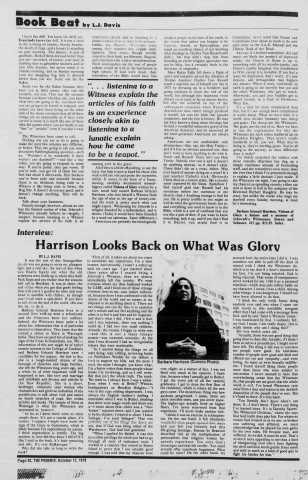
Book Beat by L.j. DavisI know the drill. You know the drill, too. Everybody knows the drill. It is ten o%u2019clock in the morning on Sunday, bloody Sunday, the doorbell rings, and a looney is standing on your doorstep. Two loonies. A pair of goofballs. Both of them dressed better than you are%u2014provided, of course, your taste in clothing runs to gabardine trousers and/or nice little dresses, but never mind; it is Sunday morning, and on Sunday morning even the shopping bag lady is dressed better than you are. Score one for the flakes.Score two for the flakes because they have you at their mercy: they run the scenario, not you. They run the scenario because you know who they are, you know what they are going to do, you know how you are going to be forced to respond, and unless you have been living on the other side of the moon you know that all of these things are as immutable as if they were carved in stone; it is much like one of those idiot kid games where you are made to say %u201c fart%u201d or %u201c asshole%u201d even if you don%u2019t want to.The Witnesses have come to call.Nothing you can say or do is going to make the next few minutes any different, or better. They are going to ask you some absolutely flabberghasting question%u2014such as, %u2018%u2018Wouldn%u2019t it be wonderful if there weren%u2019t any dandruff?%u201d%u2014and like a tiny robot, you are going to respond in some way. If you%u2019re polite, they get worse. If you%u2019re rude, you get rid of them but you feel bad about it afterwards, first because you%u2019ve been rude and secondly because there is no dividend; being rude to a Witness is like being rude to Sirius, the Dog Star. It doesn%u2019t do you any good, and it doesn%u2019t change anything. They will be back.Talk about your bummers.Funnily enough, however, almost no one has the faintest notion of what Jehovah%u2019s Witnesses actually believe in%u2014largely, I stispect, because listening to a Witness explain the articles of his faith is anexperience closely akin to listening to a lunatic explain how In came to be a teapot. Unlike, say, Baptists Witnesses count among their number few supple intelligences. T heir tracts, though wierdly central to their faith, are illiterate, illogical, and crammed with witless misinformation. Their emmissaries are the sort of people nobody would sit with in the lunchroom in high school. If God were dead, their translation of the Bible would have him. . listening to aWitness explain thearticles of his faithis an experiencecloselv akin tolistening to alunatic explainhow he cameto be a teapot. %u201dturning over in his grave.All of this is a little off-putting, to say the least, but help is now at hand for those who wish to lift the veil and probe the mysteries within. It comes in the form of a funny, moving, carefully documented memoirhistory called Visions of Glory written by a nice, smart lady named Barbara Grizzuti Harrison, who was herself a Witness from the age of nine to the age of twenty-one, and the truth is pretty much what you might expect. Witnessing for Jehovah is a religion founded by a haberdasher, and it shows. (Today it would have been founded by a used-car salesman. Same difference.)Americans are probably the theologicallyweakest people on the face of the earth, to lhe extent that unless you happen to be Catholic, Jewish, or Episcopalian, you stand an excellent chance of not knowing what theology is. Charles Taze Russell sure didn%u2019t, but that didn%u2019t stop him from founding an entire religion; ignorance may not be bliss, but it certainly leads in the direction of originality.Mary Baker Eddy fell down a flight of stairs and instantly solved the dilemma of Thomas Aquinas; Charles Taze Russell made a supreme ass of himself one day in 1873 by dressing up in a bedsheet and going outdoors to await the end of the world, but although this important event did not occur (and, so far as anyone knows, has also not occurred on any of the subsequent occasions when Russell%u2019s descendants have rather smugly prediced it would), his was the faith that ignores mountains, and the rest is history. He may not have known a thing about theology but he had a wonderful instinctive grasp of the American character, and he answered all the hard questions Americans are always asking.Americans are not comfortable with abstractions%u2014like, say, the Holy Trinity%u2014 and if it has no obvious practical use, they don't want to have anything to do with it. Swell, said Russell. There isn%u2019t any Holy Trinity. Nobody ever saw it and it doesn%u2019t do anything anyway, so it doesn%u2019t exist. Christ didn't die on a cross, either. Who ever heard of anyone dying on a cross? It's just another Catholic trick. Obviously Christ died on a torture stake, like a cavalry scout captured by the Sious. (Somehow 1 find myself glad that Russell had his revelation before the invention ot the electric chair.) Anything strange is bad for you, life is pretty terrible so you might as well do what the government wants you to, and everything you need to know is in the Bible, which is a sort of cookbook that you use like a pair of dice; if you want to know something, look it up, and if you don%u2019t find it in Daniel, you might find it inCorinthians, never mind that Daniel and Corinthians have about as much to do with each other as the S.A.E. Manual and the Tibetan Book of the Dead.Anyway, it's in there someplace. Art and music are likely the product of depraved minds, the Church of Rome is up to something with all its mumbo-jumbo, and Christ%u2019s earthly kingdom was established in 1914, except it is invisible. If you feel a teeny bit depressed, don%u2019t worry, it%u2019s just demons, and Armageddon may happen any minute. When it does, everybody on earth is going to die horribly but you and the other Witnesses, who get to watch. Afterwards, you and your buddies get to spend eternity in a kind of Devittown. What fun.It's a little bit more complicated than that, but it%u2019s not enough more complicated to worry about. What we have here is a world view divides humanity into sheep and goats. The sheep are the Witnesses. The goats are the rest of us. Here we have at last the explanation for why the Witnesses are such rotten landlords up on Brooklyn Heights. They aren%u2019t really landlords at all, you see. What they%u2019re doing is, they%u2019re herding goats. You%u2019re all going to die anyway, so what difference does it make?I%u2019ve barely scratched the surface with these remarks (Harrison has dug up a simply enormous amount of fascinating stuff, and she remembers even more; does she ever) but I think I%u2019ve presented enough to explain a little decision I just made. If the Witnesses are right, I am going to take my chances on spending eternity either out cold or down in hell in the company of the Reverend Herbert Daughtry. He may be crazy, but unlike the wacko who rings my doorbell every Sunday morning, at least he%u2019s interesting.Barbara Grizzuti Harrison. Visions ofGlory: a history and a memory ofJehovah%u2019s Witnesses. Simon andSchuster. 413 pp, $12.95. Index.IntervieHarrison Looks Back on What Was GloryBY L.J. DAVISIt was the sort of day Armageddon clearly was not going to occur on, plangent light and a real sky, the sort of day when you finally figure out what the old architects were really up to when they built Park Slope and you realize that the seasons still call in Brooklyn. It was,in short, the sort of day when you get that goofy feeling that tells you it%u2019s good to be alive and your head is atumble with cliches, as though your head were a spin-drier. If you have to talk about the end of the world, this was the da to do it.Barbara Grizzuti Harrison lives in a second Boor walk-up near a schoolyard, and the Witnesses know her address. Indeed, the Witnesses know quite a lot about her, information that is of particular interest to themselves. They know that she visited a shrine to Shiva in Warengal, India. They have accused her of making the sign of the Cross in Guatemala, too. Wh :e information of this sort might be of rather remote interest to the College of Cardinals and Barbara Grizzuti Harrison were a candidate for the papacy, the fact is that she is a tough-minded citizen of the borough of churches and large families, she left the Witnesses long years ago, and a whole lot of other important stuff has happened to her, like love and marriage and childbirth and divorce and articles in the New Republic. She is a short, forthright, eminently sane woman who chainsmokes and gives no indication of any predeliction to talk about God and razors on lonely stretches of road. She writes articles and books. The temple of Shiva at Warengal is what the Witnesses are interested in, however.%u2018%u2018As far as I knew there were no other people there. It's not a tourist place, it%u2019s remote. I suppose I might have made fhe sign of the Cross in Guatemala, which is likely because I%u2019m superstitious by nature. I think superstition is terrific. The big mystery is, how did they know I did it? It%u2019s like I said in the book, it%u2019s both menacing and silly. It%u2019s very Kafkaesque.%u201dWhy did she take so long to write the book?D.%u00ab<> 70 TUC Dlincmv%u2018%u2018First of all, it takes me about ten years to assimilate any experience; I%u2019m a slow learner. And secondly, I wasn%u2019t a writer up until six years ago. 1 got married about three years after I ceased being a Jehovah%u2019s W itness, then we almost immediately left the country. We went overseas where my then husband worked for CARE, and I lived one of those strange overseas lives-in my case rather unfocused, because there I was confronted with the misery of the world and no means at my disposal to do anything about it. There are two things one can do. One is to cauterize one's senses and not feel anything and the other is to feel it and hurt and be impotent, and that%u2019s what I did. I felt it and it hurt and 1 was impotent, there was nothing I could do. I had two very small children. Actually, the reason I began to write was %u2014and this is not a fancy literary reason%u2014was economic necessity. At the time I was divorced I had no recognizable talents that were marketable.%u2018%u2018So I started doing the things we all start doing: copy editing, reviewing books for Publishers Weekly for ten dollars a bo< k to support my kids, and the more I read, the more I thought, you know what, I%u2019m a better writer than these people whose books I%u2019m reviewing..and so I will write. But that isn%u2019t the whole truth. The truth. The truth is, I always knew I was a writer. Even when I was at BetheP%u2019-Witness headquarters on Brooklyn Heights%u2014%u2018%u2018I was in the copy editing department. I was always the English teacher%u2019s darling. I remember when I was in Bethel, thinking that there were magic words and there was a%u20141 wrote about this%u2014there was a %u201c New Yorker%u201d reporter there, and I just wanted to be his shadow, I wanted to shout %u20181 know Salinger, I%u2019ve read Salinger!%u2019 That wasn r n h n h lv n tip o f tVui tfiin n o fk n t m nout, that if God was being editor of the Watchtower, God had bad grammar.%u201c When I applied for Bethel, it was this incredible privilege for which you had to go through all sorts of endurance tests. I worked in a cannery they owned in Staten Island to prove that I was actually good enough. I was told that my chances wereBarbara Harrison (Cuiccio Photo)very slight; as a matter of fact, I was not liked very much at the cannery. I knew that, because when I actually got to Bethel, I got the worst job of all the cannery graduates. I got to clean the first floor of the residence, which is where all the new guys came. The mysterious thing was how anybody progressed. I mean, there are tnese invisible tests, and you never know. The higher-ups actually lived on higher floors. I%u2019ve never recovered from that experience. I%u2019ll never make another bed.%u201c I think it was an exercise in schizophrenia. On the one hand, it felt absolutely1* A /V%u00bb(F| 1 1 iv r l o s * * * M A A . I n %u00ab 1 A 1 ! _ 1\%u201c V I I j / v u p i v u p v u v u U I C I I U U O i band you felt you literally had this life-giving message. Simone de Beauvoir described this as the multiplication of personalities that religious women frequently experience. You were God%u2019s messenger and that felt terrific. You could actually offer somebody happiness. What could be nicer? On the otner hand, mystomach hurt the entire time 1 did it. I was somehow not able to pull off the kind of mental trick I think the Witnesses do, which is to say that if a door%u2019s slammed in my face, I%u2019m not being rejected, God is being rejected. That sense of omnipotence never worked for me. I felt it as a personal rejection%u2014which may only reflect badly on my character. I mean, I was a child. Among other things, it was dangerous. I should not have been allowed to do that.%u201c 1 think the only really funny thing anybody ever said was when 1 came out with words to this incredible arrogant effect that I had come with a message from God, and he said %u2018Send it Western Union.%u2019 I was humiliated by that. I suddenly felt, my God, I mean, I am really dopey, this is really dumb, why am I doing this?%u201dShe was twelve years old.%u201c Actually, there was one good thing that going door-to-door did. Actually, if I hadn%u2019t been so active a proselytizer, I might never have left. The thing it did was to convince me people were good. An enormous number of people were good and kind and offered me tea and sympathy...and were loving. As many as were brutally indifferent. I found myself liking those people more than those who were subject to conversion. I never seemed to have that overwhelming sense that the Witnesses do, that people are not good, that the whole world is evil. I%u2019ve heard Witnesses turn away from a door and rejoice in the devilish disposition of the people they%u2019ve met. But it%u2019s hard to leave. It%u2019s very hard.%u201c You literally don%u2019t know what%u2019s out there. It...I don%u2019t know. There%u2019s one thing I%u2019ve learned since. It%u2019s in Dorothy Sayers%u2019 The Whimsical Christian,%u2019 where she says that God really does play fair. For whatever reason God created us as we are, so broken and suffering and afflicted, we must acknowledge that he played his own game by his own rules. He became man, and suffered. As we did. It must be true. That%u2019s so much more appealing to me than a kind of bludgeoning God who%u2019s busy fighting the devil and then sends gentle Jesus meek and mild to earth as a kind of good guy to fight his battles for him,%u201d


