


Page 507 - Demo
P. 507
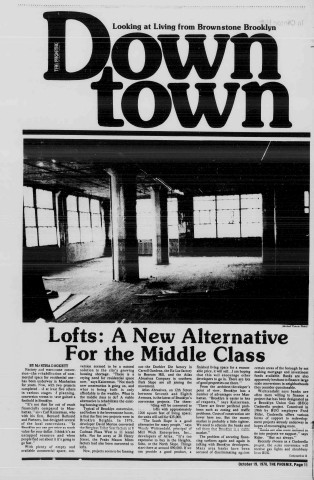
F o r t h e M i d d l e C l a s sBYMARTHABOGGETTFactory and warenouse conversion--the rehabilitation of commercial space for residential use-- has been underway in Manhattan for years. Now, with two projects completed . id at least five others in various stages f planning, conversion seems to lave gained a foothold in Brooklyn.%u201c It%u2019s not that far out of reach financially compared to M anhattan,%u2019%u2019 sa^s Carl Kaizerman, who with his firm, Bernard Rothzeid and Partners, has designed several of the local conversions. %u201c InRrnnklvn vmi pan apt twiop as miirhvalue for your dollar. I think it%u2019s an untapped resource and when people find out about it it%u2019s going to go fast.%u201dWith plenty of empty and available commercial space, conversion seemed to be a natural solution to the city%u2019s growing housing shortage. %u201cThere is a crying need for residential space now,%u201d says Kaizerman. %u201c Not much new construction is going on, and what is being built is only affordable to the wealthy. What is the middle class to do? A viable alternative is rehabilitate the existing housing stock.%u201dTypical of Brooklyn conversion, and before it the brownstone boom, is that the first two projects were in Brooklyn Heights. In 1976, developer David Morton convertedtViP R p r a la c %u00ab T n ilp f Q p af fa M n w ; o f ftCadman Plaza West to 11 rental lofts. Not far away at 20 Henry Street, the Peaks Mason Mints factory had also been converted tolofts.Now, projects seem to be fanningout-the Doehler Die factory in Carroll Gardens, the Ex-Lax factory in Boerum Hill, and the Atlas Abrasives Company in southern Park Slope are all joining the movement.Atlas Abrasives, on 12th Street between Seventh and Eighth Avenues, is the latest of Brooklyn%u2019s conversion projects. The three- !lding will be converted to - %u25a0%u25a0 | lofts with approximately1200 square feet of living space; the units will sell for 535,000.%u201c The South Slope is a good alternative for many people,%u201d saysW r> nrltr W tp K fp tir lo k l n r ! n r>i n o l /-%u00bb%u00a3 w *------------- r**---1%u2014Mill Wich Enterprises, Inc., developers of Atlas. %u201c It%u2019s too expensive to buy in the Heights, Soho, or the North Slope. Things start there at around $90,000. If we can provide a good product, afinished living space for a reasonable price, it will sell...I am hoping that this will encourage other developers to go in. There are lots of good properties out there.%u201dFrom the architect/developer%u2019s point of view, Brooklyn has a number of advantages over Manhattan. %u201c Brooklyn is easier in lots of respects,%u201d says Kaizerman. %u201c There are fewer periferal problems such as zoning and traffic problems. Costs of construction are lower here too. But the money market is probably a little tighter. We need to educate the banks and*%u00ab.11 ----4 - U __ 1,1__ iV%u201c ig^ w t ittt/lvmarket.%u201dThe problem of securing financing surfaces again and again in talking with Brooklyn developers. Many area banks have been accused of discriminating againstcertain areas of the borough by not making mortgage and investment funds available. Banks are also apparently hesitant to finance large scale conversions in neighborhoods they consider questionable.W ichtendahl says banks are often more willing to finance a project that has been designated as a Brooklyn Union Gas (BUG) Cinderella project. Conceived in 1966 by BUG employee Fred Rider, Cinderella offers various forms of support to redevelopment projects already underway in hopes of encouraging more.u a im a a i c a ia u m u i c t u v i u i e u iutie into projects we support,%u201d says Rider. %u201c But not always.%u201d Recently chosen as a Cinderellaproject, the arias conversion will receive gas lights and shrubbery from BUG.Continued on 13IliIOctober 19,1978, THE PHOENIX, Page 11


