


Page 509 - Demo
P. 509
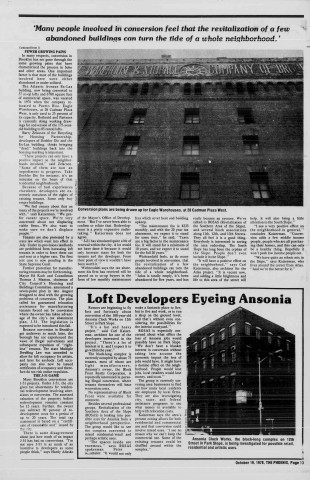
%u2018Manv people involved in conversion feel that the revitalization o f a fewabandoned buildings can turn the tide of a whole neighborhood. %u2019Continued from 11FEWER GROWING PAINSIn many respects, conversion in Brooklyn has not gone through the same growing pains that have characterized the process in Soho and other areas. One important factor is that most of the buildings involved here were either abandoned or under utilized.The Atlantic Avenue Ex-Lax building, now being converted to 57 co-op lofts and 6700 square feet of commercial space, was vacated in 1976 when the company relocated to Puerto Rico. Eagle Warehouses, at 28 Cadman Plaza West, is only used to 25 percent of its capacity. Rothzeid and Partners is currently doing working drawings for conversion of the 175-yearold building to 85 rental lofts.Barry Zelacsen of the Recycling for Housing Partnership, developers of Doehler Die and the Ex-Lax building, thinks bringing %u201c dead%u201d buildings back into the housing marking is important.%u201c These projects can only have a positive impact on the neighborhoods involved,%u201d said Zelacsen. %u201c Some of them are now an impediment to progress. Take Doehler Die for instance, it%u2019s an intrusion on the heart of that residential neighborhoods.%u201dBecause of bad experiences elsewhere, developers are extremely conscious of the rights of existing tenants. Some only buy empty buildings.\many of the projects we%u2019re involved with,%u201d said Kaizerman. %u201c We prefer vacant space. W e%u2019re very concerned about not displacing viable firms...We also want to make sure we don%u2019t displace people.%u201dTenants are also protected by a state law which went into effect in July. Under its provisions landlords are prohibited form harassing loft tenants in order to force them out and rent at a higher rate. The first test case is now pending in the State Supreme Court.Further protection for manufacturing tenants may be forthcoming. Mayor Ed Koch and Councilman Thomas J. Manton, chairman of City Council%u2019s Housing and Buildings Committee, announced a seven-point plan in late August designed to deal with the growing problems of conversion. The plan called for guaranteed relocation assistance for m anufacturing tenants forced out by conversion where the owner has taken advantage of the city%u2019s tax abatement plan, J-51. The legislation is expected to be introduced this fall.Because conversion in Brooklyn got underway so much later, the borough has not experienced the wave of illegal conversions and subsequent expulsion of %u201c rightless%u201d tenants. The state Multiple Dwelling Law was amended to allow for loft occupancy for artists, and later for anybody. Loft occupants can also now be issued certificates of occupancy and therefore do not risk undue expulsion.THE J-51 GAMEMany Brooklyn conversions are J-51 projects. Under J-51, the city gives tax abatements for residential redevelopment involving alterations or conversion. The assessed valuation of the property before redevelopment remains constant for 12 years. Further, the owner can subtract 90 percent of redevelopment costs for a period of up to 20 years. The total tax abatement is based on a %u201c certificate of reasonable cost%u201d issued byf lip o if vThere is some disagreem ent about just how much of an impact J-51 has had on conversions. %u201c I%u2019m not sure J-51 is as much of an incentive to developers as some people think,%u201d says Hardy AdaskoConversion plans are being drawn up for Eagle Warehouses, at 28 Cadman Plaza West.of the Mayor%u2019s Office of Development. %u201c But I%u2019ve never been able to confirm or refute that. Redevelopment is a pretty expensive undertak in g .%u2019%u2019 Kaizerman does not agree.%u201c Jj51 has simulated quite a bit of renewal within the city. A lot would not have dene it because it would only increase taxes for both the tenants and the developer. From their point of view it wouldn%u2019t have been worth it.%u201dWichtendahl says the tax abatement his firm has received will be passed on to co-op buyers in the form of low monthly maintenancefees which cover heat and building upkeep.%u201c The maintenance fee is $235 monthly, and with the 20 year tax abatement, we expect it to stand for some time,%u201d he said. %u201c Taxes are a big factor in the maintenance fee. It will stand for a minimum of 10 years, and we expect it to stand for the full 20 years.%u201dWichtendahl feels, as do many people involved in conversion, that the revitalization of a few abandoned buildings can turn the tide of a whole neighborhood. %u201c Atlas is totally emply, it%u2019s been abandoned for five years, and hasreally become an eyesore. We%u2019ve talked to ROSAS (Revitalization of the Southern Area of the Slope), and several block associations along 11th, 12th, and 13th Streets. They all feel it is a good thing. Everybody is interested in seeing the area redevelop. The South Slope has long been the orphan of the Slope. People don%u2019t even include it in the Slope.%u201d%u201c It will have a positive effect on the neighborhood,%u201d says Carl Kaizerman, also architect for the Atlas project. %u201c It is vacant now, and adding a little brightness and life to this area of the street willhelp. It will also bring a little attention to the South Slope.%u201d%u201c I see a very positive effect on the neighborhood in g en eral,%u201d concludes Kaizerman. %u201c Conversion adds a few middle income people, people who are all purchasing their homes, and this can only be a healthy thing. Hopefully it won%u2019t push low income people out.%u201c We have quite an ethnic mix in the Slope,%u201d says Kaizerman, who lives around the corner from Atlas. %u201c And we%u2019re the better for it.%u201dLoft Developers Eyeing AnsoniaRumors are beginning to fly fast and furiously about conversion of the 100-year-old Ansonia Clock Works on 12th Street in Park Slope.%u201c It%u2019s a hot and heavy project,%u201d said Carl Kaizerman, architect for one of the developers interested in the project. %u201c T here%u2019s a lot of interest in it, and I expect it to go within the year.%u201dThe block-long complex is currently occupied by about 75 tenants, most of whom are light manufacturers. Ansonia%u2019s owner, the Block Front Realty Corporation, is reportedly interested in pursuing illegal conversion, where tenants themselves will bear renovation costs.No representatives of Block Front were available for comment.Besides several professional groups, Revitalization of the Southern Area of the Slope (ROSAS) is looking into possible uses for Ansonia from a neighborhood perspective. The group would like to see the complex converted to mixed residential/retail and perhaps artistic uses.%u201c The spaces inside are enorm ous,%u201d says ROSAS spokesman Peter Altschuler. %u201c It would not onlymake a fantastic place to live, but to live and work, or to run a shop on the ground level, and that%u2019s without even considering the possibilities for the interior courtyard.%u201d ROSAS is especially concerned about what effect the loss of Ansonia jobs would possibly have on Park Slope. %u201c We don%u2019t have a blanket interest in conversion without taking into account the economic impact the loss of jobs would have. It might have a domino effect on the neighborhood. People would lose jobs, local retailers would lose money, and so on.%u201dThe group is currently surveying area businesses to find out how many local residents are employed by local firms. They are also investigating city, state, and federal assistance programs to see what money is available to help with relocation costs.Kaizerman says the area%u2019s present zoning allows for both residential and commercial use and that conversion could involve mixed uses. %u201c 1 see reason why we can%u2019t keep the commercial use. Some of the existing tenants could be shuffled around within the complex.%u201dAnsonia Clock Works, the block-long complex on 12thStreet in Park Slope, is being investigated for possible retail,residential and artistic uses.October 19,1978, THE PHOENIX. Page 13


