


Page 560 - Demo
P. 560
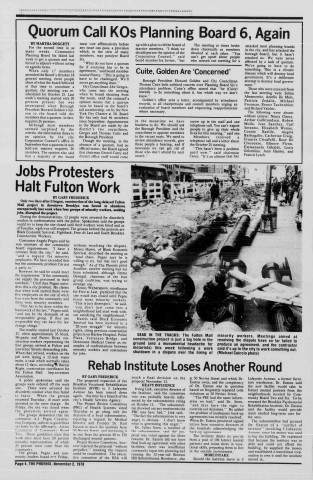
%u00bb'**.** %u00bbQuorum Call KOs Planning Board 6, AgainBY MARTHA DOGGETTFor the second time in as many weeks, Community Planning Board Six failed last week to get a quorum and was forced to adjourn without acting on agenda items.When only 17 members attended the Board%u2019s October 18 general meeting, three people short of what the board believed at that time to constitute a quorum, the meeting was rescheduled for October 25. Last week%u2019s meeting started with 20 persons present but was interrupted when Borough President Howard Golden%u2019s liaison to the board told the members that a quorum, in fact, requires 26 persons.Although most members seemed surprised by the criteria, the information dates to an opinion by the city Corporation Counsel%u2019s office in September that a quorum in non land-use matters requires 26 members. The opinion also said that a majority of the boardmust vote affirmatively before any issue can pass, a provision which, in the view of many members, may paralyze Board Six.%u201c What do you have a quorum for if everyone has to be in agreement, %u201c said board member Louise Finney. %u201c This is going to have to be challenged. We%u2019ll never get anything done.%u201dCity Councilman Abe Gerges, who came into the meeting when he heard shouting from the room, said the counsel%u2019s opinion means that a quorum must be based on the board%u2019s full membership, set by the New York City Charter at 50. Board Six has only had 46 members since September. Appointments to the Board are made by the district%u2019s two councilmen, Gerges and Thomas Cuite and the Borough President.Though the meeting, in the absence of a quorum, had no official status, the Board agreed that chairman Gerard Carey and district office staff would comeup with a plan to rid the board of inactive members. %u201cI think we should pursue the opinion of the Corporation Counsel,%u2019%u2019 said board member Ira Levine, %u201cbutin the meantime we have business to do. We should ask the Borough President and the councilmen to appoint members to the vacant seats. We need to review attendence records, give these people a hearing, and if necessary we can get rid of those who don%u2019t attend by next month.%u201dThe meeting at times broke down chaotically as members shouted at each other. %u201cYou can%u2019t get upset about people who missed one meeting for ascrew up in the mail and one telephone call. You can%u2019t expect people to give up their whole lives for this meeting,%u201d said ohe.Members received a telephone call and a letter about the October 25 meeting.%u201c This hasn%u2019t been a problem until now,%u2019%u2019 said chairman Carey. %u201c It%u2019s an ailment that hasattacked most planning boards in the city, and has attacked the borough -board, but it hasn%u2019t attacked us. We were never affected by a lack of quorum. We%u2019re going to have to do something. This is a chronic disease which will destroy local government. It%u2019s a deliberate attempt to destroy local government.%u201dThose who were excused from the last meeting were Selma Abramowitz, Aniello De Maio, Patricia Zedalis, Michael Freeman, Renee Taubenblatt and Richard Valchic.The following were absent without excuse: Nancy Clancy, Arthur Gulbrandsen, Robert Mollo, Jose Sanchez, Carl Soranno, Elizabeth Wynne, Connie Barille, Angela Barbagallo, Catherine Craig, Frances Crisafulli, Rose De Crescenze, Elinore Flynn, Emmanuela Gibaldi, Louis Gelormino, Joan Hanley, and Francis Lynch.Cuite, Golden Are %u2018Concerned%u2019Borough President Howard Golden and City Councilman Thomas Cuite both exibited concern over Planning Board Six%u2019s attendance problem. Cuite%u2019s office stated that %u201che (Cuite) intends to do something about it, but which way we don%u2019t know.%u201dGolden%u2019s office sent a letter, accompanied by attendance records, to all chairpersons and council members urging an evaluation of board members and requesting reappointments where necessary.Page 4, THE PHOENIX, November 2,1978Jobs Protesters Halt Fulton WorkBY GARY FREDERICKOnly two days after it began, construction of the iong-deiayed Fulton Mail project in downtown Brooklyn was forced to shutdown unexpectedly last week when four groups of minority workers, seeking jobs, disrupted the project.During the demonstrations, 13 people were arrested for disorderly conduct in confrontations with the police. Spokesmen said the groups would try to keep the site closed until their workers were hired and as of Tuesday, work was still stopped. The groups behind the protests are Black Economic Survival, Fightback, Free At Last and South Brooklyn Construction Workers.Contractor Angelo Pegno said he was unaware of the community board requirements. %u201cI have a contract from the city,%u201d he said,%u201c and a request for minority employees. We have exceeded that but the community problem I%u2019m not a party to.%u201dHowever, he said he would meet the requirement %u201c if the community can supply the personnel in their numbers.\ders this a city problem. He claims that when work started there were five employees on the site of whch four were from the community and three were minority members.%u201cThis has to be done within the framework of the law,%u201d Pegno said,%u201cand not by the demands of an irresponsible group. If they are responsible they can have the lawchange things.%u201dThe trouble started last October 25. when approximately 35 black,Hispanic and Puerto Rican construction workers representing the four groups arrived at Fulton and Lawrence Streets demanding jobs.When they arrived, workers on the job were laying a 12-inch water main, a task which normally takes about 12 days, according^ Bernie Rogin, construction coordinator for the Fulton Mall Improvement Association.A police spokesman said the groups were ordered off the work site. Three were arrested for disorderly conduct when they failed to leave. When the groups returned Thursday, 10 more were arrested on the same charge. On Friday, the site was closed when the protestors arrived again.The groups demanded that the contractor, A.J. Pegno Construction Company, adhere to guidelines set forth by the Affirmative Action^ rnmmiinifu RrvarH .........*%u2022*%u25a0%u00bb **%u2014%u25a0** \Two. These guidelines state that work sites must have 50 percent minority representation, of which 25 percent must come from the community.The groups, Pegno, and community leaders board met Friday,without resolving the dispute. Moses Harris, of Black Economic Survival, described the meeting as %u201ctotal chaos. Pegno says he is willing to try, but that isn%u2019t good enough.%u201d As of The Phoenix press deadline, another meeting had not been scheduled, although Jimmy Denegal, chairman of the four group coalition, was trying to arrange one.Kenny Witherspoon, coordinator for Free at Last, predicted that the site wouid stay closed until Pegno hired more minority workers. %u201cThis is just disrespect,%u201d he said, %u201c you don%u2019t just come into a neighborhood and start work without satisfying the neighborhood.%u201dHarris said Black Economic Survival has been involved in a %u201c 20-year struggle%u201d for minority rights, citing previous construction projects on Harlem Hospital, Police Plaza, Verrazano Bridge, and Downstate Medical Center as examples of confrontations between minority workers and contractors for jobs.DEAD IN THE TRACKS: The Fulton Mallconstruction project is just a big hole in theground (and a monumental headache formotorists) this week following a workshutdown in a dispute over the hiring ofminority workers. Meetings aimed atresolving the dispute have so far failed toproduce an agreement, and the contractorsaid it%u2019s up to the city to work something out.(Michael Cuiccio photo)Rehab Institute Loses Another RoundBY GARY FREDERICKThe proposed expansion of the Brooklyn Vocational Rehabilitation Institute (BVRI) to 3 Lafayette Avenue has been turned down again, this time by a branch of the city%u2019s Health Services Agency.The Project Review Committee (PRC) of Health Systems voted Thursday to go along with the decision of a local subcommittee, rejecting a request by Medical Director and Founder Dr. Karl Easton to move the institute from5 0 N e v in s S t r e e t a n rt i n r r e a s in o itin size from the present 40 to 150 discharged mental patients.Project Review Committee, however rejected the proposal %u201cwithout prejudice,%u201d meaning the request could be resubmitted. The executive committee of the HSA willreach a final decision on the proposal November 13.HEAVY INFLUENCEIrving Link, executive director of the Institute, said the committee vote was probably heavily influenced by the subcommittee ruling on October 12. %u201cThe subcommittee drowned out any sentiments the PRC may have had,%u201d Link said. %u201c The fact the subcommittee is very angry is obvious. I don%u2019t know what is generating this anger.%u201dDr. Julius Stern, a member oft h p s u b c o m m it t e e s a id t h p n rr> -posal was voted against for three reason's: Dr. Easton did not have final back-up agreement with other facilities; there was insufficient community input into planning and running the 12-year-old Boerum Hill Rehabilitation Residence, alsoat 50 Nevins Street and which Dr. Easton owns; and the competency of Dr. Easton was in question based on frequently repeated code violations at 50 Nevins Street.%u201cThe PRC had the same information we had,%u201d said Dr. Stern, %u201c and they have the right to overrule our decisions.%u201d He added the problem of inadequate back-up agreements was recently resolved. When Dr. Easton presented signed letters from executive directors of the hospitals acknowledging theh a r k - n n a o r p p m p n tQ uThe institute draws its peo tie from a pool of 196 former mental patients and trains them in vocational skills, preparing them to live in the outside environment.MORE INTAKEShould the institute move to 3Lafayette Avenue, a former furniture warehouse, Dr. Easton said the new facility would take in former mental patients from the neighborhoods covered by Community Board Two and Six. To be renamed the Brooklyn Psychosocial Rehabilitation Institute, Dr. Easton said the facility would provide much needed long-term care for the area.The subcommittee had accused Dr. Easton of a %u201c conflict of interest\Avenue since his monev was used to buy the building. He explained that because the institute was in debt and could not afford the building, he supplied the money and established a transitional corporation to own it until the institute moved in.


