


Page 562 - Demo
P. 562
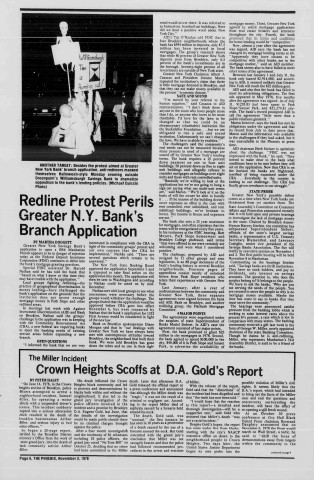
ANOTHER TARGET: Besides the protest aimed at GreaterNew York Bank%u2019 branch application, anti-redliners maskedthemselves Halloween-style Monday evening outsideGreenpoint%u2019s Williamsburg!? Savings Bank to dramatizeopposition to the bank%u2019s lending policies. (Michael CuiccioPhoto)Redline Protest Perils Greater N.Y. Bank%u2019s Branch ApplicationBY MARTHA DOGGETTGreater New York Savings Bank%u2019s application to open a fifth Manhattan branch appears to be in danger of rejection today as the Federal Deposit Insurance Corporation (FDIC) continues to delve into the bank%u2019s mortgage granting practices.Special FDIC assistant Dr. Harold Nathan said he has told the bank that %u201cbased on what I knew at this time they may have trouble with the application.%u201dLocal groups fighting redlining%u2014the practice of geographical discrimination in money lending%u2014have challenged the bank%u2019s application on the grounds that the institution does not invest enough mortgage money in Park Slope and other redlined areas.In meetings last week with Against Investment Discrimination (AID) and Bank on Brooklyn, Nathan said the groups%u2019 challenge to the application was in keeping with the Community Reinvestment Act (CRA), a new federal law requiring banks to meet the banking needs of existing service areas before expanding a new branch.OPEN QUESTIONS%u201c I informed the bank that we are veryinterested in compliance with the CRA in light of the community groups%u2019 protest and our own concern that the CRA be implemented,%u201d Nathkn said. %u201cThere are several questions which remain to be answered.%u201dThe New York State Banking Board approved the application September 5 and is expected to take final action on the application this month. The application will then be sent to Washington and according to Nathan could be acted on by midDecember.Nathan met with local groups to see what concessions were necessary before the groups would withdraw the challenge. The groups feared that the application would be approved before CRA goes into effect November 6, but were reassured by Nathan that the bank%u2019s application for 1332 First Avenue would be considered in light of the new law.Bank on Brooklyn spokesperson Diane Moogan said that in %u201cour dealings with Greater New York we have always been met with contemptuous attitudes toward Brooklyn, the neighborhood that built their bank. We were told Brooklyn has gone down the tubes and no one in their righfmind would invest there. It was referred to as burned out, bombed out buildings. Neer did we hear a positive word about New York City.%u201dAID%u2019s Tim Q%u2019Hanlan told FDIC tha* in four Brooklyn neighborhoods where the bank has $594 million in deposits, only $7.5 million has been invested in local mortgages. The group%u2019s research shows that while 80 percent of Greater New York deposits stem from Brooklyn, only 6.5 percent of the bank%u2019s investments are in the borough. Seventy-eight percent of all investments are outside of New York state.Greater New York Chairman Albert J. Casazza and President Jerome Maron repeated the institution%u2019s claim that thefe is little mortgage demand in Brooklyn, and that they can not make money available in the present %u201c economic climate.%u201dSAFE AND SOUND%u201c I%u2019m moved by your referral to the human equation,%u201d said Casazza to AID representatives. %u201c I don%u2019t think there is anyone in the room who loves people more than I do, or anyone who loves to be more charitable. I%u2019d love for the laws to be changed so that we could be an eleemosynary (charitable) institution like the Rockefeller Foundation . . .but we are obligated to run a safe and sound institution. Unfortunately we can%u2019t change the laws. We have to abide by realities. %u201dThe challengers said the community%u2019s real needs can not be measured because many persons in need of a mortgage are scared off by Greater New York%u2019s lending terms. The bank requires a 25 percent down payment on one to four unit buildings, 50 percent down on five to eight unit buildings and allegedly refuses to consider mortgages on buildings over eight units and those with rent controlled units.%u201c Basically we%u2019re willing to look at the applications but we%u2019re not going to hang a sign out saying what our multi-unit terms are,%u201d said Maron. %u201c We%u2019ll look at it on the basis of will the owner be able to handle it . . . If the income of the building doesn%u2019t cover expenses as often is the case with rent controlled, rent subsidized, and rent stabilized buildings, we%u2019re hesitant to invest. The income is frozen and expenses are not.%u201dThe bank also sets a 25 year maximum for mortgages, and often stipulates that the terms will be renegotiated every five years. In his testimony at the FDIC hearing, Bart Meyers, Park Slope homeowner and Brooklyn College professor, said terms %u201cthat were offered to me were certainly not welcoming and were what I considered punitive.%u201dThe challenge, prepared by AID and cosigned by 11 other groups and nine legislators, is an 88 page document of the bank%u2019s lending history in several Brooklyn neighborhoods. Fourteen pages of appendixes consist mostly of notorized letters from Park Slope residents who relate their experiences with Greater New York.Last January, after d, year of confrontations between the community and Greater New York, three separate agreements were signed between the bank and AID, Bank on Brooklyn, and another redlining group, the Flatbush Mortgage Committee.4 MAJOR POINTSThe agreements were negotiated under the auspices of state Superintendent of Banks Muriel Siebert. In AID%u2019s case the agreement consisted of four major points.First, the bank promised to grant $25 million in city mortgages in 1978. Second, the bank agreed to spend $100,000 in the city, $40,000 of it in Park Slope and Sunset Park, to advertise the availability ofmortgage money. Third, Greater New York agreed to solicit mortgage applications from real estate brokers and attorneys throughout the city. Fourth, the bankn r n m f C Q J U r- a -.-,-%u2014-. %u2014 %u2014 J _ _ p i u i u i a c u m a t n a a n u t u u u i u u i i dfor home lending would be %u201c competitive.%u201dNow, almost a year after the agreement was signed, AID says the bank has not changed its mortgage lending terms at all. %u201cApparently they have chosen to be competitive with other banks not in the mortgage market,%u201d said an AID member. The bank seems also to have failed to meet other terms of the agreement.Between last January 1 and July 31, the bank only loaned $2,914,000, and according to AID, it seemed unlikely that Greater New York will reach the $25 million goal.AID said also that the bank has failed to meet its advertising obligations. The first ads appeared in May 1978, five months after the agreement was signed. As of July 31, $1228.83 had been spent in Park Slope/Sunset Park, and $21,279.81 citywide. The bank%u2019s record prompted AID to call the agreement %u201c little more than a public relations gimmick.%u201dMaron however, says the bank has met its obligations under the agreement and that its record from July to date prove that. Maron said the information was available to the challengers if they had asked, but it was unavailable to the Phoenix at press time.AID chairman Herb Steiner is optimistic about the challenge. %u201c FDIC was not impressed with the bank,%u201d he said. %u201cThey intend to make clear to the bank what conditions have to be met before they will act on the application. Now that CRA is on the horizon the banks are frightened, terrified of being examined under the CRA . . . Everybody in the country is looking to our challenge. The CRA has finally given creedance to our struggle.%u201dSTATE PROBEGreater New York%u2019s possible defeat comes at a time when New York banks are threatened from yet another front. The State Assembly%u2019s Committee on Consumer Affairs and Protection announced recently that it will hold open and private hearings to investigate the lack of mortgage money in the state. Chaired by Brooklyn Assemblyman Harvey Strelzin, the committee has subpoened Superintendent Siebert, officials of the state%u2019s largest savings banks, a representative of U.S. Treasury Secretary Blumenthal, and Lawrency Costiglio, senior vice president of the Savings Banks Association. The five will testify in executive session on November 1 and 2. The first public hearing will be held November 8 in Manhattan.Commenting on the hearings Strelzin said, %u201c Savings banks are thrift institutions. They have no stock holders, and pay no dividends, only interest on savings accounts. The question is, who does the surplus belong to? It belongs to the people. We have to ask the banks, %u2018Why are you not serving the needs of the people. You are created to serve the people so why is no mortgage money available. Maybe the time has come to say to banks that they must serve the community.%u201dThe hearings were announced amidst pressure from the banking lobby which is seeking to raise interest rates above the present 8Vi percent, a rate which is low in comparison with many states. The banking community received a gift last week in the form of George W. Miller, newly appointed chairman of the state Banking Committee. Though he claims he is anti-redlining, Miller, who represents Manhattan%u2019s 51st Assembly District, is said to be a friend of the banks.The Miller IncidentCrown Heights Scoffs at D.A. Gold%u2019s ReportBY PETER HALEY%u201c On June 14, 1978, in the Crown leights section of Brooklyn, police ifficers attempted to arrest a leighborhood resident, Samuel diller, for operating a motor ehicle with a suspended driver%u2019s icense. This incident suddenly rupted into a serious altercation /hich resulted in the death of Irooklyn businessman Arthur diller, and serious injury to two' %u2022olice officers.%u201dSo began a 20-page report, listilled by the Brooklyn District attorney%u2019s Office from the work of state grand jury, into the death of lack community activist Arthur diller.His death inflamed the Crown Heights black community and led to protests and demonstrations by blacks both within and without the neighborhood. It also led to the grand jury investigation of the police officers involved in the incident and a promise by Brooklyn D.A. Eugene Gold, last June, that the details of the investigation would be made public should there be no criminal charges brought against the police.After a four month investigation and the testimony of 81 witnesses including 18 police officers, the grand jury voted %u201c No True Bill%u201d on October 25, deciding that no crime had been committed in the Millerdeath. Later that afternoon D.A. Gold released the official report at a press conference and announced that although the Miller death was %u201ctragic,%u201d it was not the result of a criminal or negligent act. According to the report Miller died of asphyxia caused by a forearm held around his neck.The death, Gold said, was %u201c unusual,%u201d the first instance he has seen in 10 years as a prosecutorof a death caused by the use of a forearm around the neck. But Gold concurred with the grand jury%u2019s conclusion that Miller was not savagely beaten and that the police had followed recommended pro-, cedures in the arrest and restraintof Miller.With the release of the report, Gold said that the %u201c distortions%u201d of. the incident had been dispelled and that %u2018 %u2018the truth has now been told. %u2019%u2019%u201cI would hope that the reaction to this report%u2014a detailed and thorough investigation%u2014will be a supportive one,%u201d said Gold who declared that Miller%u2019s death \not a racial incident.%u201dDespite Gold%u2019s hopes, the reporthas come under fire from blacksstarting with the city%u2019s NAACP executive office on . down to the neighborhood people in Crown Heights. Two days later, the United States Justice Department began its own probe into thepossible violation of Miller%u2019s civil rights. It seems likely that the D.A.%u2019s report, which had intended to bring out the facts of the Miller case and end the questions and controversy surrounding the incident, will have the effect of re-opening a still fresh wound.At an (Tctober 30 press conference at City Hall Black United Front chairman Reverend Daughtry announced that on November 6. 1978 the Front would march on Wall Street, a tactic, he said, to %u201c shift the focus of demonstrations away from targets within the community to thecontinued on page 8


