


Page 569 - Demo
P. 569
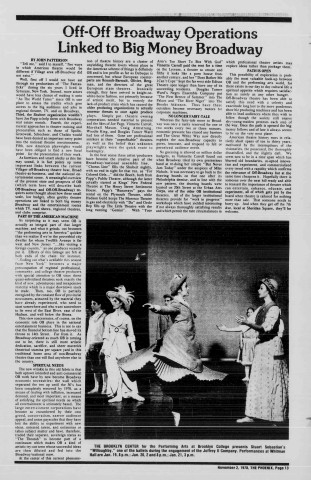
O f f - O f f R m a r l I I 7 2 1 1 TyA n cP ^ A U L I U H O ILinked to Big Money BroadwayBY JOHN PATTERSON%u201cTell me,%u201d said I to myself, %u201cfive ways in which American theatre would be %u2022different if Village area off-Broadway did not exist.%u201dWell, first off I would not have sat through six productions of %u201cThe Fantasticks%u201d during the six years 1 lived in Syracuse, New York. Second, more actors would have less chance of making it onto %u201c As The World Turns%u201d since OB is one place to amass the credits which give access to the big auditions and jobs in regional theatre, TV, and on Broadway. Third, the Shubert organization wouldn%u2019t have Joe Papp to help them with Broadway real estate rentals. Fourth, the experimental approaches to theatre training and presentation such as those of Spolin, Grotowski, Schechner, and Chaikin would have been denied an important entry point into the national theatre consciousness. Fifth, new American playwrights would have been obliged to find a new focal point for the presentation of their work.As facetious and smart alecky as this list may sound, it in fact points up some important links between the current Villager off-Broadway theatre beat. Broad theatre-as-business, and the national entertainment scene. A meaningful overview of the present state and prospects of OB (which term here will describe both Off-Broadway and Off-Off-Broadway) requires some thought about how these small scale, low budget, often grubby theatre operations are linked to both big money Broadway and the entertainment routes which TV, road shows, regional theatres, and clubs comprise.PART OF THE AMERICAN MACHINEAs surprising as it may seem OB is actually an integral part of that larger machine, and what it grinds out becomes %u201cthe performing arts in America%u201d quicker than we realize if we%u2019re the proverbial city dweller for whom Twelfth Avenue is far west and New Jersey %u201c ...like visiting a foreign country,%u201d as one producer recently put it. Effects of this linkage are felt at both ends of the chain: for instance, %u201c ..finding out what%u2019s available this season from New York%u201d becomes a major preoccupation of regional professional, community, and college theatre producers with special attention to OB since these quasi-subsidized theatres seek exactly the kind of new, adventurous and inexpensive material which is a major downtown stock in trade. Then, too, OB is partially energized by the constant flow of provincial newcomers, attracted by the material they have already experienced, who need to start somewhere and who want somewhere to lie west of the East River, east of the Hudson, and well below the Bronx.This view concentrates, of course, on the economic role OB plays in the national entertainment business. This is not to say that the financial bottom line has moved its throne to 14th Street. Far from it. As Broadway-oriented as much OB is turning out to be, there is still more artistic dedication, sacrifice, and sheer maverick theatrical stamina per square yard in this traditional home area of non-Broadway theatre than one will find anywhere else in the country.SPIRITUAL NEEDSThe new wrinkle in this old fabric is that both uptown intended and anti-commercial OB work have by now become Broadway economic necessities: the wall which separated the two up until the 50%u2019s has been completely removed by 1978, as a means of dealing with inflation, increased demand, and most important, as a means of satisfying the spiritual needs on which all entertainment is ultimately based. The large entertainment corporations have become so encumbered by their own greed, conservatism, narrow appeal, and union payscales that they have lost the ability to experiment with new ideas, untested talent, and taboo subject matter and have, therefore, traded their separate, sovereign status as %u201cThe Theatah%u201d to become part of a continuum which rnakes OB a kind of artistic try-out town whose successful ideas are then diluted and fed into the Broadway/national maw.At the center of this current phenomenon of theatre history are a cluster of unyielding theatre lovers whose place in the American scheme of things is definitely OB and is low profile as far as Dubuque is concerned, but whose European counterparts are Renault-Barrault, Olivier, Bergman, and the directors of the great European state theatres. Ironically enough, they have arrived in knight-onwhite-horse fashion, not primarily because of artistic merit, but to remedy thb lack-of-product crisis which has caused the older producing organizations to actually murmur threats to once again produce plays. Simply put, theatre owning corporations needed material to present and the likes of Joe Papp, Vinnette Carroll, Marshall Mason, Craig Armstrong, Woodie King, and Douglas Turner Ward had lots of them. Gone are professional snickers at their %u201c unprofitable%u201d theatres as well as the belief that unknown playwrights were the quick route to bankruptcy.In the best sense these artist/producers have become the creative part of the Broadway/national assembly line. %u201cChorus Line%u201d fills the Shubert nightly, with no end in sight for that run, as %u201c For Colored Girls...%u201d did the Booth, both from Papp%u2019s Public Theatre, although the latter actually started at Kings%u2019 New Federal Theatre at The Henry Street Settlement House. Papp's %u201c Runaways%u201d pays the rental on the Plymouth Theatre, while Hudson Guild keeps The Morosco Theatre in gas and electricity with %u201c Da%u201d and Circle Rep fills up The Little Theatre with the long running %u201cGemini%u201d . With %u201c YourArm%u2019s Too Short To Box With God%u201d Vinnette Carroll paid the rent for a time on the Lyceum, a theatre so ornate and filthy it looks like a porn house from another century, and her %u201c Dont Bother Me I Can%u2019t Cope%u201d kept the far west side Edison Theatre open longer than have any of its succeeding residents. Douglas Turner Ward%u2019s Negro Ensemble Company put %u201cThe First Breeze of Summer%u201d into The Palace and %u201cThe River Niger%u201d into The Brooks Atkinson. Thus have these outsiders become necessary motors tor corporate machines.NO LONGER FAIRY-TALEWhereas the fairy-tale move to Broadway was once a rarity reserved for one or two works every two or three seasons, economic pressure has erased any barriers and The Great White Way now directly exploits the non-Broadway capacity to guess, innovate, and respond to felt or perceived audience needs.No guessing is allowed on million dollar budgets, as Vinknette Carroll found out when Broadway tried its own pretentious hand at re-doing her simple %u201c But Never Jam Today%u201d under the auspices of Mike Nichols. It was necessary to go back to the drawing boards on that one after its Philadelphia demise, and in line with the new pattern, the drawing boards were located on 20th Street at the Urban Arts Corps, one of the older OB institutional theatres. All of the larger institutional theatres provide for \workshops which have yielded interesting if not always thoroughly satisfying results and which permit the rare circumstances inwhich professional theatre artists may explore ideas rather than package them.PATH IS OPENThis possibility of exploration is probably the most valuable hook-up between OB and the performing arts world, for there exists in our day to day cultural life a spiritual appetite which requires satisfaction as surely as any other hunger. Off-Broadway theatre has been able to satisfy this need with a celerity and exactitude long lost to the more ponderous show biz producing machines and has been able to lead audiences where they wish to follow though the society still enjoys shy-voung-maidcn protests each step of the way. Once the path is opened the big money follows and of late it always seems to be on the very next plane.American theatre history runs in relatively short spans of ten to thirty years, motivated by the interruptions of the visionaries, the possessed, the thoroughly dissatisfied, and the slightly daft. We seem now to be in a time span which has blurred old boundaries, co-opted innovation and experiment, and commercialized every trend with a rapidity which confirms the relevance of Off-Broadway but at the same time cheapens it. Hopefully there is someone over the next hill ready and able to reassert the importance of theatre which can entertain, enhance, educate, and experiment, all of which gets put by the board when theatre is tailored for nothing more than sale. That someone needs to hurry up. And when they get off the 7thAve. local at Sheridan Square, they%u2019ll bewelcome.THE BROOKLYN CENTER for the Performing Arts at Brooklyn College presents Stuart Sebastian%u2019s%u201c Willoughby,%u201d one of the ballets during the engagement of the Joffrey II Company. Performances at WhitmanHall are Jan. 19,8 p.m.; Jan. 20,2 and 8 p.m.; Jan. 21,3 p.m.Novemoer z, 1978, t h e p h o e n ix , Page 13


