


Page 576 - Demo
P. 576
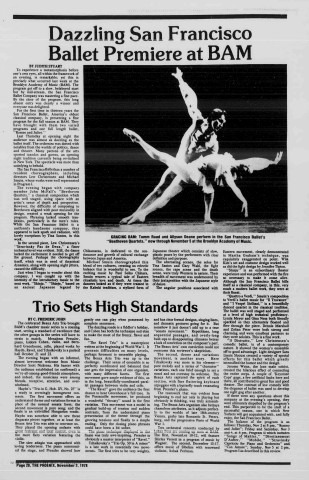
Dazzling San FranciscoBY JUDITH STUARTBallet Premiere at BAMTo experience a metamorphosis before one%u2019s own eyes, all within the framework of an evening, is remarkable; yet this is precisely what occurred last week at the Brooklyn Academy of Music (BAM). The program got off to a slow, belabored start but by mid-stream, the San Francisco Ballet Company was mastering a fine pace. By the close of the program, this long absent entry was clearly a winner and everyone was delighted.For the first time in thirteen years the San Francisco Ballet, America%u2019s oldest classical company, is presenting a fine program for the fall season at BAM. They have brought with them two varied programs and one full length ballet, %u201c Romeo and Juliet.%u2019%u2019Last Thursday at opening night the audience was almost as dazzling as the ballet itself. The orchestra was dotted with notables from the worlds of politics, dance and theater. Many patrons of the arts sported tuxedos and gowns, an opening night tradition currently being revitalized in New York. The spectacle was more than satisfying to behold.The San Francisco Ballet has a number of resident choreographers, including directors Lew Christensen and Michael Smuin, whose works were well represented in Program I.The evening began with company member John McFall%u2019s %u201c Beethoven Quartets,%u2019%u2019 a classical composition which was well staged, using space with an artist%u2019s sense of depth and perspective. However, the difficulty of composing to Beethoven aligned with poor musicality in design, created a weak opening for the program. Phrasing lacked smooth transitions, particularly in the men%u2019s roles. While the San Francisco Ballet is a uniformly handsome company, they appeared to lack spark and radiance, with lovely exceptions by Tina Santos, in this work.In the second piece, Lew Christensen%u2019s %u201c Stravinsky Pas de Deux,%u201d a finer technical level was evident. Still, the dance lacked the excitement it needed to get off the ground. Perhaps the choreography itself, which was in need of theatrical dynamics, along with opening night jitters, caused the difficulty.Just when I began to wonder about this company, I was caught up with the intensity of the introductory music to the next work, %u201c Shinju.%u201d %u201c Shinju,%u201d based on an ancient Japanese legend byGRACING BAM: Tomm Ruud and Allyson Deane perform in the San Francisco Ballet%u2019s%u201c Beethoven Quartets,%u201d now through November 5 at the Brooklyn Academy of Music.Chikamatsu, is dedicated to the continuance and growth of cultural exchange between Japan and America.Michael Smuin choreographed this blend of two cultures, creating an eclectic balance that is wonderful to see. To the exciting music by Paul Seiko Chihara, Smuin weaves a typical tale of Eastern ritualistic love and death. At times the dancers looked as if they were trained in the Kabuki tradition, a stylized form ofJapanese theater which consists of slow, plastic poses by the performers with clear definition and purpose.The alternating scenes, the solos for Tina Santos and Gary Wahl, the fight scenes, the rape scene and the death scene, were truly Western in nature. Their breadth of movement was underscored by their juxtaposition with the Japanese style of dance.The angular positions associated withTno Sets High StandardsBYC. FREDERIC JOHNThe celebrated Beaux Arts Trio brought BAM%u2019s chamber music series to a rousing start, setting a standard of excellence that the other groups in the series will have to strain to match. Menahem Pressier, piano, Isidore Cohen, violin, and Bernhard Greenhouse, cello, played works by Haydn, Ravel, and Tchaikovsky to a packed hall October 21 and 22.The evening began with an informal, almost irreverent welcome from Music Director Scott Nickrenz. His banter with the audience established (or confirmed) a we%u2019re-all-among-good-friends atmosphere, and indeed, the musicians were among friends, receptive, attentive, and overwhelmed.Haydn%u2019s %u201cTrio in G, Hob. XV, No. 25%u201d is a study in seemingly incongruent contrasts. The first movement offers an understated theme and variations format in place of the normal sonata form; the second movement is pure song; and the finale is an unbridled Hungarian rondo. Haydn was somehow able to sew these disparate pieces together, or at least the Beaux Arts Trio was able to convince us. They played the opening andante with5*V%u00abH IVilUtUUt WUU IVtHl VUUUUI) C v'C u iuthe more fiery variation featuring the violin.The slow adagio was approached with loving tenderness. The piano commanded the stage, and Pressier showed howgently one can play when possessed by complete assurance.The dazzling rondo is a fiddler%u2019s holiday, and Cohen has both the technique and elan to make the most of the frenzy, flavor and fun.%u201cThe Ravel Trio%u201d is a masterpiece written at the beginning of World War I. It presents difficulties on many levels, perhaps foremost to ensemble playing. The Beaux Arts Trio was up to the challenge. Their sense of ensemble is so perfectly coordinated and balanced that one gets the impression of one organism, with many different facets. The first movement gave ample evidence of this, as in the long, beautifully-coordinated parallel passages between violin and cello.%u201cThe Ravel%u201d gave the audience the first chance to hear Greenhouse%u2019s full tone. In the Passacaille movement, he produced a wonderful %u201cthroaty%u201d sound in the first variation. This movement was a model in gradual build-up of tension and sudden contrasts, from the understated piano presentation of the theme through the growing tensions and finally to a simple ending. Only the closing piano phrases could have been a bit softer.iiic piauu ig u u iB ju c uid^/iajfcu in iiicfinale was truly awe-inspiring. Pressier is obviously a master interpreter of %u201cRavel.%u201dTchaikovsky%u2019s %u201cTrio Op. 50 in A minor%u201d is a late work in essentially two movements. The first tries to be very weighty,and has clear formal designs, singing lines, and dramatic gestures going for it. But somehow it just doesn%u2019t add up to a true %u201csonata movement.%u201d Repetitions, long sequential passages, and overly-long built-ups to disappointing climaxes betray a lack of conviction on the composer%u2019s part. The Beaux Arts%u2019 own conviction could not overcome this reviewer%u2019s skepticism.The second, theme and variations movement, is another story. Here Tchaikovsky was more in his elem entpure melody and a series of %u201c character%u201d variations, each one brief enough to set a mood and not overstay its welcome. The Beaux Arts captured the spirit of each section, with fine fluttering keyboard arpeggios with a bjjtterfly touch emanating from Pressier%u2019s piano.The teamwork that was evident from beginning to end not only in playing but obviously in thinking, was truly astonishing. The Beaux Arts organism also betrays chameleon attributes, as it adjusts perfectly to the worlds of late 18th-century Vienna, gushy late Romantic St. Petersburg, and the progressive Paris of World War I.Two orchestral concerts conducted bvr . , u %u2014 r ------------------%u2022__ .... .%u201c %u201c %u2022w w > * w a a w u m t ii g U jp aV AJIl a i D r t i V l .The first, November 10-12, will feature Shirley Verrett in a program of music by Wagner. The second, December 15-17, offers music of Sibelius with renowned violinist, Itzhak Perlman.Eastern movement, clearly demonstrated in Martha Graham%u2019s technique, was exquisitely exaggerated on point. WUa Kim%u2019s set and costume design worked well as did the light design by Jennifer Tipton.%u201c Shinju%u201d is an extaordinary theater experience and was performed with the fire so necessary to make it come alive. Although the San Francisco Ballet bills itself as a classical company, in this, very much a modern ballet work, they were at their finest.%u201c Quattroa Verdi,%u201d Smuin%u2019s composition to Verdi%u2019s ballet music for %u201cH Trovatore%u201d and \danced quartet in the classical tradition. The ballet was well staged and performed at a level of high technical proficiency. Lynda Meyer and Gina Ness both literally sparkled as they alternately floated and flew through the piece. Dennis Marshall and Zoltan Peter were both strong and charming and were excellent partners as they were soloists. This is a fine work.%u201c II D istratto,%u201d Lew Christensen%u2019s comedic ballet, is of a contemporary nature. It showed the women%u2019s ensemble off to good advantage. Light designer Sara Linnie Slocum created a variety of special effects for this ballet which greatly intensified the humor and the design.Jerome Weiss, the lone male soloist, created the hilarious effect of connecting the entire corps. A couple of %u2018Keystone Cops%u2019 gags, a few artificial limbs here and there, all contributed to great fun and good theater. The contrast of low comedy with the elegance of ballet was used to develop one sight gag after another.If there were any questions about this company at the evening's opening, they were ultimately dispelled by the program%u2019s end. This purported to be the start of a successful season, one in which New Yorkers will get acquainted with, and fully enjoy, the San Francisco Ballet.The balance of the program is as follows: Thursday, Nov 2 at 8 pm, %u201c Romeo and Juliet%u201d ; Friday and Saturday, Nov 3 ana <%u00bb, at a pm, Program U which includes %u201c Songs of M ahler,%u201d %u201c Divetissement D%u2019Auber,%u201d %u201c M obile,%u201d %u201c Stravinsky Capriccio for Piano and Orchestra%u201d and \Program I as described in this review.


