


Page 660 - Demo
P. 660
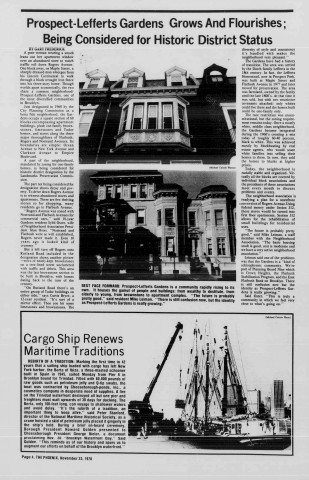
Prospect-Lefferts Gardens Grows And Flourishes;Being Considered for Historic District StatusBY GARY FREDERICKA poor woman wearing a smock leans out her apartment window over an abandoned store to watch traffic roll down Rogers Avenue. One block away, on Maple Street, a sharply dressed man emerges from his Lincoln Continental to walk through a black wrought iron fence into his three-story home. Though worlds apart economically, the two share a common neighborhoodProspect-Lefferts Gardens, one of the most diversified communities in Brooklyn.Just designated in 1968 by the City Planning Commission as a bona fide neighborhood, the Gardens occupy a square section of 60 blocks encompassing apartm ent buildings, plush one-family brownstones, limestones and Tudor homes, and stores along the three major thoroughfares of Flatbush, Rogers and Nostrand Avenues. Its boundaries are simple: Ocean Avenue to New York Avenue and Clarkson Avenue to Empire Boulevard.A part of the neighborhood, mandated by zoning for one-family homes, is being considered for historic district designation by the Landmarks Preservation Commission.The part not being considered for designation shows decay and poverty. To drive down Rogers Avenue is to witness abandoned stores and apartments. There are few thriving stores so for shopping, many residents go to Flatbush Avenue.%u201c Rogers Avenue was zoned with Nostrand and Flatbush Avenues for commercial uses,%u201d said 10-year Gardens resident Sybil Oster, wife of Neighborhood Association President Alan Oster. %u201c Nostrand and Flatbush were so well established, Rogers never made it. Even 10 years ago it looked kind of crummy.%u201dBut a left turn off Rogers onto Rutland Road included in the designation shows another picture %u2014rows of neatly-kept brownstones on a tree-lined street uncluttered with traffic and debris. This area was the last brownstone section to be built in Brooklyn, with homes dating back to the turn of the century.%u201c On Rutland Road there%u2019s an entire group of Tudor buildings on either side,%u201d says Curtis Bryce, a 12-year resident. %u201c It%u2019s sort of a mirror effect. Then you hit some limestones and brownstones. The*%u2022BEST FACE FORWARD: Prospect-Lefferts Gardens is a community rapidly rising to itsown. It houses the gamut of people and buildings: from wealthy to destitute, fromelderly to young, from brownstone to apartment complex. %u201c The future is probablypretty good,%u201d said resident Mike Leiman. %u201c There is still confusion now, but the identityas Prospect-Lefferts Gardens is really growing.\Tdiversity of style and consistency it%u2019s handled with makes the neighborhood very pleasant.%u201dThe Gardens have had a history of transition. The area was settled by the Dutch family Lefferts in the 18th century. In fact, the Lefferts Homestead, now in Prospect Park, was built at Maple Street and Flatbush Avenue in 1977 and later moved for preservation. The area was farmland, owned by the family until the late 1800%u2019s. At that time it was sold, but with two restrictive covenants attached: only whites could live there and the homes built could be one-family only.The race restriction was unconstitutional, but the zoning requirement remains today. Once a mostly white, middle class neighborhood, the Gardens became integrated during the 1960%u2019s creating a mix today of roughly 60-40 percent, black to white. This was achieved mostly by blockbusting by real estate agents, who would scare white families into selling their homes to them. In turn, they sold the homes to blacks at higher prices.Today, the neighborhood is racially stable and organized. Virtually all the blocks are covered by individual block associations and the presidents of these associations meet every month to discuss problems and events.The neighborhood association is readying a plan for a storefront conversion of Rogers Avenue.Using federal money under Secion 312, these stores would be turned into first floor apartments. Section 312 allows for the rehabilitation of small buildings for residential uses.%u201c The future is probably pretty good,%u201d said Mike Leiman, a staff member with the Neighborhood Association. %u201c The basic housing stock is good, cost is moderate and we have a very active neighborhood association.%u201dLeiman said one of the problems was that the Gardens is a %u201c kind of schizophrenic community. We%u2019re part of Planning Board Nine which is Crown Heights, the Flatbush Stabilization Program, and the East Flatbush Bank on Brooklyn. There is still confusion now but the identity as Prospect-Lefferts Gardens is really growing.%u201dSaid Oster, %u201c This is truly a community in which we feel very close to what%u2019s going on.%u201dCargo Ship RenewsMaritime TraditionsREBIRTH OF A TRADITION: Marking the first time in 42years that a sailing ship loaded with cargo has left NewYork harbor, the Berta of Ibiza, a three-masted schoonerbuilt in Spain in 1945, sailed Monday from Pier 6 inBrooklyn bound for Trinidad. Filled with 60,000 pounds ofraw goods such as petroleum jelly and 0-tip swabs, theboat was contracted by Cheeseborough-ponds, Inc., acosmetics company in desperate need of supplies. A fireon the Trinidad waterfront destroyed all but one pier andfreighters must wait upwards of 30 days for docking. TheBerta, only 100-feet long, can voyage to shallower watersand avoid delay. %u201c It%u2019s the rebirth of a tradition, animportant thing to keep alive,\director of the National Maritime Historical Socieiy, as acrane hoisted a skid of petroleum jelly placed it gingerly inthe ship%u2019s hold. During a brief on-boardBorough President Howard Golden presented toCheeseborough President George Bieler, a documentproclaiming Nov. zu %u2022 -Brooklyn Waterfront Day.%u201d SaidGolden, %u201c This reminds us of our history and spurs us toaugment our efforts on behalf of the Brooklyn waterfront.\Page 4, THE PHOENIX, November 23,1978(Michael Cuiccio Photo)


