


Page 662 - Demo
P. 662
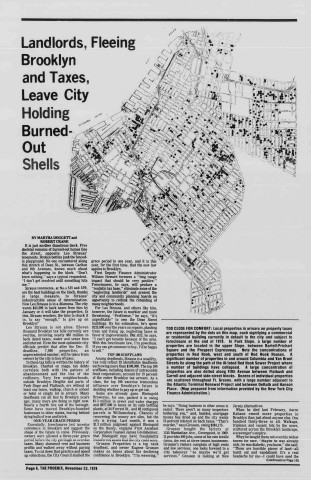
Landlords. FleeingBrooklynand Taxes,Leave CityHoldingBurnedO u tShellsBY MARTHA DOGGETT andROBERT CRANEIt is just another disastrous block. Five skeletal remains of burned-out homes line the street, opposite Leo S trau ss%u2019 tenements. Broken bottles junk the fencedin playground. No one encountered along this stretch of Dean St., between Carlton and 6th Avenues, knows much about what%u2019s happening to the block. %u201cDon%u2019t know nothing,%u201d says a typical respondent. %u201cI don%u2019t get involved until something hits m e.%u201dStrauss tenements, at No.s 535 and 539, are the best buildings on the block, thanks in large m easure, to S trau ss%u2019 indestructible sense of determination. Now Leo Strauss is in a dilemma. The city wants $43,000 in back taxes from him by January or it will take the properties. Is this, Strauss wonders, the time to chuck it in, to say %u201c enough,%u201d to give up on Brooklyn?Leo Strauss is not alone. Eleven thousand Brooklyn tax bills currently are overdue, involving nearly $63 million in back dated taxes, water and sewer fees and interest. Even the most optimistic city officials predict that after the Dec. 31 deadline, 7,000 properties, an unprecedented number, will be taken from owners by the city in lieu of taxes.In those tax bills is written the history of Brooklyn. Charted on maps, tax debts correlate both with the pattern of abandonem ent and the line of the redliners. Very few neighborhoods, outside Brooklyn Heights and parts of Park Slope and Flatbush, are without at least one home, walkup, church or school or hotel or empty lot in arrears. Many deadbeats cut all ties to Brooklyn years ago; many more are doing so right now. Nearly a fourth live out of the borough. Some have moved Brooklyn-founded businesses to other states, leaving behind dying hulls of iron and brick.ONE-YEAR GRACE PERIOD Essentially, foreclosures test investor confidence in Brooklyn and suggest the shape of the future to come. Previously, owners were allowed a three-year grace-----: ~ J U -f 4.1-----U.. 4 ---------- 4%u2014 pviit/u UV/iUl L WUC guv VUUgli UII UYtl uuutaxes. Many skimmed rent and business profits and walked away without paying taxes. To cut down that practice and speed up collections, the City Council slashed thegrace period to one year, and it is this year, for the first time, that the new law applies to Brooklyn.First Deputy Finance Administrator Wiiiiam Howard foresees a %u201c long range impact that should be very positive.%u201d Foreclosures, he says, will produce a %u201crealistic tax base,%u201d eliminate some of the %u201cneglecting landlords%u201d and present the city and community planning boards an opportunity to rethink the rebuilding of many neighborhoods.For Leo Strauss, and others like him, however, the future is murkier and more threatening. %u201c Profitwise,%u201d he says, %u201cit%u2019s unprofitable%u201d to own the Dean Street buildings. By his estimation, he%u2019s spent $125,000 over the years on repairs, planting trees and fixing up, neglecting taxes in favor of improvements. Bat still, he says, %u201cI can%u2019t get tenants because of the area. With this foreclosure law, I%u2019m powerless. If you can get someone to buy, I%u2019d be happy to sell.%u201dTOP 100SCOFFLAWSAmong deadbeats, Strauss is a smallfry. Tax rolls reflect 23 identifiable deadbeats each owing more than $100,000. The top 100 scofflaws, including dozens of untraceable front corporations, account for 19 percent of the entire Brooklyn tax arrears. As a class, the top 100 exercise tremendous influence over Brooklyn%u2019s future in deciding whether to pay up or get out.Some are already gone. Rheingold Breweries, for one, packed it in owing $1.3 million in sewer and water charges and $977,000 in taxes on its suds bottung plants, at 34 Forrest St., and 48 contiguous parcels in W illiamsburg. Chances of recovering the money are slim, but the city is trying. Last month, it won a $1.3 million judgment against Rheingold on the theory, explains First Assistant Corporation Counsel James Greilsheimer, that Rheingold may have fraudulently__t ____ 1 _ 4. _ 4.1 4. it. . %u2018i 1 I W4 uiioiui A cu aoocto mat uic Clbjr CISUIU SClZC.Grossen Properties is a top rank deadbeat, and owner Eugene Grossen makes no bones about his declining confidence in Brooklyn. %u201cI%u2019m wavering,%u201dTOO CLOSE FOR COMFORT: Local properties in arrears on property taxesare represented by the dots on this map, each signifying a commercialor residential building currently in default to the city and subject toforeclosure at the end of 1978. In Park Slope, a large number ofproperties are located in the upper Slope, between Bartell-PrichartSquare and the Prospect Expressway. Note the concentrations ofproperties in Red Hook, west and south of Red Hook Houses. Asignificant number of properties in and around Columbia and Van BruntStreets lie along the path of the ill-fated Red Hook Sewer Project wherea number of buildings have collapsed. A large concentration ofproperties are also dotted along Fifth Avenue between Flatbush andCarroll and adjacent side-street blocks. Dozens of individual propertiesare scattered throughout Ft. Greene, with a large number adjacent tothe Atlantic Terminal Renewal Project and between DeKalb and HansonPlace. (Map prepared from information provided by the New York CityFinance Administration.)he says. %u201cDoing business in other areas is easier. There aren%u2019t so many inspectors bothering you,%u201d and, besides, mortgage money has dried up and the city wants 15 percent interest on back taxes. %u201cThat%u2019s murder,%u201d says Grossen, owing $284,175.Grossen bought the factory at 1155 Manhattan Ave., Greenpoint, in 1969. It provides 400 jobs, some at his own textile firms, me rest at tnree tenant Businesses. Grossen%u2019s renters complain of high rents and low services; one looks forward to a city takeover %u201c so m aybe we%u2019ll get services.%u201d Grossen is looking at NewJersey alternatives.When he died last February, Aaron Kahane owned m ore properties in Brooklyn than just about anyone else. One hundred thirty-three in all. Walkups, triplexes and vacant lots by the score, scattered across the Brooklyn landscape, a scavenger%u2019s empire.Whey he bought them not even his widow Knows tor sure. %u201cMaybe he was already sick; he was diabetic, you know,%u201d she said. %u201cThose are horrible pieces of land%u2014all burnt out and vandalized. It%u2019s a real headache for me%u2014I could have used the (Continued on Page 10)Page 6, THE PHOENIX, November 23,1978


