


Page 69 - Demo
P. 69
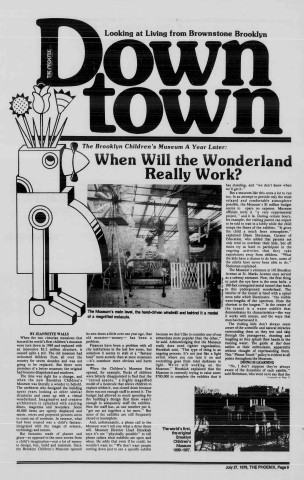
Looking at Living from Brownstone BrooklynThe Brooklyn Children%u2019s Museum A Year Later:When Will the WonderlandReally Work?The Museum%u2019s main level, the hand-driven windmill and behind it a modelof a magnified molecule.BY JEANNETTE WALLSWhen the two Victorian mansions that housed the world%u2019s first children%u2019s museum were torn down in 1969 and replaced with an innovative $3.5 million structure, it caused quite a stir. The old museum had welcomed children from all over the country for seven decades and was not going to be replaced. But there were promises of a better museum; the original had become dilapidated and rundown.The time was right for a change, and when the new Brooklyn Children%u2019s Museum was literally a wonder to behold. The architects who designed the building spent years looking at other similar structures and came up with a virtual wonderland. Imaginative and creative architecture is splashed with exciting blues, magentas and lavendars. Some 40,000 items are openly displayed and music, voices and projected pictures seem to come out of nowhere. In essence, what had been created was a child%u2019s fantasy, integrated with the magic of science, technology and nature.But fantasies made of plaster and glass%u2014as opposed to the ones woven from a child%u2019s imagination%u2014cost a lot of money to design, buy, build and maintain. Since the Brooklyn Children%u2019s Museum openedits new doors a little over one year ago, that old monster%u2014money%u2014 has been a problem.Finances have been a problem with all city institutions in the last few years, but somehow it seems to stab at a %u201cfantasy land%u201d more acutely than at most museums %u2014it%u2019s somehow more obvious and hurts more.When the Children%u2019s Museum first opened, for example, flocks of children were bitterly disappointed to find that the %u201c curved spaces,%u201d a highly magnified model of a molecule that allows children to explore within it, was closed down because there was not enough staff to attend it. The budget had allowed so much spending for the building%u2019s design that there wasn%u2019t enough to adequately staff the exhibits. Now the staff has, as one member put it, %u201c got our act together a lot more.%u201d But some of the exhibits are still frequently closed or incomplete.And, unfortunately, a phone call to the Museum won%u2019t tell you what a drive there will. Museum Director Lloyd Hezekiah says it%u2019s not %u201c physically possible%u201d to tell phone callers what exhibits are open and when. He adds that even if he could, he wouldn%u2019t want to: %u201c We don%u2019t want people coming down just to see a specific exhibitbecause we don%u2019t like to consider any of our attractions more popular than the other,%u201d he said. Acknowledging that the Museum really does need tighter organization, Hezekiah said, %u201cThis type of thing is an ongoing process. It%u2019s not just like a light switch where you can turn it on and everything goes from total darkness to light. We%u2019re still working on the Museum.%u201d Hezekiah explained that the Museum is currently trying to raise some $700,000 to complete the exhibits that ithas standing, and %u201cwe don%u2019t know when we%u2019ll get it.%u201dBut a museum like this costs a lot to run too. In an attempt to provide only the most relaxed and comfortable atmosphere possible, the Museum%u2019s $1 million budget seems to spare no expense. Museum officials term it \project,%u201d and it is. During certain hours, for example, the visiting parent can expect to be told to wait in a lobby while the child romps the floors of the exhibits. %u201c It gives the child a much freer atmosphere,%u201d explained Diane Sheinman, Curator of Education, who added that parents not only tend to overbear their kids, but oft times try so hard to participate in the ongoing activities that they take experiences away from children. %u201c What the kids have a chance to do here, some of the adults have never been able to do,%u201d Sheinman explained.The Museum%u2019s entrance at 145 Brooklyn Avenue at St. Marks Avenue once served as a subway entrance. Now, the first thing to catch the eye here is the neon helix, a 180-foot corregatea metal tunnel that leads to this underground wonderland. The interior of the tunnel is lined with a spiral neon tube which illuminates %u201cthe visible wave-lengths


