


Page 71 - Demo
P. 71
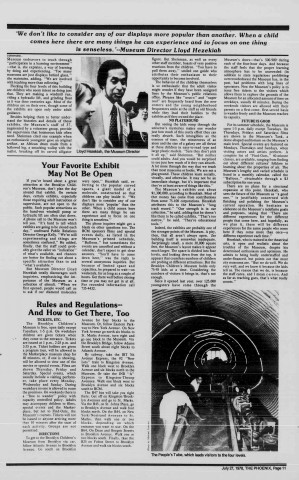
%u2018We don't like to consider any of our displays more popular than another. When a childcomes here there are many ihings he can experience and io focu s on one thingis se n seless.M u seu m Director Lloyd HezekiahCONTINUED...Museum endeavors to teach through %u201cparticipation in a learning environment%u201d %u2014that is, she explains, a way of learning by doing and experiencing. %u201cToo many museums are just displays behind glass,%u201d she maintains, adding, %u201c We are involved with teaching more than collecting.%u201dFlocking the four levels of this building are children who seem intent on doing just that. They are making a windmill run, riding a hydraulic lift, and grinding flour as it was done centuries ago. Most of the children are on their own, though some of the exhibits are open only under adult guidance.Besides helping them to better understand the histories and details of these exhibits, the M useum%u2019s staff of 37, augmented by a volunteer group, provide the supervision that boisterous kids often need. Sheinman cited one example when an enthusiastic youngster gave an original artifact, an African drum made from a hollowed log, a smacking wallop with the mallot, breaking off its carved alligator Lloyd Hezekiah, the Museum DirectorYour Favorite ExhibitMay Not Be OpenIf you%u2019ve heard about a great attraction at the Brooklyn Children%u2019s Museum, don%u2019t plan the day around that exhibit. On certain days, certain exhibits, especially those requiring adult instruction or supervision, are not open to the public. Such popular attractions as the hand-run windmill pump or hydraulic lift are often shut down. A phone call to the Museum won%u2019t tell you. %u201c It%u2019s hard to tell which exhibits are going to be closed each day,%u201d confessed Public Relations Director George Kelly. %u201c We%u2019re still experimenting and things are sometimes confused.%u201d He added, finally, that the staff could probably give the caller an %u201c indication%u201d of what%u2019s available, and chances are better for finding out about a specific attraction than to ask %u201cwhat%u2019s available.%u201dBut Museum Director Lloyd Hezekiah totally discourages such inquiries, emphasizing the importance of the Museum as a collection of stimuli. %u201c When we first opened, people would call us to ask if our diamond moleculeswere open,%u201d Hezekiah said, referring to the popular curved spaces, a giant model of a molecule, constructed so that children can play inside it. %u201c We don%u2019t like to consider any of our displays more %u2018popular%u2019 than the other. When a child comes here there are many things he can experience and to focus on one thing is senseless.%u201dThe phone inquirer might get a blank on other questions too. The BCM sponsors films and special events daily, as listed in the Museum%u2019s printed schedule, %u201c Balloon,%u201d but sometimes the events are cancelled and without a calendar, don%u2019t expect to get clear answers. %u201c You%u2019ll have to come down here,%u201d was the reply to several anonymous inquiries. But because of limited space and capacities, be prepared to wait%u2014on weekends, for as long as a couple of hours. Get there well before closing time or you may not get in at all. For recorded information call 735-4432.Rules and RegulationsAnd How to Get There, TooTICKETS, ETC.The Brooklyn Children%u2019s Museum is free, open daily except Tuesdays, 1-5 p.m. On weekdays children are given tickets when <- \they come to the entrance. Tickets are issued at 1 p.m., 2:25 p.m. and 3:55 p.m. Ticket holders are given a program tour, will be allowed in the Marketplace museum shop for 40 minutes, or, if one is showing, will be allowed to view one of the movies or special events. Films are shown Thursday, Friday and Saturday. Special events, which usually include a visiting performer, take place every Monday, Wednesday and Sunday. During weekdays no one is allowed to roam the premises. On weekends there is a %u201cfree to wander%u201d policy with capacity controlled policy. Adults may accompany children to films, special events and the Marketplace, but not to Find-Outs, the Museum%u2019s courses. Tickets will not be issued to anyone arriving more than 10 minutes after the start of each activity. Groups are not permitted.DIRECTIONSTo get to the Brooklyn Children%u2019s Museum from Brooklyn via car, follow Atlantic Avenue to Brooklyn Avenue. Go south on BrooklynAvenue for four blocks to the Museum. Or, follow Eastern Parkway to New York Avenue. On New York Avenue go north six blocks to St. Marks Avenue, turn right and go one block to the Museum. Via the Brooklyn Bridge, follow Adams Street south about eight blocks to Atlantic Avenue.By subway, take the IRT 7th Avenue Express, the #2 %u201c New Lots%u201d train to Kingston Avenue.Walk one block west to Brooklyn Avenue and six blocks north to the Museum. Or take the IND %u201c A%u201dExpress to Kingston-Throop Avenues; Walk one block west to Brooklyn Avenue and six blocks south to BCM.The B47 bus will take you right there. Get off on Kingston/Brooklyn Avenues and go to St. Marks.Via the B45, on St. Johns Place, go to Brooklyn Avenue and walk four blocks north. On the B44, on New York/Nostrand Avenues to St.Marks, then walk one or two blocks, depending on which .?entrance you want to use. On the 1B64, On Dean and Bergen Streets ^to Brooklyn Avenue. Walk one or |two blocks south. Finally, tkae the sB25 on Fulton Street to Brooklyn %u00a3Avenue and walk six blocks south. %u00a7figure. But Sheinman, as well as every other staff member, boasts of very positive reactions from the children. %u201cYou have to pull them away,%u201d smiled one guide who attributes their enthusiasm to their opportunity to become involved.The behavior of the children themselves is so enthusiastic that the adult visitor might wonder if they have been assigned lines by the Museum%u2019s public relations office. Phrases like %u201c neat-o%u201d and %u201c super cool%u201d are frequently heard from the new comers and the young neighborhood frequenters smile at the staff as old friends while they lead their buddies to the exhibits as if they owned the place.NO PLAYGROUNDBut seeing the kids romp through the universe%u2019s mysteries makes one wonder just how much of this costly effort they can really absorb. Such intangibles as the essence of time, the minuteness of an atom and the size of a galaxy are all thrust at these children in easy-to-read type and large plastic models. %u201c Sure they don%u2019t pick it all up,%u201d said Sheinman. %u201c But neither could adults. And you would be surprised to see just how much of it they can absorb. A lot more through the way that we teach than most museums or books. We are not a playground. These children learn socially, visually, and otherwise. It may not be an immediate change, but it%u2019s important that they're at least aware of things like this.%u201dThe Museum%u2019s exhibits cost about $1,300,000, according to Hezekiah. Most of that money has come from contributions from some 75-100 corporations. Hezekiah attributes this to the Museum%u2019s %u201c long track record.%u201d %u201c Our strength is in our collection,%u201d he said, adding that he doesn%u2019t like them to be called exhibits, %u201c That%u2019s too narrow,%u201d he said, %u201c They%u2019re educational tools.%u201dIndeed, the exhibits are probably one of the stronger points of the Museum. A pity, then, that all aren%u2019t always open. The building itself is somewhat inadequate. Surprisingly small, a mere 30,000 square feet, the Museum%u2019s layout makes it appear much larger. The space is divided into four levels, and looking down from the top, it appears that countless numbers of children are probing at different attractions. But the Brooklyn Children%u2019s Museum holds only 75-95 kids at a time. Considering the numbers of visitors it brings in, that%u2019s not enough.Since it opened last year, over 125,000 youngsters have come through theMuseum%u2019s doors%u2014that%u2019s 500-900%u2019 during each of the four-hour days. And because the staff feels that the proper learning atmosphere has to be uncrowded (in addition to state regulations prohibiting overcrowdedness) the Museum has, in the past, had problems with long lines of spectators. Now the Museum%u2019s policy is to issue free tickets to the visitors which allows them to explore the grounds of the Museum for an allocated amount of time on weekdays, usually 40 minutes. During the weekends visitors are allowed with their parents on a first-come, first-served basis to wander freely until the Museum reaches its capacity.FUTURE IS GOODFor its summer schedule, the Museum is open 1-5 p.m. daily except Tuesdays. On Thursdays, Fridays and Saturdays films are shown in the Museum%u2019s Tank, a dome-shaped auditorium on the Museum%u2019s main level. Special events are featured on Mondays, Thursdays and Sundays, when visiting actors and artists perform. A complete list of %u201c Find-Outs,%u201d 40-minute classes, are available, ranging from finding out about different cultures%u2019 folklore to learning about the properties of air. The Museum%u2019s lengthy and varied schedule is listed in a monthly calendar, called the %u201c Balloon,%u201d obtainable through a $3 subscription for one year.There are no plans for a structural expansion at this point. Hezekiah, who sees the future of the Museum as %u201c a good one,%u201d is justifiably concerned with finishing and polishing the Museum%u2019s current operation. He hesitates to elaborate on the Museum%u2019s indefinite goals and purposes, saying that %u201cThere are different experiences for the different people that come here, and hopefully, as we plan it, there will be different experiences for the same people who come here if they come more than once%u2014a different experience each time.%u201dHezekiah, who is trained in the theatrical arts, is open and realistic about the troubles of the Museum, despite his determined enthusiasm and optimism. He admits to being badly understaffed and under-financed, but points out that most city museums are. %u201c But we do well. We do very well, and we know it because the kids tell us. The reason that we do, is because the staff cares, and 1 mean c-a-r-e-s. And as far as teaching goes, that%u2019s what really counts.%u201dThe People%u2019s l ube, which leads visitors to the four levels.July 27,1978, THE PHOENIX, Page 11


