


Page 82 - Demo
P. 82
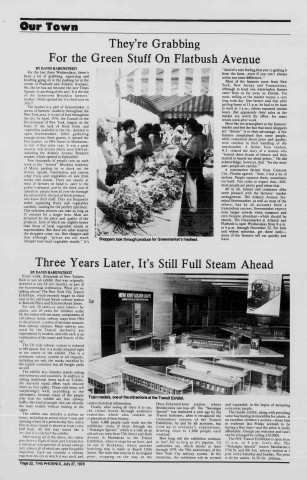
Our TownThey%u2019re GrabbingFor the Green StuffBY DAVID HABENSTREITFor the last three Wednesdays, there%u2019s been a lot of grabbing, squeezing and fondling going on in the parking lot at the corner of Flatbush and Atlantic Avenues.No. the lot has not become the new Times Square, or anything of the sort. It is the site of the downtown Brooklyn farm ers%u2019 market, which opened for it%u2019s third year on July 5.The market is a part of Greenmarket, a series of farmers' markets throughout the New York area; it is one of four throughout the city. In April, 1976, the Council on the Environment of New York, largely on the basis of the lack of fresh fruits and vegetables available in the city, decided to open Greenmarket. After gathering enough money from grants, it opened the first market, on 59th Street in Manhattan, in July of that same year. It was a great success, and several others soon followed, including the Atlantic Avenue Brooklyn market, which opened in September.Now thousands of people turn up each week at the %u201d second%u201d Brooklyn Academy of Music parking lot to check out the lettuce, squash, watermelon, and various other fruits and vegetables on sale from trucks and stands. There are usually at least 15 farmers on hand to cater to the public's demand, and by the third year of operation. people from all over the borough are attracted by the lure of fresh produce, who know their stuff. They are frequently seden squeezing fruits and vegetables carefully, looking for the perfect specimen.This selection process can take as long as 15 minutes for a single item. Most are attracted by the price and quality of the products, both of which are slightly better than those of local vegetable stands or supermarkets. But there are other reasons the shoppers come, too. One shopper said that although %u201c prices are not much cheaper tnan local vegetable stands,%u201d it%u2019sOn Flatbush Avenue%u201c kind of a nice feeling that you%u2019re getting it from the farm...even if you can%u2019t always notice any taste difference.%u201dMost of the farmers come from New York, New Jersey and Connecticut, although at least one watermelon farmer came from as far away as Florida. For most, selling at the market means a very long work day. One farmer said that after getting home at 11 p.m. he had to be back to work at 3 a.m.; others reported similar hours. But apparently their sales at the market are worth the effort, for many return week after week.Most like the atmosphere at the farmers%u2019 market and feel the fact that most shoppers are %u201cchoosy%u201d is to their advantage. A few farmers complained that some people, while concerned about price and quality, were careless in their handling of the merchandise. A farmer from Goshen, N.Y. related the story of a woman who %u201cbusted three heads of lettuce and then started to hassle me about prices.%u201d He did acknowledge, however, that %u201c for the most part, people are careful.%u201dA watermelon farmer from Crescent City, Florida agreed. %u201c Sure, I lost a lot of melons. People squeeze them, sometimes too hard. You come to expect that...Still, most people are pretty good about that.All in all, farmer and consumer alike seem pleased with the farmers%u2019 market arrangement. The Atlantic Avenue Terminal Greenmarket, as well as most of the others, has by all accounts been a tremendous success. Greenmarket expects even larger crowds when tomatoes and corn become abundant%u2014which should be shortly. The Greenmarket at Atlantic and Flatbush is open Wednesdays from 8 a.m. to 6 p.m. through November 22. For best and widest selection, get there early%u2014 many of the farmers sell out quickly and Shoppers look through produce for Greenmarket%u2019s freshest leave.Three Years Later, It%u2019s Still Full Steam AheadTrain models, one of the attractions at the Transit Exhibit.BY DAVID HABENSTREITEvery week, thousands of New Yorkers flock to see an exhibit that was originally intended to run for two months, as part of the bicentennial celebration. What are we talking about? The New' York City Transit Exhibition, which recently began its third year at the old Court Street subway station at Boerum Place and Schermerhorn Street.For only 50 cents%u2014a mere token%u2014 for adults, and 25 cents for children under 18, the visitor will see many components of old subway trains, subway maps from 1904 to the present, a series of intricate mosaics from subway stations. Many subway cars used by the Transit Authority are represented by models, and with each is an explanation of the name and history of the car.The 231-mile subway system is reduced to 480 square feet in a model situated right in the center of the exhibit. This is a miniature subway system in all respects, including not only the tracks travelled by the typical commuter, but all freight yards as well.The exhibit also includes stands selling refreshments and souvenirs. In addition to selling traditional items such as T-shirts, the souvenir stand offers such obscure items as iron spikes. These odd items sell surprisingly well, according to the attendants, because many of the people who visit the exhibit are true subway buffs%u2014the kind of people who can identify the train models without looking at the signs.The exhibit also includes a section on buses, including an actual driver%u2019s seat and steering wheel of a present-day bus, and a film on mass transit is shown at least every half hour. All this may sound like a lot%u2014but it is only half the exhibit.After seeing all of the above, the visitor goes down a flight of stairs and is treated to a historical retrospective of actual subway cars, almost all of which are open for public inspection. Each car contains a subway map trom the era in which it was used, andcarries historical information.Finally, after seeing all there is to see, the visitor leaves through authentic turnstiles, which also contain an explanatiion of their history.Some 4,000 people each week see the exhibition, many of them through the %u201c Nostalgia Special,%u201d which is a ride on an old subway train from 57th Street and Sixth Avenue in Manhattan to the Transit Exhibition, where it stops for an hour, and on out to Rockaway, where another hour-long stop is made at Beach 116th Street. The train then returns to its original point, stopping on the way at theHoyt-Schermerhorn station, where Brooklynites can hop off. The %u201cNostalgia Special%u201d was instituted a year ago by the Transit Authority, after it recognized the tremendous success of the Transit %u2022Exhibition, by and by all accounts, has lived up to everyone%u2019s expectations, drawing close to 1,000 people each weekend.How long will the exhibition continue to run? For as long as it%u2019s popular, TA authorities say, which means at least through 1979, the 75th anniversary of the New York City subway system. In the meantime, the exhibition will be revisedand expanded, in the hopes of attracting even more people.The transit exhibit, along with providing some fascinating memorabilia for adults, is an excellent children%u2019s activity%u2014those kids in evidence last Friday seemed to be having a fine time%u2014and the price is easily affordable. Groups are welcome and tours can be arranged by calling 330-3060.The NYC Transit Exhibition is open from 11 a.m. to 4 p.m. every day. The %u201c Nostalgia Special%u201d leaves Manhattan%u2019s 57th St. and 6th Ave. subway station at 1 p.m. every Saturday and Sunday. The price is 53 for aduits, $i.50 for children.Page 22, THE PHOENIX, July 27,1978


