


Page 253 - Demo
P. 253
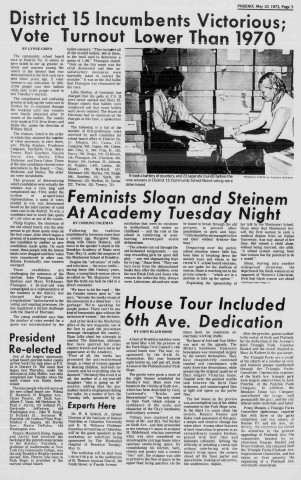
PHOENIX, May 10, 1973, Page 3District 15 Incumbents Victorious;Vote Turnout Lower Than 1970BY LYNNE GRIFOThe community school board race in District No. 15 seems to have failed to stir up greater interest and concern among the voters in the district than was demonstrated in the first such race held three years ago, if voter turnout is any indication. In 1970, 12,095 people cast their ballots while only 11,481 people voted in last Tuesday%u2019s election.The complicated and confusing process of tallying the votes cast in District No. 15 continued through the weekend until nine winners were finally obstained after 23 counts of the ballots. The counts were made at P.S. 29 on Henry and Baltic Sts., under the direction of William Boyd.The winners, listed in the order in which they attained the number of votes necessary to elect them, are: Philip Kaplan, Prudence Cangiano, Heriberto Cruz, Mary Treacy, Emil Giordano, Vincent Darcy, Alex Morley, Ellen Michener, and Doris Cohen. Three of the nine candidates elected were newcomers to the Board %u2014 Cruz, Michener, and Morley. The other six were incumbents.The process of determining which candidates were actually the winners was a very long and complicated one. First, under the system of proportional representation, a quota of votes needed to win was determined based on the total number of valid votes cast in the district. To win, a candidate had to reach that quota of 1,145 votes on one of the counts.Philip Kaplan, the chairman of the old school board, was the only person to get those quota votes on the first count, after which began a process of transferring votes from one candidate to another as new candidates made quota. On each count, those people with the lowest totals were dropped and their votes were transferred to other candidates. Eventually, nine winners emerged.Three candidates are challenging the outcomes of the election, John Flanagan, Lillie Shelton and Mary El-Khouri. Flanagan, a 20-year-old who campaigned as a representative of the students in the district, has charged th a t%u201cgross irregularities%u201d had occurred in the voting and counting processes. He has registered a formal challenge with the Board of Elections.The young candidate says that the number of votes needed for a quota was miscalculated by thePresidentRe-electedOne of the longest community school board election ballot counts in New York City took place at P.S. 54 in District 13. The count that began last Thursday, under the direction of John Muller, was only completed late Tuesday when the ninth winner was finally determined.The nine people who will serve on the new school board are: Wilma E. Maynard, 47 Kingston Ave.; Claire Pearce, 107 Sixth Ave.; Albert T. Vann, 400 Herkimer St.; Paul J. Jarvis, 115 Ashland PL; Gertrude Jefferson, 429 Washington Ave.; John W. Kemp, 33 Pulaski St.; Seymour W. Pustilnik, 140 Cadman Plaza West; Mildred J. Zapata, 383 Myrtle Ave.; Mario DeFalco, 164 Washington Ave.Pearce, Maynard, Kemp, Zapata and Jarvis had received the backing of the parents associations in the district. Pustilnik, aProfessor of mathematics at New ork City Community College, was the only Brooklyn Heights resident elected. Mrs. Pearce, who lives in Park Slope, is president of the current school board.ballot-counters: %u201cThey included all of the invalid ballots, 469 of them, in the total used to determine a quota of 1,196,%u201d Flanagan stated. %u201cOnly on the 21st count was the error discovered and then unsatisfactory measures were hurriedly taken to correct the mistake.%u201d It was on the 21st ballot that Flanagan was eliminated for the race.Lillie Shelton, of Gowanus, has charged that the polls at P.S. 32 were never opened and Mary ElKhouri claims that ballots were misplaced and that some ballots were never counted. The Board of Elections had no comment on the charges at this time, a spokesman said.The following is a list of the number of first-preference votes received by each candidate for school board office in District No. 15: Allegra, 101; Cama, 173; Cangiano, 943; Cogen, 244; Cohen, 489; Cruz, A., 204; Cruz, H., 532; Darcy, 739; Drago, 379; El-Khouri, 146; Flanagan, 524; Giordano, 464; Hunter, 145; Jackson, 35; Johnson, 53; Kaplan, 1,642; Leotta, 126; Manti, 726; McNeill, 167; Michener, 670; Morley, 719; Ralph, 246; Sanchez, 151; Sarlo, 507; Schuman, 122; Shelton, 53; Staino, 222; Torres, 152; Treacy, 751.It took a battery of counters, and 23 separate rounds before the nine winners in District 15 Community School Board voting were determined.PHOENIX PHOTO by Francois DumaineFeminists Sloan and SteinemAt Academ y Tuesday NightR V r n D R I M V c m I %u2019M A M : BY CORRINE COLEMAN ______________ _________________ 1__ r > . , . . . . . . . ^ 1 ^ _ _Following the tradition established by feminists more than a century ago, Margaret Sloan, along with Gloria Steinem, will move to the speaker%u2019s stand at the Brooklyn Academy of Music next Tues. May 15, under the auspices of the Montessori School of Brooklyn.Despite the %u201cadvances%u201d of radio and television %u2014 the mass media%u2014 during these 20th Century years, Sloan, a young black woman who is an editor on %u201cMs. Magazine,%u201d feels that the truth can best be told in a direct encounter.institution that owes its existence to motherhood, will center as childhood %u2014 and the role of the school in reinforcing or overturning stereotyped sexist delineations. .%u201cThe schools can cut through the old-fashioned assignments %u2014 can stop rewarding girls for quiet doll play %u2014 can end stigmatizing boys for crying,%u201d Sloan feels. %u201cThey can turn away from the dehumanized books they offer the children, even the new Black Dick and Janes who remain the imbeciles they always were. Literature, old and new mustbe found to break through the old pictures, to present other possibilities to girls and boys. %u201cGirls should be encouraged to live out their wildest dreams%u2014like boys.%u201dDespairing over the public school situation where little has been done in breaking down the ancient ways and where in the recent N Y. school board elections, no one spoke for the abolition of sexism, Sloan is reaching out to the private schools %u2014 %u201cwhich are in a position to take up the option.%u201dExplaining the sponsorship ofher talk by the Montessori School, Sloan notes that Montessori herself, the first woman to earn a medical degree from an Italian University, was way ahead of her time. She raised a child alone, without being married, she adds. %u201cA school system coming from that woman has the potential to be a model.%u201dSloan, tearing into another widespread distortion, the depiction of the black woman as an opponent of Women%u2019s Liberation, feels that black women are aheadContinued from Page 14House Tour Included6th Ave. DedicationBY JOHN BLACKMORE%u201cWe have to hit the road %u2014 like the Grimke sisters used to,%u201d she says, %u201cbecause the media image of the movement is a distortion %u2014 it%u2019s garbage! We%u2019re speaking for simple justice. There can%u2019t be any kind of humanistic plan without the inclusion of women,%u201d she declares.And at her desk in the Manhattan office of the new magazine, one of the first to push the pro-woman message throughout the country, Sloan talks about her attempts to counter The distortion, attempts that have spurred her cross country travels and have led to her appearance at the Academy. %u201cFirst of all, the media has promoted the anti-motherhood image, a vision of women opposed to bearing children, hell-bent for careers and let everything else be damned.%u201d Obviously this is not it at all, the mother of a six-year-old daughter %u201cwho is going on 30%u201d asserts, adding that the promother stand is emphasized during her talks. As a matter of fact, the Tuesday talk, sponsored by anExpertsDr. W. H. Sebrell, Jr., former Director of the Institute of Human Nutrition at Columbia University and R. R. Williams Professor Emeritus of Nutrition at Columbia, will be the guest speakers at the workshop on nutrition being sponsored by The Methodist Hospital of Brooklyn Tuesday, May 15.The workshop will be held from 1:00 to 3:00 p.m. in the auditorium of St. Thomas Aquinas Church, 249 Ninth Street, at Fourth Avenue.A host of Brooklyn notables were on hand May 4 for the preview of the Park Slope Civic Council%u2019s 14th annual house tour. The tour, cosponsored by the Sixth St. Association, this year featured eight homes on, and just off, Sixth Avenue at the Flatbush end of Park Slope.The guests were given a taste of the eight houses scheduled for Sunday%u2019s tour. Most were row houses in the vicinity of Sixth Ave., which has been described by Gary Lockwood%u2019s %u201c Bricks and Brownstones%u201d as, %u201cthe only street in New York which retains a semblance of the scale and character of the City%u2019s handsome mid-century avenues.%u201dVisitors were mustered at the home of Mr. and Mrs. Del Barker on Sixth Ave., and then proceeded to tne sterling Pi. nome ot sculptor M. Hildebrand, who has converted what was once considered an unsalvagable carriage house into a spacious studio-living space. By consolidating his kitchen, bath, closets and pantry into a central %u201cbox%u201d unit, the sculptor was able to preserve the flow of space in the upper floor living quarters. On thestreet level, he maintains an enormous working studio.The home of Joel and Nan Miller was next on the agenda. The Miller%u2019s handsome Italianate brownstone was renovated largely by the owners themselves. They have imaginitively combined comfort and convenience with early American decorations, while preserving the original qualities of their elegant Victorian home. Notable were the painted marble sink between the third floor bedrooms, and uninterrupted flow of light and space on the parlor floor.The last house on the preview was an example of one of the oldest rowhouses in the Park Slope area. In the short 1V2 years since the owners, Messrs. Posner and Baker, took possession of this gem, a unique and creative change has taken place. Among other features of their renovation-in-process is an extraordinary country kitchen, graced with Delf tiles and elaborate cabinetry. Solving the difficulty of including a rental unit without interfering with the house%u2019s living space, the owners closed off the front parlor and space below, making an attractive, but unobtrusive, duplex.After the preview, guests walked to the center of Sixth and Flatbush for the dedication of the Avenue%u2019s third Triangle Park. Cameras flashed and the crowd cheered as Mary Jo Walters lit the gas lamps.The Triangle Parks are a result of the efforts of a number of civic and business groups coordinated through the Triangle Parks Committee. Construction expenses of the Sixth Ave. triangle park were largely underwritten by Jack Pintchik, of the Pintchik Paint Company. In addition, the Brooklyn Union Gas Company contributed the lamps (and presumably the gas), and the city offered some materials and labor.Penny Mongin, a Triangle Parks Committee spokesman, reported that with three of the parks completed, and two others, at Hansen PI. and 8th Ave., unrtarvx/Qv* thp cnmmittop hac hirnpd > %u25a0 -------- %u2014its attention to the general upgrading of Flatbush Ave. The committee, headed by cochairm en George Michel and Bruce Graham, has renamed itself the Triangle Parks-Flatbush Ave. Improvement Committee, and has taken as first priority the organizing of a Flatbush Ave. merchants association.


