


Page 269 - Demo
P. 269
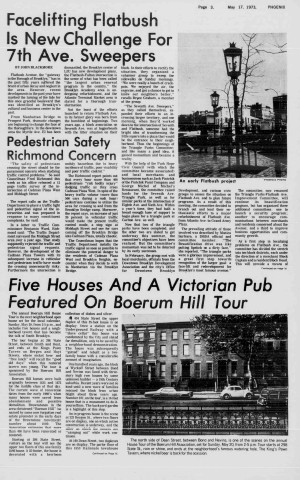
Page 3, May 17, 1973, PHOENIXFacelifting FlatbushIs New Challenge For7th Ave. SweepersBY JOHN BLACKMOREFlatbush Avenue, the %u201cgateway to the Borough of Brooklyn,%u201d has in the past fifty years suffered the brunt of urban decay and neglect in the area. However, recent developments in the past year have marked the turning of the tide for this once graceful boulevard that was identified as Brooklyn%u2019s cultural and business center in the past.From Manhattan Bridge to Prospect Park, dramatic changes are beginning to change the face of the thoroughfare. In the downtown area the Myrtle Ave. El has beendismantled, the Brooklyn center of LIU has new development plans, the Flatbush-Fulton intersection is the scene of what has been called %u201c the largest urban renewal program in the country,%u201d the Brooklyn Academy area is undergoing refurbishment, and the Atlantic Terminal Market area is slated for a thorough transformation.Not the least of the efforts launched to return Flatbush Ave. to its former glory was born from the humblest of beginnings. Two years ago, a block association on Seventh Ave. was at loggerheads with the litter situation on theirPedestrian SafetyRichmond Concern%u201cYhe safety of pedestrians crossing the street should be the paramount concern when studying traffic control problems.%u201d So said Councilman Fred Richmond this week as his office released a 12 page traffic survey of the intersection of Cadman Plaza West and Middagh StreetThe report calls on the Traffic Department to place a traffic light and pedestrian signal at the intersection and was prepared in response to many constituent complaints, he said.In a letter to Traffic Commissioner Benjamin Ward, Richmond said: %u201cThe Traffic Department surveyed the Middagh Street area over a year ago. That study supposedly rejected the traffic and pedestrian signal requests. However, the development of the Cadman Plaza Towers with its subsequent increase in vehicular and pedestrians traffic have made the crossing unnecessarily risky. Furthermore the intersection isunduly hazardous due to heavy incidence of traffic, poor visability and poor traffic control.%u201dThe Richmond report points out that every hour more than 400 pedestrians %u201crisk bodily injury%u201d dodging traffic as they cross Cadman Plaza West. In spite of the heavy traffic volume (more than 500 cars during a rush hour) pedestrians continue to utilize the area for crossing to and from the Brooklyn Bridge ramp. Moreover, the report says, an increase of just 20 percent in vehicular traffic would make the present traffic control mode, a stop sign at Middagh Street and one for cars coming off the Brooklyn Bridge into Cadman Plaza, totally chaotic.The Councilman hopes that the Traffic Department installs the traffic signal as soon as possible to eliminate the potential danger to the residents of Cadman Plaza West and Brooklyn Heights, encounter when they decide to walk to Manhattan via the Brooklyn Bridge.block. In their efforts to rectify the situation, they organized a volunteer group to sweep the sidewalks on Sunday mornings. %u201cWe were really a bunch of crackpots. We enjoyed the air, the exercise, and got a chance to get to know our neighbors better,%u201d recalls Bryce Graham, a member of the group.%u201cThe Seventh Ave. Sweepers,%u201d as they called themselves, expanded their efforts to an increasing larger territory, and one morning, when they%u2019d worked down to the intersection of Seventh and Flatbush, someone had the bright idea of transforming the little square into a plaza that would be the entrance to their neighborhood. Thus the beginnings of the Triangle Parks Committee; and like many a good idea, it gained momentum and became a reality.With the help of the Park Slope Civic Council (with which the committee became associated) and local merchants and businessmen such as Jack Pintchik of the Pintchik Paint Company and George Michel of Michel%u2019s Restaurant, the committee raised funds for the Seventh Ave. Triangle Park, as well as for similar parks at the intersection of Eighth Ave. and Sixth Ave. Within a year%u2019s time, they had built a broad enough base of support to begin plans for a triangle park at Carlton Ave. as well.Now that two of the triangle parks have been completed, and the other two are slated to get underway this summer, the committee%u2019s objectives have been realized. But the com mittee%u2019s momentum was not to be deterred by its early successes.In February, the group met with local merchants, officials from the Downtown Brooklyn Development Association and the city%u2019s Office for Downtown BrooklynAn e a rly Flatbush project PHOENIX PHOTODevelopment, and various civic groups to assess the situation on Flatbush Ave. and to plan future programs. As a result of this meeting, the committee decided to branch out and lend their enthusiastic efforts to a major refurbishment of Flatbush Ave. from Atlantic Ave. to Grand Army Plaza.The prevailing attitude of those involved was described by Monica Surfraro, a DBDA official and committee member. %u201c The Beautification drive was like putting lipstick on a dirty face,%u201d ' she reported, %u201cThe triangle parks were a glorious improvement, and a great first step towards recognition of the larger goal: a face-lift and redevelopment for Brooklyn%u2019s most famous avenue.%u201dThe committee, now renamed the Triangle Parks-Flatbush Ave. Improvement Committee, will continue its beautification program, but has organized three additional committees: one to launch a security program; another to encourage communications between merchants and residents concerned about the Avenue; and a third to improve business opportunities and community growth.As a first step in localizing problems on Flatbush Ave., the committee has divided the stretch into ten block districts, each under the direction of a merchant Block Captain and a resident Block Head. This will provide a means ofContinued on P a g e 16Five Houses And A Victorian PubFeatured On Boerum Hill TourThe annual Boerum Hill House Tour is the next neighborhood open house set for the local calendar, Sunday, May 20, from 2-5 p.m., and includes five houses and a neighborhood tavern that has become the talk of South Brooklyn.The tour begins at 298 State Street, between Smith and Hoyt, and ends at the Kings Pawn Tavern on Bergen and Hoyt Streets, where nickel beer and %u201cfree lunch%u201d will recall the %u201cgood old days%u201d when this restored tavern was young. The tour is sponsored by the Boerum Hill Association.Boerum Hill homes were built originally between 1835 and 1875 for the middle class of that day. The current wave of renovation dates from the early 1960%u2019s when many houses were saved from abandonment and possible demolition. Brownstones in the area christened %u201cBoerum Hill%u201d (so named by some now forgotten real estate promoter in the early days of the Brownstone movement) number about 1000. TheA c s n c in tin n p g tim n tp c th a t m n rothan 400 have been renovated or restored.collection of dishes and silver./ I 434 State Street the upper duplex of this 25-foot house is on display. Once a station on the Underground Railway with a %u201cslave cellar%u201d this house was condemned by the City and slated for demolition, only to be saved by a neighborhood demonstration. The house was subsequently %u201cgutted%u201d and rebuilt as a twofamily house with a considerable amount of imagination.One hundred years ago, the block of Wyckoff Street between Bond and Nevins was lined with threestory high row houses by some unknown builder %u2014 a 19th Century suburbia. Recent years were not so kind until a new wave of families rescued the block from urban blight about three years ago. Number 237, on the tour, is a 16-foot house that is a monument to do-ityourselfism. The backyard garden is a highlight of this stop.An in-progress house is the scene at 223 Bergen St., where two floors are on display, one on which active construction is underway, and the- i t . ------------ ---1- ! -I . 4 1. . _____u u i c i v n w i i iv . i l u i c v w u c i a a i c%u201ccamping out%u201d while work continues.Starting at 298 State Street, visitors on the tour will see the upper two floors of this one-family 1846 house. A 25-footer, the house is decorated with a heirloomAt 160 Dean Street, two duplexes are on display. The parlor floor of this 1853 Italianate townhouseThe north side of Dean Street, between Bona and Nevins, is one of the scenes on the annualHouse Tour of the Boerum Hill Association, set for Sunday, May 20, from 2-5 p.m. Tour starts at 298State St., rain or shine, and ends at the neighborhood%u2019s famous watering hole, The King%u2019s PawnContinued on Page 16 Tavern, where nickel beer is back for the ocassion.


