


Page 29 - Demo
P. 29
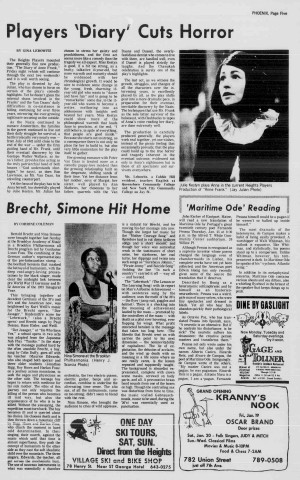
PHOENIX, Page FivePlayers 'Diary' Cuts HorrorBY GINA LEBOWITZThe Heights Players mounted their generally fine new production, %u201c The Diary of Anne Frank,%u201d Friday night (which will continue through the next two weekends) and it is well worth seeing.The play is directed by Jay Julian, who has chosen to focus on certain of the play%u2019s comedic highlights. Yet he doesn%u2019t gloss the internal chaos involved in the Franks%u2019 and the Van Daans%u2019 daily difficulties in co-existence in hiding, continuing for over three years, mirroring the ever-growing nightmare occuring on the outside.As the Nazis continued to menace Amsterdam, the families in the garret continued to live out their daily struggle for survival, a battle ironically very nearly won %u2014 from July of 1942 until close to the end of the war %u2014 under the firm guiding hand of Mr. Frank, until their eventual discovery by the Gestapo. Walter Wallace, as Anna%u2019s father, provides fine acting as the truly patriarchial head of both houses (%u201c God understands shortages,%u201d he says), as does Ron Lawrence, as Mr. Van Daan, his sniveling counterpart.Yet the focus of the play has to be Anna herself, too cheerfully played by Julie Kestyn. Mr. Julian haschosen to stress her gaiety and prankishness, and the first act seems more like a comedy than the tragedy we all expect. Miss Kestyn is good, if a bit too strong, as a bratty, talkative 13-year-old, but more warmth and maturity should be evidenced with her chronological growth. It would be nice to evidence some change in the young, fresh, charming 13- year-old girl who wants to %u201c dance and have fun%u201d and is going to be %u201c remarkable%u201d some day, to the 15- year-old who wants to become a writer, mellowing into an adolescense with insights well beyond her years. Miss Kestyn could show more of the philosophical warmth that leads Anne to proclaim, at the end, %u201c I still believe, in spite of everything, that people are good inside.%u201d Because she starts out so strong, as a consequence there is not only no place for her to build to, but also very little momentum for the play itself to gather.Her growing romance with Peter Van Daan is treated more as a comedic puppy-love incident than the growing relationship built on the desperate, shifting sands of their time. Yet her distance from her mother, envy of Margot, her sister, well played by Ann Mathews, her closeness to her father, quarrels with the VanDaans and Dussel, the overlyfastidious dentist who comes to live with them, are handled well, even if Dussel is played strictly for laughs. And the Chanukah celebration is surely one of the play%u2019s highlights.The last act, as we witness the growth, struggles, and changes of all the characters over the intervening years, is excellently played by all, as the play shifts gear into a more dramatic pace, in preparation for their eventual, inevitable discovery by the Nazis. The techniques that use Mr. Frank as the sole bitter survivor of the holocaust, with flashbacks to tapes of Anna%u2019s voice reading her diary, are done extremely well.The production is carefully produced generally, the players work real together, yet one wishes, instead of the picnic feeling that occasionally prevails, that the play could build up to the true horror and tragedy inherent in the eventual outcome, evidenced not only in Anna%u2019s nightmares but in those of all spectators and survivors everywhere.Ms. Lebowitz, a Cobble Hill resident, teaches English at Queensboro Community College and New York City Community College on Jay St.Brecht Simone H it H om eBY CORRINE COLEMANBertold Brecht and Nina Simone were brought together last Sunday at the Brooklyn Academy of Music in a Brooklyn Philharmonia all Brecht program led by Conductor Lucas Foss. The combining of the German author%u2019s representations of the pre-holocaustian stomp %u2014 the beerhall heroism that masked the betrayal of humanism, with the deep cool-angry-loving presentations by the black singer, made clear the midnight link between p(re World War II Germany and B52 America of the 1973 Inaugural Year.This bringing together of decadent Germany of the 20%u2019s and 30%u2019s and the American now, was heightened by Kurt Weill%u2019s music for the Brecht opera, %u201c Der Jasager,%u201d Hindemith%u2019s score for %u201c Lehrstuck,%u201d (also a Brecht opera) and Brecht songs by Paul Dessau, Hans Eisler, and Weill.%u201c Der Jasager,%u201d or %u201c He Who Says Yes,%u201d a school opera in two acts was adapted from the Japanese Noh Play %u201c Taniko.%u201d In the story with the message pushed hard by the often unsubtle Brecht, a boy, sung by Colin Duffy, goes off with his teacher (Maurice Edwards, who also staged both operas) and three older students (Jonathon Rigg, Roy Hines and Harlan Foss) on a journey across mountains, to seek the sages and physicians on the other side. The teenage boy hopes to return with medicine for his sick mother. The ethic of this journey not only requires the killing of the person who becomes ill mid way, but also the acquiescence of he who is to be killdd. Without the yeasaying, the expedition must turn back. The boy becomes ill and is queried about his choice. He chooses death and is then thrown down a mountain cliffu y iu g g , I lined aiiu ila iiu u Fuoa,who clinch the moment in hard cold determination. In their singing, their march, against the music which until that time is almost superfluous, they push the concept of humanism to the other side as they cast the soft idealistic child over the mountain. The three singers, Edwards, the teacher, allgel aCiuss iuc uicCuaiUauC hum.The use of nouveau instruments in what was essentially a chamberNina Simone at the BrooklynPhilharmonia. (Henry J.Scorcia Photo)orchestra, the two electric pianos, electric guitar, banjo and accordian, combine to underline the alternating time sense. The alto sax, of all the instruments, came on too strong; didn%u2019t seem to blend with the rest.Nina* Simone, who brought the audience to cries of wild applause,is a natural for Brecht, and for moving his-her message into now. Though she forgot her music for tha %u201c Mother Courage Song%u201d and therefore had to cut down to4hree songs and a short encore; and though her voice was somewhat weak in the sustenance of short notes, her starkness, her cool turns, her dippings and twists into such songs as %u201c Surabaya Johnny,%u201d %u201c Pirate Jenny%u201d and Suicide Song%u201d (holding the line %u201c In such a country%u201d ) carried it off %u2014 way off%u2014 and bevond.The %u201c Lehrstuck%u201d (The Lesson or The Learning Song) with its report (on Man%u2019s Airborne Achievement %u2014 with sentences sung by the audience, uses the motif of the 20%u2019s%u2014 the flyer (jump suit, goggles and helmet). There is a checking into the meaning of achievement lauded by the mass %u2014 promoted by the controllers of the mass %u2014 with death as a pilot ever hovering, ever flapping his wings. What profit concocted heroism is the message that takes too long here. (The libretto that Brecht went on with carries the point to his next dimension %u2014 the noninevitability of capitalism). The lie of exploitation, the delusion of acclaim, and the wind up death with no meaning in a life scene where no one really cares, is the lesson repeated and supposedly taught. The background is absurdist expressionist, complete with clown scene masks, screwed on body parts, and all. A provocative brass band sounds from one of the boxes on high. Though the controlling sax was disturbing from time to time, the music (called Gebrauschmusik, music to be used, during the %u201920%u2019s) was essentially used as punctuation.QNE DAYs k I \SAT, SUN.Direct from the Heightsy i i i A f i c cfcrs m i s c c u n o* %u2022 m a m r~ m 'W*r m . a m m w g v %u25a0 %u25a0 n m . w a s ' W a7 8 H en ry St. N e a r ST G e o rg e H o te l 6 4 3 - 0 2 7 5Julie Kestyn plays Anna in the current Heights PlayersProduction of %u201cAnne Frank.\| 'Maritime O de%u2019 Reading fJohn Escher of Eastport, Maine, will read a new translation of Maritime Ode by Portugal%u2019s great twentieth century poet Fernando Pessoa Thursday, Jan. 25 at 8:30 p.m. in the Alfred T. White Community Center auditorium, 26 Willow PI.Although Pessoa is recognized as a supreme inventor whose poems changed the language even of chambermaids in Lisbon, his complete works have not yet been collected, and the American poet Edwin Honig has only recently given some of the oeuvre the translation that it deserves.Described by Honig as a heteronymic schizophrenic and by himself as an hystericoneurasthenic, Pessoa was a weird, pale man of many selves, who wore tiny spectacles and dressed in black. Yet all who hear him abandon quickly their pathological labels.As Octavio Paz, who has translated Pessoa into Spanish, says, %u201c A neurotic is an obsessive. But if he controls his disturbance, is he sick? The neurotic suffers his obsessions; the creative person masters and transforms them.%u201dPessoa not only wrote under his own name, but also under the%u2019 names Alberto Caeiro, Ricardo Reis, and Alvaro de Campos, the poet of Maritime Ode. Intriguingly, de Campos wrote of the others, %u201c My master Caeiro was not a pagan; he was paganism. Ricardo Reis is a pagan, Antonio Mora is a pagan, I am a'pagan. FernandoPessoa himself would be a pagan if he weren%u2019t so balled up inside himself.%u201dThe most dramatic of the heteronyms, de Campos makes a habit of being easily provoked. A worshipper of Walt Whitman, his outlook is expansive, like Whitman, and stylistically, his poems stand up to a comparison. Unlike Whitman, however, his temperament is dark. In Maritime Ode he speaks of his %u201c cyclonic, Atlantic being.%u201dIn addition to its metaphysical concerns, Maritime Ode contains various shouts and sea ditties, also a whirling flywheel in the breast of the speaker that keeps things up to pitch.DIIEBVUSU6HTNow Monday, Tuesday andSaturday evenings.Try it soon.G a g e ANDTo liln er%u2022iMklyi'i Uilaiik lisliimtWinner of muqh s i. ssookitn2Qannual > hocks mom aoio hauHOLIDAY 5 Jillmagazine g?e.n i ; so am to t pmAwards sat m %u00bb jo %u2022 cio.%u00abd Sunday.G R A N D OPENING%u25a0CRANNY'SN O O Ks n. %u2022- Fsi, Jan. 19OSCAR BRANDDoor prizesSat., Jan. 2 0 - Folk Singers, JUDY & MITCHSun.-W ed. Classical FilmsM ovies & M usk 8-10PMFood & Chess 7 -2 A MI 7 82 Union Streetjust off 7%u00bbh Ave.789-0508


