


Page 26 - Demo
P. 26
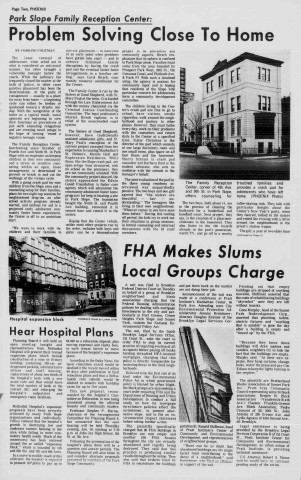
Page Two, PHOENIXPark Slope Family Reception Center:Problem Solving Close To HomeBY CORRIN'E COLEMANThe inner turmoil of adolescence, when acted out in what is considered an anti-social manner, has often brought a vulnerable teenager before the courts. While the judiciary has frequently closed the matter at the halls of justice, in other cases punitive placement has been the determination. At the point of consignment %u2014 usually to a place far away from home %u2014 a beginning cycle can either be broken or quickened toward a drastic windup. With the recognition of the latter as a typical result, social agencies are beginning to view their functions as preventives of just such alienating relegations and are creating novel setups in the hope of turning %u2019round a negative teenage vision.The Family Reception Center, functioning since October at Fourth Ave. and Ninth St. in Park Slope with an emphasis on keeping children in their own community and a stress on sensitive counseling within an open, loose arrangement, is determined to prevent or break in and cut the workings of the vicious cycle.With a going crash pad for nine children from the Slope area and a counseling setup for their families, plans for two night rap sessions for neighborhood drop ins, an after school activity program already started, and outlines for aid to a projected early adolescent community foster home experiment, the Center is off to an ambitious start.%u201cWe want to work with the children and their families top r e v e n t placement %u2014 to intervene at an early point when problems have gotten into court %u2014 and to achieve minimum family disruptions by having the crash pad and the eventual foster home arrangements in a familiar setting,%u201d says Carol Hirsch, community resource coordinator for the Center.The Family Center is run by the Sisters of Good Shepherd, with Sr. Mary Paul at the helm. It is funded through the Law Enforcement Act with the money channeled via the Criminal Justice Coordinating Committee. The legal profession%u2019s interest, Hirsch explains, is in relief of the overcrowded court system.The Sisters of Good Shepherd, however, have traditionally assisted adolescent girls, and Sr. Mary Paul%u2019s conception of the current project emerged from her experience in running Manhattan%u2019s St. Helena%u2019s, Marion Hall and Euphrasian Residences. While these, like the Slope crash pad, are open setups (less structured, with no school on the premises), they are not community oriented. With the community project okayed, the sisters approached the Edwin Gould Foundation (a foster care agency which will administer the community adolescent foster home program) for help in locating a site in Park Slope. The foundation bought the Ninth St. and Fourth Ave. building, renovated it in record time and rented it to the sisters.Hoping that the Center (which, unlike most other projects run by the order, includes both boys and girls) can be a demonstrationproject in its preventive anu community aspects, Hirsch emphasizes that its sphere is confined to Park Slope alone. Families must come from the area bounded by Prospect Park West, 20th St., the Gowanus Canal, and Flatbush Ave. & Park PI. With such a localized setup, the agency is anxious for community input and is hoping that residents of the Slope with particular concern for adolescents form a community development committee.The children living in the Center%u2019s crash pad are free to go to school, have visitors, smoke cigarettes, walk around the neighborhood and journey to other places. However, they must bathe every day, work on their problems with the counselors and return daily to the Center at a specified time. Sister Christine is the director of the pad which consists of one large dormitory room and one small room, plus space on all four floors and the basement. Sherry Schram is crash pad counselor and Barbara Root is the student advocate, who acts as mediator with the schools in the teenager%u2019s behalf.The joint evaluation of the pad by the three young residents interviewed was unqualifiedly positive. The two boys and one girl agreed that %u201c the sisters are beautiful %u2014 fair %u2014 understanding.%u201d The teenagers like living in their own neighborhood. %u201c Whoever comes in you have seen them before.%u201d During this cooling off period, the kids try to work out their situations in group sessions, in formal counseling and informal discussions with the 26 staff members.The Family ReceptionCenter, corner of 4th Ave.and 9th St. in Park Slope,offers counseling forThe two boys, both about 14, are in the process of cleaning the backyard for a basketball and handball court. Next project, they say, is the creation of a playroomclubroom in the basement. They also listen to the 100 records already in the pad%u2019s possession, watch TV, and go off to a nearbytroubled families andprovides a crash pad foradolescents who have lefthome. (PHOENIX Photo)roller-skating rink. They talk with particular delight about the Center%u2019s New Year%u2019s party, when they danced, talked to the sisters and ended the evening with a drive around the neighborhood in the priest%u2019s station wagon.The girl, a year or two older thanC o n tin u ed on P a g e 12FH A M akes SlumsLocal G roups C h arg eH o s p ita l e x p a n s io n block P H O E N IX Photo by L y n n e G rifoHear Hospital PlansPlanning Board 6 will hold an open meeting tonight and representatives from Methodist Hospital will present their revised expansion plans which include construction of a nine or 10-story building containing 383-car underground parking, administrative offices and staff housing; replacement of about two-thirds of the hospital%u2019s beds with a new acute care unit that would leave the total number of beds at the current 562; and enlarging the hospital%u2019s outpatient and emergency room facilities.Methodist Hospital%u2019s expansion proposals have been severely criticized by many Park Slope organizations and individuals. Critics contend that the hospital%u2019s growth is destroying low and moderate income housing in the area while failing to meet community health needs. Much of the controversy has been centered around the so called %u201c expansion block,%u201d which is bounded by 5th and 6th Sts. and 7th and 8th Aves.In a move to mollify much of this criticism, the hospital is expected to present its1* plans to pay'up to$4,000 as a relocation stipend, plus moving expenses and realty fees, to each tenant forced to move because of the hospital%u2019s expansion plans.According to the Daily News, the basic relocation award would be doubled if the tenant moved within 90 days after publication of final relocation plans and that a $100-amonth rent subsidy would be allotted to tenants with hardship cases for up to five years.This new proposal, recommended by the hospital%u2019s Committee on Relocation, is now being circulated among the affected tenants and community leaders.Professor Stephen P. Marion, chairman of the Arrangements Committee for Planning Board 6, has announced that the open hearing will be held Thursday evening, Jan. 18, starting at 7:30 pm. at John Jay High School, 5th St. at 7th Ave.Following the presentation of the hospital%u2019s plans there will be a question and answer periods. The Planning Board will also listen to and consider alternate proposals presented by members of the Pa%u2019*1' Slope Community.A suit was filed in Brooklyn Federal District Court on Tuesday on behalf of a group of Brooklyn neighborhood and block associations charging that the Federal Housing Administration policies for dealing with mortgage foreclosures in the city and particularly in Fort Greene, Crown Heights Park Slope and Sunset Park, violates the National Environmental Policy Act.The suit, filed by the South Brooklyn Legal Services Office, 152 Court St., asks the court to order FHA to stop its current practice of requiring eviction of all occupants before paying off banks holding defaulted HFA-insured mortgages, charging that this policy is directly reesponsible for hastening decay in the cited neighborhoods.Believed to be the first suit of its kind under the Environmental Policy Act in which government policy is blamed for urban blight, the block groups are also seeking a court order requiring FHA and the Department of Housing and Urban Development to conduct a full study on how its mortgage foreclosure policies affect the invironment; to present alternative steps, and to file an environmental impact statement before taking further action.The plaintiffs specifically charged that 80 FHA buildings in Brooklyn are now empty and another 200 FHA houses throughout the city are virtually abandoned and rapidly being destroyed. They said that this practice is producing similar results throughout the nation. They also said that brokers hired hv FHA to rehabilitate the buildingsand put them back on the market are not doing their job.Announcement of the suit was made at a conference at Pratt Institute%u2019s Manhattan Center, 46 Park Ave. Attending were City Environmental Protection Administrator Jerome Kretchmer; Attorney Douglas Kramer of the Brooklyn Legal Services Corporation B ; Ronald Shiffman, head of Pratt Institute%u2019s Center of Community and Environmental Development, and representatives of neighborhood groups.%u201c There can be no doubt that abandoned buildings are the single factor most contributing to the decay of a neighborhood,%u201d saidRrotchmar w/hn fila/4 __ ~ - --w. , ..%u00bb.u %u201c * v %u00ab uii uuiuavii.in support of the suit.Pointing out that empty buildings are stripped of anything movable, Shiffman asserted that the costs of rehabilitating buildings %u201c skyrocket%u201d once they are left without tenants.Gene Murphy, head of the Sunset Park Redevelopment Corp., asserted that plumbing, toilets, electric fixtures and %u201c anything that is salable%u201d is gone the day after a building is empty and %u201c tinned up%u201d by the FHA.%u201c Because they know these buildings will draw junkies and vandals, neighbors try to hide the fact that the buildings are empty, Murphy said. %u201c At their own expense, they hang curtains, change locks, water the grass and pay Con Edison to keep the lights burning in the empties.%u201dThe plaintiffs are Brotherhood Blocks Association of Sunset Park Inc.; Pratt Area Community Council representing some 50 block associations; Bergen St. Block Association (Vanderbilt-Sixth Ave.); Classon - Franklin-Greene Ave. Block Association; Pedro Crescent of 251 50th St.; John Antonio of 288 Greene Ave. and Lydia Aguayo of 5416 Second Ave., all Brooklyn.Legal assistance is being provided by the Brooklyn Legal Services Corporation B of 152 Court St., Pratt Institute Center for Community and Environmental Development, an urban action of Pratt Institute, is providing technical assistance.U.S. Attorney Robert A. Morse Raid h p WOUld h a y p no comment pending study of the action.


