


Page 3 - Demo
P. 3
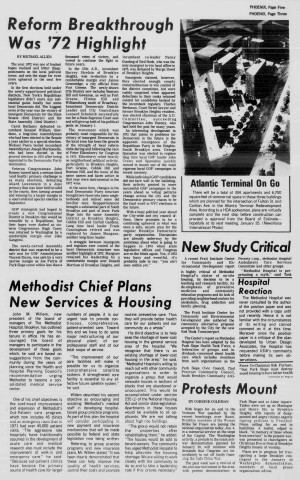
PHOENIX, Page FivePHOENIX, Page ThreeReform BreakthroughW as '77 H iahliahtBY MICHAEL ALLENThe year 1972 was one of fondest hopes realized and bitter disappointments on the local political scene, and sets the stage for even more upheaval in the next few years.In the first elections held under the newly-apportioned political districts, New York%u2019s Republican legislature didn%u2019t score any substantial gains locally but some local Democrats did. The b iggest news of the year was the victory of insurgent Democrats for the State Senate (23rd District) and the State Assembly (52nd District).Carol Bellamy defeated incumbent Senator William Giordano, a long-time Assemblyman who had been elected to the Senate a year earlier in a special election. Michael Pesce bested incumbent Assemblyman Joseph Martuscello, who had been elected in the general election in 1970 after being appointed to the Democratic Party nomination.Veteran Congressman John Rooney turned back a serious third (and fourth) primary challenge in as many elections, defeating Allard Lowenstein in a June primary that was later held invalid by the courts, then turning around and winning by a larger margin in a court-ordered special election in September.GOP strategists had hoped to create a new Congressional District in Brooklyn that would be winnable by a Republican, but their hopes were dashed as sixterm Congressman Hugh Carey was returned to Washington by a comfortable margin over John Gangemi.The newly-carved Assembly district that was expected to be a safe seat for GOP Assemblyman Vincent Riccio, was safe by a very narrow margin as Joe Ferris of Park Slope came within less than athousand votes of victory, and vowed to continue the fight in future years.In the 57th A.D., incumbent Harvey Strelzin of Brooklyn Heights, won re-election by a comfortable margin over James Greenridge, a city official from Fort Greene. The newly-drawn 57th District now includes Boerum Hill and Gowanus, as well as Fort Greene, Clinton Hill and Williamsburg south of Broadway. Incumbent Democratic District Leader and City Councilman Leonard Scholnick successfully ran for a State Supreme Court seat and will give up both of his political posts on January 1.The movement which was probably most responsible for the victory of insurgent Democrats in the local area has been the growth of the strength of local reform clubs during and following the race of Peter Eikenberry for Congress in 1970. Eikenberry relied heavily on neighborhood political activity, particularly in Brooklyn Heights, Fort Greene, Cobble Hill and Boerum Hill, and the many of the same names and faces active in that year were instrumental in the 1972 wins.At the same time, changes in the local Democratic Party structure brought new faces into some neighborhoods and retired some old familiar ones. Reapportionment brought a substantial part of South Brooklyn and part of lower Park Slope into the same Assembly District as Brooklyn Heights, Cobble Hill and Carroll Gardens. Long time local leader Frank Cunningham retired and was replaced by James Mangano, another long-time leader.A struggle between insurgents and regulars over control of the local Democratic structure was another highlight of 1972. Mangano retained his leadership by a comfortable margin over Donald Morrison of Brooklyn Heights, andincumbent co-leader Nancy Gooding of Red Hook, who was the only insurgent to win local office in 1970, was defeated by Marge Dowd of Brooklyn Heights.Insurgents claimed, however, they elected enough county commmitteemen to win control of the district committee, but were rudely surprised when apparent defections in their ranks retained control for candidates backed by the incumbent regulars. Charles Berkman, Court Street lawyer and former Brooklyn Heights resident, was elected chairman of the A.D. C o m m itte e , s u c c e e d in g Congressman John Rooney, who had held the post for many years.An interesting development in 1972 that points to problems for Democrats in the future is the apparent resurgence of the Republican Party in the HeightsSouth Brooklyn area. George Spanakos was elected to replace long time local GOP leader John Crews and Spanakos quickly moved to mount one of the most vigorous local GOP campaigns in recent memory.While individual GOP candidates did not fare well in the balloting, their activity pointed to more successful GOP campaigns in the years ahead as voting patterns change across the city and the Democratic primary ceases to be the final word in NYC elections in the future.With a busy political year ahead for City-wide and city council offices, there promises to be a continuing upheaval in what was once a safe, secure area for the regular Brooklyn Democratic party organization. Discussions are already underway by the ambitious about what is going to happen in 1974 when state legislative offices and Congress are on the block again. Yes, if 1972 was busy and eventful, it%u2019s probably safe to say, %u201cyou ain%u2019t seen nothin yet.%u201dMethodist ChieNew Services & HousingJohn M. Willem, new president of the board of managers of The Methodist Hospital, Brooklyn, has outlined three primary goals for his tenure in office. He has encouraged the board of managers to participate in the development of these goals which, he said are based on suggestions from the community during the years of planning since the Health and Hospital Planning Council%u2019s recom m endation urging Methodist to become a consolidated medical service center.One of his chief objectives is the continued improvement and expansion of Methodist%u2019s Out-Patient care program, which now includes 45 clinicsciuu on emergency ruuni uidi in1971 had over 45,000 patient visits. %u2018%u2018The aggressive role hospitals have traditionally assumed in the development of acute care and medical research also must include the improvement of walk-in and emergency care.%u201d he said. %u2018%u2018Because out-patient clinics have become the primary source of health care for largernumbers of people, it is our urgent task to provide continuous, com prehensive, patient-oriented care. Toward this end we have to do some major restructuring of our physical plant, of our professional staff and of our total scope of service.%u201cThe improvement of our core facilities will make it possible for us to organize com prehensive s a te llite systems. A strengthened core facility is essential to any effective future satellite system,%u201d he said.Willem described his second objective as encouraging and assisting Methodist%u2019s medical staff in developing hospitalbased group practice programs. As part of this plan the hospital...:n : _V Y III L U M I O I U C I p u l I I L I ^ U U I I g I I Inew payment and insurance mechanisms that will be made possible by federal and state legislation now being written.Referring to group practice programs and new insurance plans, Mr. Willem stated, %u201c It has been clearly demonstrated that these can help improve the quality of health services, control their costs and promoteAtlantic Terminal On GoThere will be a total of 304 apartments and 6,700 square feet of commercial space in these three buildings which are planned for the intersection of Fulton St. and Carlton Ave. in the Atlantic Terminal Redevelopment Area. According to a HDA spokesman, plans are virtually complete and the next step before construction can proceed is approval from the Board of Estimate%u2014 hopefully at its next meeting, January 25. (NewsVoice International Photo)New Study Criticalroutine preventive care. Thus they will provide better health care for our patients and our community as a whole \His third objective is to help ease the shortage of lower-cost housing in the general service area of the hospital. %u201c We recognize that there is an existing shortage of lower-cost housing in the area,\%u201c Methodist Hospital is willing to reach out with other community organizations in order to organize a group that would renovate houses in sections of blocks that are abandoned or unoccupied. This would be accomplished under section 235 (j) of the National Housing Act and similar state legislation. Apartments in these houses wouid be available to ail applicants. We are not talking~ i-------a u : ~ u ~U I A ) U 1 m g l l l I O L U U I I U I ! I g O .\the properties after rehabilitating them,%u201d he added. %u201c The houses would be sold to tenant-owners. The community has urged Methodist Hospital to help alleviate the housing shortage. We are willing to work closely with the community to do so and to take a leadership role if this proves necessary.%u201dA recent Pratt Institute Center for Community and Environmental Development reportis highly critical of Methodist Hospital%u2019s choice of on-site housing, its decision to be a teaching and research facility, its de-emphasis of preventive medicine and community education programs and its lack of providing neighborhood centers for alcoholism, drug addiction and family planning.The Pratt Institute Center for Community and Environmental Development also authored the community alternative proposal accepted by the City for the new Red Hook Containerport.The Center%u2019s report on Methodist Hospital has been adopted by the Park Slope Health Task Force, a federation of groups and individuals concerned about health care which includes members from such organizations as thePark Slope Civic Council, 72nd Precinct Community Council, South Brooklyn Community AntiPoverty corp., Methodist Hospital Ambulatory Care Services Committee and other groups.%u201c Methodist Hospital is perpetuating a myth,%u201d said TaskHospitalReactionThe Methodist Hospital was never consulted by the author of the position paper and was not provided with a copy until just recently. Hence it is not familiar with the circumstances of its w riting and cannot comment on it at this time. Moreover since the position paper is a critique of the plan developed by Urban Design Associates, the Hospital has requested UDA%u2019s comments before making its own observations.Force Co-Chairman Bob Furman, %u201cthat Park Slope must destroy sound housing to have better healthContinued on Page 8Protests MountF ' ' -BY CORRINE COLEMANWith hopes for an end to the Vietnam War quashed by the recent bombings over Hanoi,B r n n U t m m n m K n r c n f fV%u00bbn W n m n n p ir t n in r t n n f i f-i------ W----J *'***'-' %u25a0>Strike for Peace are joining the national organization today, Jan. 4, in a memorial service on the steps of the Capitol. The Washington activity, a prelude to the mass antiwar demonstration planned for January 20, will continue with demands that Congress act immediately to cut off funds finanPark Slope and at Albee Square Tables were set up on Montague and Henry Sts. in Brooklyr Heights, with reports of disap pointed and angry citizens eagerljA t V U l U l / U Vv . u i g U 1C J U U U V/1I J I I U m u .The past week saw a revival of the anti-war movement in the area, with protest demonstrations inNixon calling for an end to hostilities. A leaflet, edged in black, %u201cin memory of those whose lives were lost%u201d in the present war, was presented to churchgoers on Christmas Eve in front of Brooklyn Heights houses of worship.Plans are in progress for transporting a large Brooklyn contingeni to the January 20 W ashington dem onstration, members of local peace organizations advise.


