


Page 314 - Demo
P. 314
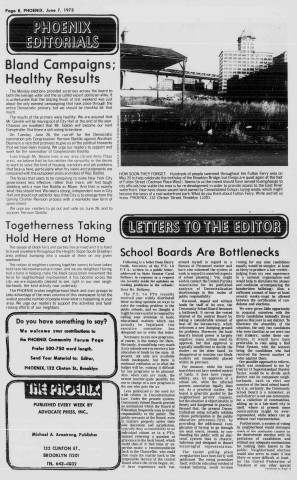
Page 8, PHOENIX, June 7, 1973m& ?i h 1Bland Cam paigns;Healthy ResultsThe Monday elections provided surprises across the board to both the average voter and the so-called expert politician alike. It is unfortunate that the blazing finish of last weekend was just about the only earnest campaigning that took place through the entire Democratic primary, but we should be thankful for that much.The results of the primary were healthy. We are assured that Mr. Garelik will be moving out of City Hall at the end of the year. Chances are excellent that Mr. Goldin will become our next Comptroller. But there is still voting to be done.On Tuesday, June 26, the run-off for the Democratic nomination pits Congressman Herman Badillo against Abraham Beame in a race that promises to give us all the political fireworks that we have been missing. We urge our readers to support and work for the nomination of Congressman Badillo.Even though Mr. Beame lives in our area (Grand Army Plaza area), we believe that he has neither the sympathy or the desire to work to solve the kind of housing, narcotics and job problems that face us here, particularly when his views and statements are compared with the outspoken plans and ideas of Rep. Badillo.The forces that seem to be conspiring to make New York City government less effective, rather than more, will find tough sledding with a man like Badillo as Mayor. And that is exactly what they should find. We need a strong, independent man in City Hall and should not settle for less if the City is to emerge from the coming Charter Revision process with a workable new form of governmentHOW SOON THEY FORGET: Hundreds of people swarmed throughout the Fulton Ferry area onMay 20 to help celebrate the birthday of the Brooklyn Bridge, but things are quiet again at the footof Fulton Street (Cadman Plaza West). Seems to us the crowd should have served to emphasize tocity officials how viable the area is for re-development in order to provide access to the East Riverwaterfront. View here shows vacant land owned by Consolidated Edison, laying waste, which mightbecome the basis of a real waterfront park. What do you think about Fulton Ferry. Write and let usknow. PHOENIX, 132 Clinton Street, Brooklyn 11201.We urge our readers to go out arid vote on June 26, and to support Herman Badillo.Togetherness Taking Hold Here at HomeThe season of block fairs and parties has arrived and it is hard to travel anywhere throughout the Heights-Slope-South Brooklyn area without bumping into a couple of them on any given weekend.The notion of neighbors coming together seems to have taken hold here like nowhere else in town, and we are delighted. Having had a hand in helping make the block association movement the force for neighborhood improvement it has become across the city, we are especially pleased to see, right in our own neighborhoods, the kind activity now underway.The PHOENIX invites neighborhood block and civic groups to take advantage of the news columns of this newspaper to let the widest possible number of people know what is happening in yourarea. We urge our readers to support the activities and fundraising efforts of our neighbors.School Boards Are BottlenecksDo you have something to say?W%u00ab walcoma your contributions frottw PHOENIX CoiiHSunify Forum PagoProfor 500-750 word longfrh.Send Your Material to: Editor,PHOENIX, 132 Clinton St., BrooklynM ichael A. Armstrong, Publisher132 CLINTON ST.,BROOKLYN 11201TEL 643-4032Following is a letter from HarrySmith, Secretary of the P.S. 7-8P.T.A., written as a public letter,addressed to State Senator CarolBellamy in response to a requestshe recently made for opinions onreading problems in the schools:Dear Ms. Bellamy,The P.S. 7-8 PTA recentlyreceived your widely distributedletter inviting opinions on ways tosolve the reading problem in thepublic schools, and we thought itmight be more useful to respond bycalling your attention to basiceducational matters which canactually be legislated. Ourexecutive committee hasdelegated me to write this letter.Necessary to any new programs,of course, is the money for them.Obviously, it would help very muchif city schools were to receive a fairallocation of funds by the state. Atpresent, not only are availablefunds inadequate, but there iscontinual confusion as to what thebudget will be, making it difficultfor any programs to be planned.Also, when cuts are made, thenewest teacher-quite possibly theone in charge of a new program-isthe one who gets the ax.Less publicized is the need forwide reform in DecentralizationLaw. Under the present system,Community School Boards providean instrument which the Board ofEducation frequently uses to evaderesponsibility to the public. Thepublic servants at the Board, evenin matters properly under theirsole discretion and jurisdiction,typically deny accnuntahilitv to an individual citizen or to a PTA,instead referring a question orgrievance to the local board, whichcould then-if it had time or expertise-make a recommendationback to the Chancellor, who couldthen route the matter back to theresponsible bureau of the centralBoard where the circle began, etc.(I have experience such runaround myself in regard to aBureau of Personnel matter andhave also witnessed the system atwork in regard to assorted aspectsof school planning.) You mightwish to contact the United ParentsAssociation for its publishedanalysis of Decentralizationshortcomings in this realm ofpublic responsibility.Harassed, unpaid and withoutfunds for staff of its own, theCommunity School Board becomesa bottleneck. It serves the vestedinterest of the central Board bytaking a considerable amount ofheat off the bureaucracy, whichwelcomes a new dumping groundfor problems. Moreover, the localboard%u2019s limited power is largelynegative: many actions need itsapproval, but that approval istypically insufficient to decide thematter; on the other hand, itsdisapproval or inaction can blockmatters not reasonably placedwithin its province.For instance, while the localboard does not have needed controlof funds, it does have responsibility, say, for approval of aschool site, while the affectedparents association legally doesnot. As a practical matter, theboard is generally guided by theneighborhood parents%u2019 requests,but the situation is objectionable intheory and dangerous in practice.Beyond that, the present Decentralization setup actually inhibitscitizen participation in die publiceducation processes-first, byproviding the additional complication of having to go throughthe iocai board; second, Dy confounding the public with an electoral system that is chaotic,ludicrous and designed to thwartm eaningful representation.The recent polling placeirregularities have been fairly wellpublicized. The voting procedureitself, with the ridiculous method ofranked balloting, needs revision(voting for any nine candidatesequally would be simpler, at leastas likely to produce a fair verdictjudging from my own experiencein a national organization-andwould help to eliminate the abusesand confusion accompanying thehandwritten balloting). Also, asufficient amount of time-at leastseveral weeks-must be allowedbetween the certification of candidates and elections.We were given little opportunityto acquaint ourselves with thethirty candidates belatedly thrustupon us this year in our district. Toillustrate the absurdity of thesituation, the only two candidateswho were familiar to me were tworeal stinkers; under these conditions, it would have beenpreferable to vote using a BadPoint System, with the winnersbeing the candidates who hadreceived the fewest number ofvotes against them.One possible approach to reform,which was mentioned to me byDistrict 13 Superintendant StanleyTaylor, would be to divide eachdistrict into its component neighborhoods, each to elect onemember of the local school board.As it is, certainly, the CommunitySchool Board is a misnomer, aseach district is not one communitybut a collection of communities,adding up to a fair-sized city initself, where at present somecommunities might be overrepresented, while others can gowithout real representation.Furthermore, a system of voting by neighborhood would eliminateiiiu u u i n i i i e c u u iu M u ii u a u s e u u ythe districtwide election with itsprofusion of candidates andwithout any adequate mechanismsfor making them known to thepublic. Neighborhood electionwould also serve to make it lesslikely-or more difficult, at leastfor the United Federation ofTeachers or any other specialr n n tin iiM l on P a ne n


