


Page 87 - Demo
P. 87
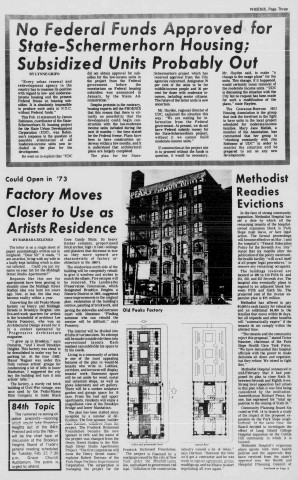
PHOENIX, Page ThreelllllllllllllllllllllllNo Federal Funds Approved forState-Schermerhorn Housing;Subsidized Units Probably OutBY LYNNE GRIFO%u201cEvery urban renewal and redevelopment agency in the country has to reassess its position with regard to low- and moderateincome housing and the present Federal freeze on housing subsidies. It is absolutely impossible to produce such units in N.Y.C. without Federal funds.%u201dThis Feb. 13 statement by James Robinson, coordinator of the StateSchermerhorn St. housing project for the State Urban Development Corporation (UDC), was Robinson%u2019s response to the question of possible elimination of all moderate-income units now included in the plan for the development.He went on to explain that %u201cUDCdid not obtain approval for subsidies for the low-income units in the project from the Federal government before the moratorium on Federal housing subsidies was announced in January, by the Nixon Administration.%u201dDespite protests to the contrary, housing experts tell the PHOENIX that this means that there is virtually no possibility that the development could begin construction with the low-moderate income units included during the next 18 months %u2014 the time stated for the Federal freeze. Plans have been to have construction underway within a few months, and it is understood that architectural plans are largely completed.The nlan fnr the StatejSchermerhorn project which has received approval from the City agencies concerned, designates 70 per cent of the units to he for middle-income people and 30 per cent for those with moderate incomes, including senior citizens. The future of the latter units is now uncertain.Mr. Hayden, regional director of UDC, explained the situation this way: %u201cWe are waiting for information from the Federal government. At present, we do not have Federal subsidy money for the State-Schermerhom project; without , it we cannot build moderate-income units.%u201dIf construction at the project site is to proceed without the funds in Question, it would be necessarv.Mr. Hayden said, to make %u201ca change in the usage plans%u201d for the units. This change, if it happened, would certainly mean removal of the moderate income units. %u201cUDC is discussing the situation with the City but no request has been made for such a modification of the plans,%u201d state Hayden.The Gowanus-Boerum Hill Housing Association is the group that took the forefront in the fight to have units in the local project scheduled for moderate-income families. Mary Jane Melish, a member of the Association, has commented that her group is %u201cchecking constantly with Jim Robinson of UDC%u201d in order to monitor the situation and be prepared to act on any new developments.Could Open in %u201973Factory MovesCloser to Use asArtists ResidenceBY BARBARA ZELENKOThe letter is on a single sheet of paper, painstakingly written out in longhand. %u201cDear Sir%u201d it reads, %u201cI am an artist, living with my wife in a badly kept building which is also rat infested. . . Could you put my name on your list for the Middagh Street Studio Apartments?%u201dRequests like this one for apartments have been pouring in steadily since the Middagh Street Studios idea was born ten years ago. Now, at last, the idea may become reality within a year.Converting the old Peaks-Mason factory (at Henry and. Middagh Streets in Brooklyn Heights) into live-and-work quarters for artists is the brainchild of architect Lee Harris Pomeroy, who won an Architectural Design Award for it in a contest sponsored by %u2019P ro g re s s iv e A rc h ite c tu re magazine.%u201cI grew up in Brooklyn,%u201d says Pomeroy, %u201cand I loved Brooklyn Heights. This factory was about to be demolished to make way for a parking lot. At the time (1962) Mayor Wagner was under fire from various artists%u2019 groups for condemning a lot of lofts in lower Manhattan, I suggested the city buy the building and turn it into artists%u2019 lofts.%u201dThe factory, a sturdy red brick building of Civil War vintage, was once used by the Peaks-Mason Mint Company to make Black84th TopicThe rumored re-zoriingof police precincts%u2014rezoningHl/o RrAT%u00bblfl\\/n IIIUW1I t%u00bb VMIM %u00bb.%u00bb**%u2022 'W WV...y ,,Heights out of the 84th Precinct and into the 76th%u2014 will be the chief topic of discussion at the Brooklyn Heights Board of Trade%u2019s general meeting scheduled for Tuesday, Feb. 27, 7:30 p.m., Grace Church Auditorium. The pubiic is urged to attend._________Crow Candy Mints. Its heavy timber columns, proportioned brick arches, high (11 foot) ceilings and pilasters that decrease in size as they move upward are characteristic of factory architecture in the 1860%u2019s.The windowless north side of the building will be completely rebuilt to give it windows and arches to match the others. Fire escapes will be removed. The Landmarks Preservation Commission, which designated Brooklyn Heights a Historic District in 1965, suggested some improvements in the original plan: restoration of the building%u2019s cornice, painting of brickwork, andvpaving the sidewalks and entrance court with bluestone. %u201cFinding someone who can rebuild the cornice will be difficult,%u201d says Pomeroy.The interior will be divided into 42 lofts of various sizes. No attempt will be made to subdivide them into conventional layouts. Each resident caosubdivide his space to fit his needs.Living in a community of artists ie one of the most appealing features of the plan to would-be tenants who write in. Lobbies, corridors, and terraces will display tenants%u2019 work. Basement space will be set aside for wood, metal and ceramics shops, as well as photo laboratory and art gallery. There will be a sunken sculpture garden and garage space for 18 cars. From the roof and upper apartments, residents will enjoy a magnificent view of the Brooklyn Bridge and lower Manhattan.The plan has been stalled since inception by a number of difficulties. The first sponsor, builder%u00bb %u25a0%u00bb Tli -----------! t l---1------- <*_-----tU -n id ii l i a i u i u , w im u ic w alu t u u icproject. The Fredrick Richmond Foundation became the new sponsor in 1970, and the name of the project was changed from the Henry Street Studios to the Middagh Street Studio Apartments Project. %u201cThe first corporation still owns the Henry Street name,%u201d explains Robert Dorman of the Fai k Siupe Northern Improvement Corporation. The corporation is managing the project for the*%u00a33 1 4 -'&; I I r f fO ld P e a k s F a c to ry<3>Jlobby and promenade levelFredrick Richmond Foundation.The project is financed by a mortgage issued by the city of NewXT---1. ----4 Hf f U%u00abLol 1 T l UUV u iiu u u ivlaw, and subject to government red tape. %u201cInflation in the constructionindustry caused a lot of delay,%u201d says Dorman. %u201cBetween the time we%u2019d get a contractor and he wasrn n r t r\\ pirfr%u00bb or* o ah t n%u00bb%u00ab%u00ab^iAri * vw mu Mfji mullein, %u00bbyi ivvowould go up, and we%u2019d have to start negotiating all over again.%u201dMethodistReadiesEvictionsIn the face of strong community opposition, Methodist Hospital has set a date by which all the remaining tenants of the hospitalowned expansion block in Park Slope must leave, or face legal action. The formal proceedings will become effective on Mar. 1 and the hospital%u2019s %u201cTenant Relocation Policy for the Seventh Ave. Site%u201d states that six months after the publication of the policy statement, the health facility %u201cwill avail itself of all proper legal procedures,%u201d to remove any remaining occupants.The buildings involved are located at 490 to 510 Fifth St. and 251, 255, and 257 Seventh Ave. The hospital also eventually plans to expand to an adjacent block between Fifth and Sixth Sts. The projected cost of the 10-year expansion plan is $75 million.Methodist has offered to pay $4,000 to each family for relocation and an additional $4,000 to the families that move within 90 days, but all stipends and other benefits will %u201cautomatically expire%u201d if the tenants do not comply within the allotted time.%u201cThe tenants and the community reject this proposal,%u201d stated Victor Hausner, chairman of the Park Slope Health Care Task Force. %u201cWe have demanded that hospital officials with the power to make decisions sit down and negotiate, but they refuse. We intend to fight this.%u201dMethodist Hospital announced in mid-February that it had postponed its plan to close Sixth St. between Seventh and Eighth Aves. Strong local opposition had arisen to this plan when it was first being considered by the institution. Assemblyman Michael Pesce, for one, has expressed his %u201ctotal opposition to the closing of Sixth St.%u201dCommunity Planning Board Six voted on Feb. 14 to launch a study of the impact of the proposed expansion on the Park Slope neighhnrhnnd At thp same timp theBoard decided to investigate the effect of Long Island College Hospital expansion on the Cobble Hill community in which it is located.Methodist Hospital%u2019s expansion plans ignore both state health policies and the approvals they fyave received from the state%u2019s annrnyal arm the Health and Hospital Planning Council ofContinued on Page 1023235348485348484823535353534823534853485323232353234823234848535323535353235348535353532323482323482323485353482348232353235353532323485323234823485353485353234848234823484848234823232348234848485353


