


Page 314 - Demo
P. 314
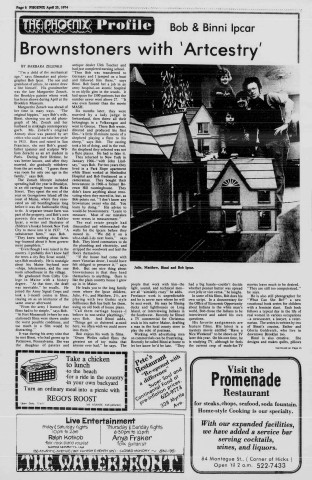
Page 6 PHOENIX April 25, 1974ProfileBrownstoners with Artcestry'Julie, Matthew, Binni and Bob I pear.BY BARBARA ZELENKO%u201c I%u2019m a child of the mechanical age,%u201d says filmmaker and photographer Bob Ipcar. The son and grandson of artists, he cannot draw a line himself. His grandmother was the late Marguerite Zorach, the Brooklyn painter whose work has been shown during April at the Brooklyn Museum.Marguerite Zorach was ahead of her time in many ways. %u201c The original hippies,%u201d says Bob%u2019s wife, Binni, showing you an old photograph of Ms. Zorach and her husband in strikingly contemporary garb. Ms. Zorach%u2019s original Armory show was panned by art critics who could not take her style in 1913. Born and raised in San Francisco, she met Bob%u2019s grandfather (painter and sculptor William Zorach) as an art student in Paris. During their lifetime, he was better known, and after they married, she gradually withdrew from the art world. %u201c I guess there was room for only one ego in the family,%u201d says Bob.The Zorach lifestyle included spending half the year in Brooklyn, in an old carriage house on Hicks Street. They spent the rest of the year on Georgetown Island off the coast of Maine, where they renovated an old boardinghouse long before it was the fashionable thing to do. A separate tenant farm was part of the property, and Bob%u2019s own parents (his mother is Dahlov Ipcar, a writer and illustrator of children%u2019s books) forsook New York City to move into it in 1937. %u201c A subsistence farm,%u201d says Bob. %u201cThey knew nothing about farming-learned about it from government pamphlets.%u201d\country, I probably don%u2019t know half the trees a city Boy Scout would,%u201d says Bob modestly. He is nostalgic about his Maine boyhood now -ships, lobstermen, and the one room schoolhouse in the village.He graduated from Colby College in Maine with a history degree. %u201c At that time, the draft was inevitable,%u201d he recalls. He joined the Army Signal Corps and took a 3-month course in films, staying on as an instructor of the same course afterward.%u201c From the army 1 learned that films had to be simple,%u201d says Bob. %u201c At Fort Monmouth (where he was stationed) films were shown under the worst possible conditions, and too much in a film would be distracting.%u201dIt was during his army stint that he met Binni, who had grown up in Pottstown, Pennsylvania. She was the daughter of painter andantique dealer Ulek Toscher and had just completed nursing school. %u201cThen Bob was transferred to Germany and I jumped on a boat and followed him there,%u201d says Binni. Bob found her a job in an army hospital-an atomic hospital in an idyllic glen in the woods. It had space for 1500 patients but the number never went above 27. %u201c It was even funnier than the movie MASH.Six months later, they were married by a lady judge in Switzerland, then threw all their belongings in a Volkswagen and went to Greece. There Bob wrote, directed and produced his first film -%u201c a little 10-minute movie of a shepherd playing a flute to his sheep,%u201d says Bob. The casting took a bit of doing, and in the end, the shepherd they selected was not a flute player. He had to fake it.They returned to New York in January 1966-%u201cwith John Lindsay,%u201d says Bob. For two years they lived in a Park Slope apartment while Binni worked at Methodist Hospital and Bob freelanced as a cameraman. They bought their brownstone in 1968-a former Boerum Hill roominghouse. They didn%u2019t know anything about renovating when they moved in, but, as Bob points out, %u201c 1 don%u2019t know any brownstone owner who did. You learn by doing.%u201d His advice to would-be brownstoners: %u201c Learn to measure. Most of our mistakes were errors in measurement.%u201dThe real estate people had dismantled and whitewashed the walls for the Ipcars before they moved in. %u201c We did it on a what-shall-I-do next basis,%u201d says Bob. They hired contractors to do the plumbing and electricity, and stripped the woodwork and laid the floors themselves.%u201c If the house had come with more Victorian decor, I would have felt obliged to preserve it,%u201d says Bob. But one nice thing about brownstones is that they lend themselves to anything. Ours is like the plain country house 1 grew up in in Maine.He leads you to the long family room where the Ipcar children, Julie, 4 V i, and Matthew, 2 V i, are playing with two Gothic style dollhouses Bob has built for them, using an old book of house plans. %u2018%u2018Call them carriage houses--I believe in non-sexist playthings,%u201d says Bob. And Binni adds, %u201c Things get so cluttered aiound here, we often wish we could move into them.%u201dBob enjoys his work in films. %u201c Orsen Welles called films the greatest set of toy trains that anyone ever had,%u201d he says. Thepeople that work with him-the light, sound, and technical menare all %u201c aimiably crazy%u201d he adds. Freelance work is unpredictable and he is never sure where he will be next week. He may be filming ducks and lighthouses on Long Island, or interviewing Indians in the Southwest. Recently he filmed a TV commercial for Christmas seals in his native Maine, drafting a man in the local county store to play the role of postman.Working with advertising men on commercials can be frustrating. Recently he called Binni at home to let her know he%u2019d be late. %u201c Theyhad a big hassle-couldn%u2019t decide whether peanut butter was spread over jelly or vice versa,%u201d he laughs.In some of his films, Bob does his own script. In a documentary for the Office of Economic Opportunity about Indians in the white man%u2019s world, Bob chose the Indians to be interviewed and asked his own questions.His favorite assignm ents are feature films. His latest is a mystery movie entitled %u201c Have a Nice Weekend%u201d to be shown on TV later this year. On his own time, he is studying TV, although he feels the current crop of made-for-TVmovies leave much to be desired. %u201cThey are still too computerized,%u201d he says.He is also still photographer for %u201c What Can She Be?%u201d a new vocational book series for children with a feminist slant. Each book follows a typical day in the life of real women in various occupations - a newscaster, a lawyer, a veternarian. The series is written by two of Binni%u2019s cousins, Esther and Gloria Goldreich, who live in downtown Brooklyn too.Binni is also creative. She designs and makes quilts, pillowsContinued on Page 35Take a chicken \to lunch ~-to the beach -for a ride in the country? -in your own backyard %u25a0 Turn an ordinary meal into a picnic with IREGO%u2019S ROOSTOpen Daily: 11 to 11 169 ATLANTIC AVE.(atClinlon)ll%u00a3 * 6!e< S%u00b0 > 'CpO'e*\v' s%u00ae-Live EntertainmentFriday %u00a3 Saturday nights 10pm to 2amRalph KotKobfoiK-rocK piano vocalistS U P P E P SERVED 'T IL I A M156 ATLANTIC AVENUE ( BET. CLINTO N $ HENRY S7*0Thursday %u00a3 Sunday nights 6:30pnrto loprriAnya FraKer%u25a0folk g u ita ris tCLOSED MONDAY 854 -(951T 1 V - I %u2014 T ~i%u2014 n %u2014 t %u00ab r -w%u2014 n rVisit thePromenadeRestaurantfor steaks, chops, seafood, soda fountain.Home-style Cooking is our specialty.With our expanded facilities?we have added a service barserving cocktails,wines, and liquors.I84 Montague St., ( Corner ot Hicks )Open til 2 a.m. 5 2 2 - 7 4 3 3


