


Page 345 - Demo
P. 345
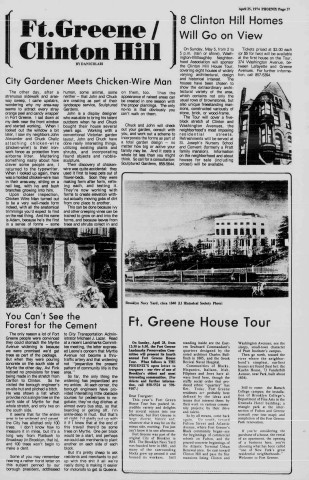
April 25,1974 PHOENIX Page 37Brooklyn Navy Yard, circa 1840 [LI Historical Society Photo]You Can't See theForest for the Cement Ft. Greene House TourThe only reason a lot of Fort Greene people were convinced they could stomach the Myrtle Avenue widening is because we were promised we%u2019d get trees as part of the package. But when they were pouring concrete on the south side of Myrtle the other day, Avi Fink noticed no provisions for trees being made in the stretch from Carlton to Clinton. So he visited the borough engineer%u2019s on-site hut and pitched a bitch. He was shown a list which provides not a single tree on the north side of Myrtle for that whole stretch, and only two on the south side.It seems that for the entirea re a tn h o u/irionorj a n d nov/orithe City has allotted only 100 trees. I don%u2019t know how to measure it in miles, but it%u2019s a long way from Flatbush to Broadway (in Brooklyn, that is), and 100 trees won%u2019t begin to make a dent.Some of you may remember hearing a rather florid ietter on this subject penned by our borough president, addressedto City Transportation Administrator Michael J. Lazar. Read at a recent Landmarks Committee meeting, the letter expressed Leone%u2019s concern that Myrtle Avenue not become a thrutraffic artery and that widening not %u201c jeopardize the present pattern of community life in the area.%u201dSo far, the only thing the widening has jeopardized are my ankles. At each corner, the borough engineers have provided interesting little obstacle courses for pedestrians to negotiate; they%u2019ve dug ditches at almost every bus stop, so that boarding or getting off, I%u2019m ankle-deep in mud. But that%u2019sall rig h t; Pri glarlly nut un w ithit if T knew that at the end of this travail there%u2019d be some trees on Myrtle. One per block would be a start, and perhaps we could ask merchants to plant another on each side of each block.But it%u2019s pretty cheap to ask residents and merchants to put up with this shit if aii we:re really doing is making it easier for motorists to get to Queens.On Sunday, April 28, from12:30 to 5:30, the Fort GreeneLandmarks Preservation Committee will present its fourthannual Fort Greene HouseTour. What follows is THEPHOENIX%u2019S open letter totourgoers - our view of one ofBrooklyn%u2019s oldest and mostinteresting communities. [Fortickets and further information, call 858-5524 or 596-9107.]Dear Tourgoer:This year%u2019s Fort GreenHouse Tour has packed incredible variety and delightsfor several senses into oneafternoon, but Fort Greene isl a r o r H i v p r c p h i c t n r i o a n H O ' - %u2022whatever else it may be on theminus side, exciting. You justcan%u2019t know it in one afternoon.Fort Greene was part of theoriginal City of Brooklyn in1834. The Brooklyn Navy Yardwas founded here in 1801, andmany of the surroundingblocks grew up around it andhoused its workers. Stillstanding inside are the Eastern Seaboard Commandant%u2019squarters designed by thenoted architect Charles Bullfinch in 1805, and the GreekRevival Naval Hospital.Communities of Blacks,Hispanics, Italians, Irish,Filipines and Jews have always lived here, though thestuffy social order that produced ethnic %u201c quarters%u201d hasflet. Today, Fort Greeneresidents are probably bestdefined by the ideas andissues that interest them; bytheir work on various community projects; by their driveand talent.So by all means, come backonoin r\\ c / s i i f l i %u2666 *%u2022 AFulton Street and AtlanticAvenue, where Fort Greene'sBlack community began-seethe beginnings of commercialrebirth on Fulton, and thepoured-concrete beginnings ofthe Atlantic Terminal UrbanRenewal area. Go cast towardClinton Hill and pass the finemansions lining Clinton andWashington Avenues; see thesleepy, small-town characterof Pratt Institute%u2019s campus.Then go north, toward theriver where the neighborhood%u2019s sim plest, earliesthouses are found (best bet: theKuehn House, 73 VanderbiltAvenue, near Park, built about1834).Still to come: the BaruchCollege campus; the installation of Brooklyn College'sDepartment of Fine Arts in theGranada Hotel building; atriangle park at the intersection of Fulton and Greene(consult your tour map); andcompletion of the Fort GreenePark renovation.if you%u2019re considering thepurchase of a house, the rentalof an apartment, the openingof a business here, you%u2019rechoosing what has been called%u201cone of New York's greatresidential neighborhoods.%u201dWelcome to Fort Greene.Ft.Greene /Clinton HillBY DAN ICOLARIQ C* I L l i l lS J Vw l I I ! I U I I I I I I I I I U I I I U QWill G o on V iewCity Gardener Meets Chicken-Wire ManThe other day, after a strenuous sidewalk and areaway sweep, I came upstairs, wondering why my area-way seems to attract every stray orange peel and candy wrapper in Fort Greene. I sat down at my desk near the front window and started working. When I looked out the window a bit later, I saw my neighbors John Alexander and Chuck Chaliz attaching chicken-wire (chicken-wire!) to their ironwork fence as protection from airborne litte r. M uttering something nasty about how clever some people are, I returned to the typew riter. When I looked up again, there was a molded chicken-wire man in their area-way, sitting on a nail keg, with ivy and bush branches growing into him.Upon closer inspection, Chicken W ire Man turned out to be a very well-made form indeed, with all the anatomical trimmings you%u2019d expect to find on the real thing. And his name is Adam, because he%u2019s the first in a series of forms - somehuman, some animal, some neither - that John and Chuck are creating as part of their landscape service, Sculptured Gardens.John is a display designer who was able to bring his talent outdoors when he and Chuck bought th e ir house several years ago. Working with a conventional Victorian garden layout, John and Chuck have done really interesting things, utilizing existing plants and shrubs, and incorporating found objects and rubblesculpture.Their discovery of chickenwire was quite accidental: they used it first to keep pets out of flower-beds. Soon they were making form after form, refining each, and testing it. They%u2019re now working w ith forms to create elevation without actually moving gobs of dirt from one place to another.This can be done because ivy and other creeping vines can be trained to grow on and into the forms, and because leaves from trees and shrubs collect in andon them, too. Thus the appearance of raised areas can be created in one season with the proper plantings. The only no-no is that obviously you can%u2019t walk on them.Chuck and John will check out your garden, consult with you, and work out a scheme to incorporate the forms as part of a total garden design - no matter how big or active your family may be. And it costs a whole lot less than you might think. So call for a consultation: Sculptured Gardens, 858-5644.On Sunday, May 5, from 2 to 5 p.m. (rain or shine), Washington-Willoughby Neighborhood Association will sponsor the Clinton Hill House Tour, covering eight houses of widely varying architectural, design and historical interest. The houses have been chosen to show the extraordinary architectural variety of the area, which contains not only the usual rows of brownstones, but also unique freestanding mansions, constructed variously of stone, brick, or wood-frame.The Tour will cover a fiveblock stretch of Clinton and W ashington Avenues, the neighborhood%u2019s most imposing residential streets. Refreshments will be served at St. Joseph%u2019s Nursery School and Convent (formerly a Pratt family mansion). Information on the neighborhood and about houses for sale (including prices!) will be available.Tickets priced at $3.00 each (or $5 for two) will be available at the first house on the Tour, 374 Washington Avenue, between Lafayette and Greene Avenues. For further information, call 857-5394.


