


Page 201 - Demo
P. 201
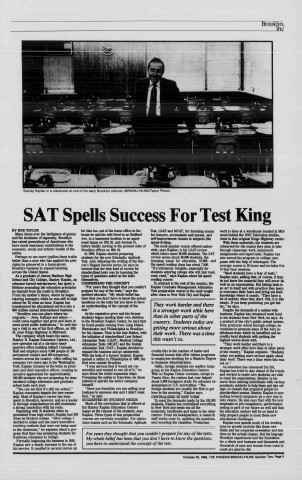
Brooklyn,_____incS ta n le y K aplan in a c la ss ro o m at o n e o f his e arly B rooklyn s ch o o ls . (B R O O K L Y N ,IN C /T a y lo r P hoto)SAT Spells Success For Test KingBY ROB TAYLORMany times over the birthplace of geniusand the incubator of ingenuity, Brooklynhas raised generations of Americans whohave made enormous contributions to theeconomic, social and artistic wealth of thenation.Perhaps no one more typifies those truthsbetter than a man who has applied the principles he pioneered in a homeigrownBrooklyn business to expand learningacross the United States.As a graduate of James Madison HighSchool and City College, Stanley Kaplan, aneducator turned entrepreneur, has spent alifetime promoting the education principleshe learned from his youth in Brooklyn.From his mother%u2019s home, where he begantutoring teenagers while he was still in highschool for 25 cents an hour, Kaplan hastransformed his educational service into a$40 million annual international business.%u201cBrooklyn was one place where immigrants %u2014 Jews, Italians and others %u2014could come together and grow and learn insome great public institutions,%u201d he said during a visit to one of his first offices, on 16thSt. near Kings Highway in Midwood.The company which bears his name,Stanley H. Kaplan Education Centers, Ltd.,now operates out of a six-story headquarters office building bdhind CarnegieHall and employs some 3,000 people in 125permanent centers and 400 temporarycenters across the country. After selling hiscompany two years ago to the WashingtonPost, Kaplan remains at the helm as president and chief executive officer, creating innovative approaches for approximately100,000 students who are preparing for standardized college admission and graduateschool tests each year.%u201cYou can see that it%u2019s still my school,%u201dKaplan comments despite the new ownership. Most of Kaplan%u2019s career has beenspent in Brooklyn, however, and as a leaderin borough organizations he still maintainsa strong connection with his roots.Beginning with 10 students when hegraduated from high school, Kaplan had 200when he finished college. %u201cAfter college Idecided to adapt and use more innovativeteaching methods that were not being usedin the classroom,%u201d he explains about a program that then was preparing students forfreshman admission to college.Formally beginning his business in 1938,Kaplan saw a steady increase in the use ofhis service. It resulted in several moves upfor him too, out of the home office in thehouse he and his wife lived in on BedfordAve. to a basement location in an apartment house on 17th St. and Avenue R,before finally moving to the present suite ofBrooklyn offices on 18th St.In 1946, Kaplan started preparingstudents for die new Scholastic AptitudeTest. And, following the writing of the Barron%u2019s Regent Review series, he says helearned that the best kind of review forstandardized tests was by learning thetypes of questions asked on the teststhemselves.UNDERSTAND THE CONCEPT%u201cFor years they thought that you couldn%u2019tprepare for any of the tests,%u201d says thespirited educator. %u201cMy whole belief hasbeen that you don%u2019t have to know the actualquestions on the tests but you have to havean understanding of the concept of thetest.%u201dAs his reputation grew and his formerstudents began sending their own childrento the Brooklyn Kaplan Center, he says thathe found people coming from Long Island,Westchester and Philadelphia to Brooklynfor his classes. Then in the late Sixties, withthe initiation of standardized Law SchoolAdmission Tests (LSAT), Medical CollegeAdmission Tests (MCAT) and the DentalAdmission Test (DAT), Kaplan decided toexpand the business and go nationwide.With the help of a former student, Kaplanopened a center in Philadelphia in 1969, thefirst ever outside Brooklyn.%u201cI was nervous that it would not runsmoothly and wanted to run all of it,%u201d hesays about the initial expansion steps.Foregoing the option to franchise, he choseinstead to operate the entire companyhimself.%u201cOnce you franchise you are selling yourbusiness to someone else and I didn%u2019t wantthat,%u201d he said.SUGGESTED BY STUDENT NEEDSMuch of the curriculum that is offered atthe Stanley Kaplan Education Centersbegan at the request of the students, saysKaplan. Three types of test preparationcourses are currently available: For admissions exams such as the Scholastic AptitudeTest, LSAT and MCAT; for licensing examsfor lawyers, accountants and nurses; andself-improvement classes in subjects likespeed-writing.The most popular course offered nationwide, says Kaplan, is his LSAT reviewwhich tutors some 26,000 students. The SATreview series about 20,000 students, thelicensing exam for education, 10,000; andthe speed reading class has about 7,000.%u201cIt%u2019s extremely valuable, especially forstudents entering college who will just read,read, read,%u201d says Kaplan about his speedreading course.In contrast to the rest of the country, theKaplan Graduate Management AdmissionTest preparation course is the most soughtafter class in New York City and KaplanThey work harder and thereis a stronger work ethic herethan in other parts o f thecountry. Students today aregetting more serious abouttheir work. There was a timethis wasn't so.credits this to the number of banks andfinancial houses that offer tuition programsto employees studying for a Masters Degreein Business Administration.Oddly, foreign students are another largegroup at the Kaplan Education Centers.With no Kaplan Center overseas, except inPuerto Rico, the centers last year helpedabout 5,000 foreigners study for entrance examinations to U.S. universities. %u201cTheforeign students are usually the first to gethere in the morning,%u201d Kaplan says.CENTRALIZED IN NEW YORKTb meet the demands made by the 100,000students, Kaplan has centralized everythingin New York and sends out all thematerials, handbooks and tapes to the othercenters. From his headquarters, a researchstaff works close by, updating the questionsand recording the cassettes. ProductionFor years they thought that you couldn V prepare for any o f the tests.My whole belief has been that you don V have to know the questions,you have to understand the concept o f the test.work is done at a warehouse located in Midwood behind the NBC Television studios,close to that original Kings Highway center.With these materials, the students arerehearsed for the exams they plan to takethrough classroom work, homeworkassignments and taped tests. Kaplan hasalso moved his program to college campuses with the help of videotapes. Theaverage course is 35 hours and includes 8 to12 four hour sessions.%u201cMost students have a fear of tests,%u201dKaplan says, adding that, of course, if theydo not know the material they will never dowell on an examination. But taking tests isan art in itself and with practice they learnto overcome their fears and bring out theirknowledge where it counts. %u201cThey have alot of anxiety when they start. But, it is liketennis. If you keep practicing you get better,%u201d he says.Despite the demands of a nation-widebusiness, Kaplan has remained most loyalto his students from New York, he says. Asa product of the city%u2019s public school system,from grammar school through college, hecontinues to promote some of the very institutions from which he benefited and hecredits local students with getting thehighest scores deals with.%u201cThey work harder and there is astronger work ethic here than in other partsof the country,%u201d Kaplan explains. %u201cStudentstoday are getting more serious again abouttheir work. There was a time when this wasnot so.%u201dAs education has consumed his life,Kaplan has tried to stay ahead of the trendsand worked to make sure students are ableto meet the expectations. Similar to hismove from tutoring individuals with variousacademic subjects to help them get into college, to classes that prepared people forstandardized exams, Stanley Kaplan is nowlooking toward computers as a new way totake exams. He also says that with the newemphasis on job competence, performancetesting is part of our future as well and thathis education centers will be on hand tohelp prepare people to meet these neweducational challenges.Kaplan now spends much of his workingtime on growth projects like these newfields and his corporate newsletter and lesstime on the actual classes. But his long-agoBrooklyn experiences laid the foundationfor a whole new business and thousands andthousands of men and women from coast tocoast are glad he did.October 30,1986, THE PHOENIX/BROOKLYN.INC Section Two, Pag* 5


