


Page 353 - Demo
P. 353
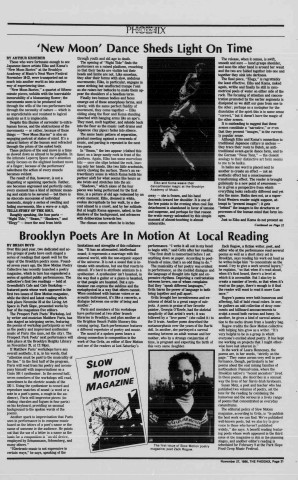
PfisncrioN 4 IX'New Moon' Dance Sheds Lieht On Time\\ j rBY ARTHUR KROEEERThose who were fortunate enough to seeJapanese dance artists Eiko and Koma%u2019s%u201cNew Moon Stories%u201d at the BrooklynAcademy of Music%u2019s Next Wave FestivalNovember 18-23, were transported not somuch into another world as into anotherway of experiencing time.%u201cNew Moon Stories,%u201d a quartet of fifteenminute pieces, unfolds with the inscrutableinexorability of a blossoming flower; themovements seem to be produced notthrough the wills of the two performers butthrough the necessity of nature %u2014 which isas unpredictable and resistant to logicalanalysis as it is implacable.Despite this illusion of surrender to extrahuman forces, and the abstractness of themovements %u2014 or rather, because of thesethings %u2014 %u201cNew Moon Stories%u201d is also anengaging portrait of states of mind. It%u2019s anatural history of the human soul refractedthrough the prism of the naked body.These pictures of the soul move in a timeso slowed down as almost to be palpable. Inthe intimate Lepercq Space one%u2019s attentioneasily focuses on the slightest hesitant moveof a finger; because of the performers%u2019nakedness the action of every musclebecomes evident.The result of this, however, is not adisgusting or agonizing spectacle. Rather,one becomes engrossed and perfectly calm;every moment has a kind of intrinsic meaning and exists to be savored %u2014 but there isno staccato succession of individualmoments, simply a series of swelling andfading movements, like a wave or a sigh.TELLS STORY OF THE SOULRoughly speaking, the four parts %u2014%u201cNight Tide,%u201d %u201cBeam,%u201d %u201cShadows,%u201d and%u201cElegy%u201d %u2014 trace the soul from birththrough youth and old age to death.The opening of %u201cNight Tide%u201d finds theperformers on a raised platform, crouchingso that their backs are visible but theirheads and limbs are not. Like amoebas,they alter their forms with slow, undulousmovements; Eiko, in particular, engages insome striking but unaffected trompe l%u2019oielas she raises her buttocks to make them appear the shoulders of a headless torso.Finally two human bodies and facesemerge out of these amorphous forms, andslowly, with the same perfect fluidity ofmovement, they come together %u2014 Eikosliding along the floor and Koma standingslouched with hanging arms like an ape%u2019s.They meet, melt together, and subside backinto the floor as the music (soft drums andJapanese clay pipes) fades into silence.The same basic pattern of separation,gradual meeting against a crescendo ofmusic, and parting is repeated in the nexttwo parts.In %u201cBeam,%u201d the two appear (clothed thistime) on a large sandy rock in front of theplatform. Again, Eiko has some marvelousbits %u2014 once she slips behind the rock, leaving only her hands, like two little arachnids,slowly clawing the surface. There%u2019s an extraordinary scene in which Koma holds hispartner aloft for what seems like hours asshe twists and stretches into the air.%u201cShadows,%u201d which alone of the fourpieces was being performed for the firsttime, is a picture of old age redeemed by anerotic moment. Eiko, dressed in white,evokes decrepitude by her walk, by a descent almost to a crawl, and by her solitude.But at length Koma appears, naked, in theshadows of the background, and advanceswith deliberation towards her.The climax comes when he is inchesEiko and Koma weave theirdance/theater magic at the BrooklynAcademy of Music.away %u2014 she is frozen, and his handdescends toward her shoulder. It is one ofthe few points in the evening when cool Zendetachment is abandoned in favor of tensionand suspense, and perhaps for that reasonthe erotic energy unleashed by this simplemoment of almost-touching is almostunbearable.The release, when it comes, is swift,smooth and sure %u2014 hand grasps shoulder,and soon the other hand is around her waistand the two are folded together into one andtogether they sink into darkness.The final piece, %u201cElegy,%u201d is regrettablythe least effective. Eiko and Koma, nakedagain, writhe and finally lie still in symmetrical pools of water on either side of therock. The focusing of attention and concentration promoted by the earlier segments isdissipated as we shift our gaze from one tothe other; perhaps as a metaphor for thedissolution of the spirit this is in some sense%u201ccorrect,%u201d but it doesn%u2019t have the magic ofthe other scenes.It is misleading to suggest that thesescenes constitute a %u201cnarrative,%u201d or e^enthat they present %u201cimages,%u201d in the currently popular sense.Although Eiko and Koma%u2019s connection totraditional Japanese culture is unclear %u2014they trace their roots to Butoh, an antitraditional avant-garde dance form, and tothe German %u201cNeue Tanz,%u201d %u2014 the closestanalogy to their distinctive art form seemsto me to be haiku.In haiku one word is placed next toanother to create an effect %u2014 not anaesthetic effect but a consciousnesstransforming effect. The reader is broughtguilelessly to a new point of awareness %u2014he is given a perspective from whicheverything looks radically different and yetalso the same. Haiku does not, as a superficial Western reader might suppose, attempt to %u201cpresent images%u201d ; it gets%u201cbehind%u201d (he images to the structures orprocesses of the human mind that form images.Just so Eiko and Koma do not present anContinued on Page 22Brooklyn Poets Are In Motion At Local ReadingBY BRIAN BOYDOver this past year, two dedicated and active groups of poets have each staged aseries of readings that speak well for thevigor of the Brooklyn poetry scene. Founded seven years ago, the Slow Motion PoetryCollective has recently launched a poetrymagazine, which in turn has engendered aseries of spirited public performances. Thecollective%u2019s first two readings %u2014 held atGreenfield%u2019s Cafe and Cafe Bookshop %u2014featured poets whose work appeared in thefirst two issues of Slow Motion magazine,while the third and latest reading whichtook place Novembe 22 at the Living ArtSpace in Park Slope, presented works byfour of the magazines five editors.The Prospect Park Poets%u2019 Workshop, ledby writer and musician Matthew Paris, hasalso staged an intriguing series, featuringthe poems of workshop participants as wellas the poetry and improvised synthesizermusic of Paris (the man, not the city). TheProspect Park Poets%u2019 next performance willtake place at the Brooklyn Heights Libraryon November 29, at 12:30pm.If Matthew Paris%u2019 workshops have anyoverall aesthetic, it is, in his words, that%u201cattention must be paid to the musicality ofthe line.%u201d In the first half of the program,Paris will read from his poetry and accompany himself with improvisations on aCasio SK-1 synthesizer. In the second half,seven members of the workshops will read,sometimes to the electric sounds of theSK-1. Using the synthesizer to record andreproduce snatches of sound (a word or anote in a poet%u2019s poem, a cough in the audience), Paris will improvise pieces (including chorales and fugues in four parts)on his keyboard, providing an unusualbackground to the spoken words of thepoems.Another spark to improvisation that Parisuses in performance is to compose musicbased on the letters of a poet%u2019s name or thename of someone in the audience. He pointsout that toe use of a letter in a name as toebasis for a composition is an oiu device, employed by Schummann, Schoenberg, andmany others.%u201d%u201cElectronic music is not expressive incertain ways,%u201d he says, speaking of thelimitations and strengths of this collaboration. %u201cIt has an attenuated, intellectualsound; it represents a marriage with themineral world, with the non-organic aspectof the universe. It is not a sound that is intimate with emotions, but one that reacts tostimuli. It%u2019s hard to attribute animism to asynthesizer. A synthesizer isn%u2019t haunted, intoe way that a guitar or a piano is haunted,or that people are haunted. But a synthesizer can express the sublime and themetaphysical ip a way that others cannot.When combined with human voices or anacoustic instrument, it%u2019s like a concerto, adialogue between one order of being andanother.%u201dParis and members of his workshopshave performed at two other branchlibraries in Brooklyn, and plan another atthe Brighton Beach Public libarary thiscoming spring. Each performance featuresa different repertoire of poetry and music.The sound of a spoken poem bears astrong connection to composition in toework of Ona Gritz, an editor of Slow Motionand one of the readers at last Saturday%u2019sperformance. %u201cI write it all out in my headto begin with,%u201d said Gritz after her reading.%u201cThe first draft is memorized before I setanything down on paper. According to poetfriends of mine, that%u2019s an odd thing to do.%u201dThe musicality of her poetry was evidentin performance, as she melded dialogue andthe language of thought into tight and expressive rhythms. Depicting a confrontationbetween lovers, one of whom complainsthat they %u201cspeak different languages,%u201dGritz bares toe power of language to bothbring together and pull apart.Gritz brought her inventiveness and exactness of detail to a great range of subjects. A poem in praise of her favoritepainter, Georgia O%u2019Keefe, had the skeletalsimplicity of that artist%u2019s work; it wasfollowed by a %u201clove poem%u201d (she called it) tothe D train. Another poem described toemetamorphasis over the years of the Barbidoll. In another, she portrayed a surrealmeeting between an adult woman and hermother, who by a strange conjunction oftime, is pregnant and expecting the birth ofthis very same daughter.Zack Rogow, a fiction writer, poet, andeditor who at toe performance read severalpoems as well as a short story set inBrooklyn, says reading his work out loud ashe writes helps him %u201cto concentrate on thesound. I try to give a work several layers,%u201dhe explains, %u201cso that when it%u2019s read aloud,when it%u2019s first heard, there%u2019s a level atwhich it is accessible. But I also try tocreate a number of levels, so that when it%u2019sread on the page, there%u2019s enough to it thatthe reader will want to read it more thanonce.%u201dRogow%u2019s poems were both humorous andaffecting, full of bold visual colors. In one,he gathers an odd collection of stray comments and billboard announcements tosculpt a mood both curious and funny. Inanother, he gives a kind of surreal animation to the socks drawn from a laundry bag.Rogow credits the Slow Motion collectivewith helping him grow as a writer. %u201cIt%u2019svery helpful to be in a group in whicheveryone%u2019s excited about poetry. It has keptme working on projects that I might otherwise have lost interest in.%u201dIn the work of Laura Hennessey, thepoems are, in her words, %u201cstrictly on thepage.%u201d They come across very well in performance, though, particularly in herpoems about the coal mining families ofnortheastern Pennsylvania, where toeBrooklyn native%u2019s %u201crecent ancestors%u201d lived.In these poems, she describes in a sensualway the lives of her Slavic-Irish forebears.Susan Metz, a poet and teacher who haspublished two volumes of poetry, set thetone for the reading by combining thehumorous and the serious in a lively rangeof poems that concentrated on everydayconundrums.The editorial policy of Slow Motionmagazine, according to Gritz, is %u201cto publishthe best work we can find. We%u2019ve publishedwell-known poets, but we also try to givevoice to those who haven%u2019t publishedwidely,%u201d she says. A benefit reading featuring poets whose work appeared in the thirdissue ot tne magazine is still in tbe planningstages, and another editor%u2019s reading isscheduled for February 9 at the Park SlopeFood Co-op Music Festival.November 27, 1986, THE PHOENIX, Page 21


