


Page 21 - Demo
P. 21
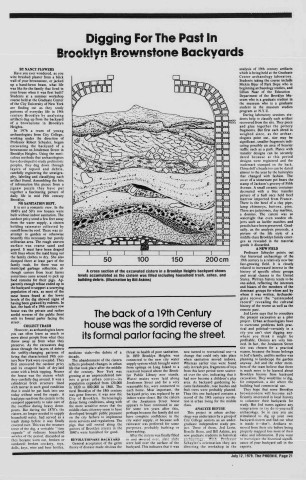
Digging For The Post InBrooklyn irownstone Backyardsi50 100 150 200cmA cross section of the excavated cistern in a Brooklyn Heights backyard showslevels accumulated as the cistern was filled including household trash, ashes, andbuilding debris. (Illustration by Bill Askins)The back of a 19th Century house was the sordid reverse of its formal parlor facing the street.BY NANCY FLOWERSHave you ever wondered, as you wire brushed plaster from a brick wall of your brownstone, or jacked up a hand-hewn beam, what life was like forihe family that lived in your house when it was first built? Students at a summer workshop course held at the Graduate Center of the City University of New York are finding out as they study patterns of everyday life in 19th century Brooklyn by analyzing artifacts dug up from the backyard of a brownstone in Brooklyn Heights.In 1976 a team of young archaeologists from City College, working under the direction of Professor Robert Schuyler, began excavating the backyard of a brownstone on Joralemon Street in Brooklyn Heights. Using the meticulous methods that archaeologists have developed to study prehistoric peoples, they dug down through layers of topsoil and debris, carefully registering the stratigraphy, labeling and classifying each artifact found. Assembling the bits of information like pieces from a jigsaw puzzle they have put together a fascinating picture of daily life in mid 19th century Brooklyn.NO SANITATION DEPT.It is not a romantic view. In the 1840%u2019s and 50%u2019s row houses were built without indoor sanitation. The outdoor privy stood a few feet away from the water supply, a cistern holding rainwater collected by runoff from i'ne roof. There was no attempt to garden or otherwise beautify this necessary but purely utilitarian area. The rough uneven surface was coarse sand and gravel. It must have been draped with lines where the maid hung out the family clothes to dry. She also dumped there at least part of the family trash, for there was no municipal garbage collection, although carters from local farms sometimes came around to pick up food remains for their pigs. Apparently enough refuse ended up in the backyard to support a scurrying population of rats, as most of the meat bones found at the lower levels of the dig showed signs of having been gnawed by rodents. In fact, the back of a 19th century row house was the private and rather sordid reverse of the public front with its formal parlor facing the street.COLLECT TRASHHowever, as archaeologists know you can often learn as much or more about people from what they throw away as from what they preserve. As the excavators dug down through the layers of debris the swiftly-changing patterns of living that characterized 19th century New York were revealed. They first uncovered the outdoor privy and its cesspool built of dry-laid stone with a brick topping. Nearer the house was the cistern which they carefully dug around. It was a cylindrical brick structure lined with mortar in such good condition that it could be put back into use today without need for repair. A lead pipe ran from the cistern to the cesspool apparently to take care of the overflow during heavy downpours. But during the 1870%u2019s the cistern, no longer needed to supply household water, had served as a trash dump before it was finally covered over. This was the treasure trove of the dig, a veritable %u201c time capsule%u201d of ordinary household articles of the oeriod, discarded as they became worn out, broken or outdated: broken crockery, toys, dolls, keys, wine and beer bottles,medicine vials%u2014the debris of a decade.The abandonment of the cistern reflects profound changes in urban life that took place after the middle of the century. New York was growing at an unprecedented rate into a great urban center%u2014its population exploded from 120,000 in 1820 to 800,000 in 1860. The rural Brooklyn of the 18th century was gone forever; it was now the City of Brooklyn. Increasingly dense living conditions, along with the more sensitive noses that the middle-class citizenry seem to have developed brought public pressure on the city fathers to implement more services and regulations. The pigs that still rooted along the gutters of Brooklyn streets in the 1840%u2019s were banished for good.r e v o l u t io n a k i Ba c k y a r dGeneral acceptance of the germ theory of disease made obvious thethreat to health of poor sanitation. In 1859 Brooklyn Heights was connected to the new city water supply system which brought water from springs on Long Island to a reservoir located where the Brooklyn Public Library now stands. Water mains were laid along Joralemon Street and for a very reasonable fee, were connected to each home. Most important, the backyard privy was replaced by an indoor water closet. But the cistern of the Joralemon Street house appears to have continued in use for some ten years after this, perhaps because the family did not have complete confidence in the city water supply, or because soft rainwater was preferred for some purposes, probably bathing or hairwashing.After the cistern was finally filled%u2022 %u00ab - J __ _ %u201e111 aiiU UIDVUtU o v u , JIU.Vwere laid over the surface of the backyard. This indicates that it wasnow turned to recreational use%u2014a change that could only take place when sanitation moved indoors. Whereas earlier toys were found only in trash pits, fragments of toys from this later period were scattered over the site, indicating that it had now become a children%u2019s play area. As backyard gardening became fashionable, rose bushes and fruit trees were probably planted. Thus this one backyard contains a record of the 19th century revolution in urban living for the middle class.ANALYZE REFUSEThis project in urban archaeology was undertaken by a group of City College seniors as an undergraduate independent study project. Three of them, Jed Levin, Roselle Hcnn, and Bill Askins, arc now graduate students in historicalA%u00abr%u00bblr.rt,f W ith Prnfp ccfir.............- - - - - %u25a0Schuyler's orientation they are directing the workshop in theanalysis of 19th century artifacts which is being held at the Graduate Center archaeology laboratory. Students taking the course include Mickin Bijur of Park Slope who is beginning archaeology studies, and Lillian Naar of the Education Department of the Brooklyn Museum who is a graduate student in the museum who is a graduate student in the museum studies program at N.Y.U.During laboratory sessions students help to classify each artifact recovered from the site. They piece and glue together the pottery fragments. But first each shred is weighed since, as the archaeologists point out, size may be significant, smaller fragments indicating possibly an area of heavier traffic such as a path. Plates with transfer designs can be securely dated because at this period designs were registered and the trademark stamped on the back. China doll%u2019s heads too can be dated almost to the year by the hairstyles that changed with fashion. The cover of a stoneware pot bears the stamp of Jackson%u2019s grocery of Fifth Avenue. A small ceramic container decorated with a blue transfer picture of a bull once held beef marrow imported from France. There is the bowl of a clay pipe, lamp chimneys, buttons, pins. There are jackstones, clay marbles, a domino. The cistern was so watertight that even wooden objects such as lucifer matches and pencils have been preserved. Gradually, as the analysis proceeds, a picture of the life style of a middle-class Brooklyn family emerges as revealed in the material goods it discarded.A NEW FIELDProfessor Schuyler points out (hat historical archaeology of the 19th century is a relatively new but fast-growing field. It is closely related to increased interest in the history of specific ethnic groups and social classes in the United States. Written history tends to be one-sided, reflecting the interests and biases of the members of the dominant groups for whom and by whom it was written. Archaeologists recover the %u201c unintended record%u2019%u2019 revealing the cultural history of the recent as well as the remote past.Jed Levin says that he considers the present excavation as a pilot project. Urban archaeologists have to overcome problems both practical and political%u2014certainly in a city you can%u2019t start digging anywhere you think it might be profitable. Choices are very limited. In fact, the Joralamon Street site was chosen for a practical reason, because the house belongs to Jed's family, and his mother was planning to landscape the garden anyway. Jed and the other members of the team believe that there is much more to be learned about Brooklyn history from backyard excavation. They would like to dig, for comparison, a site where the building had commercial use.They hope that some Brooklyn brownstoners will become sufficiently interested in local history to volunteer their backyards for study. But Jed warns against any temptation to try do-it-yourself archaeology. So in case you are stimulated to dig up your own backyard cistern and find out what is inside it%u2014don%u2019t. Artifacts removed from their site before being properly mapped lose most of their value and information. If you want to investigate the historical significance of your backyard call in the experts.July 12. 1979. The PHOENIX. Page 21


