


Page 219 - Demo
P. 219
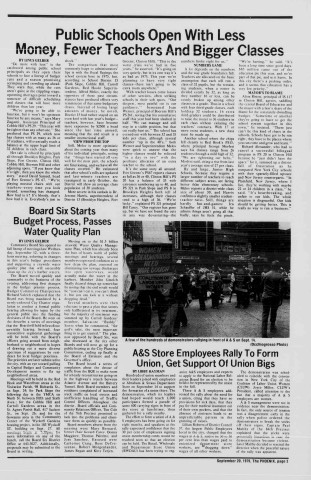
Public Schools Open With LessMoney, Fewer Teachers And Bigger ClassesBY LINUS GELBER%u201c Do more with less\catchword among public school principals as they open their schools to face a lineup of budget cuts and a season promising scrimping and crowding up ahead. They warn that, while the cuts aren't quite at the crippling stage, upcoming shortages point toward a semester of difficult scheduling and classes that will have more children than last year.%u201c We%u2019re going to be able to function, but it won%u2019t be optimum function by any means,%u201d says Mary Zagami, Assistant Principal of Cobble Hill%u2019s PS 29. %u201c This year will be tighter than any otherone.%u201d She predicted that PS 29, which now has classes with as many as 36 or 37 students, will eventually reach a balance at the upper legal limit of 32 children in each class.Her tale is echoed by principals all through Brooklyn Heights, Park Slope, Fort Greene, Clinton Hill, Cobble Hill, Boerum Hill and other adjoining spots. %u201c If you know that it%u2019s tight, then you know the whole story,\of Fort Greene%u2019s PS 67. %u201c We%u2019re playing musical chairs with our teachers--evcry time you look around, something has changed. How bad is it? It%u2019s bloody, that%u2019s how bad it is. Everybody%u2019s just inshock.\The comparison that most commonly leaps to administrators%u2019 lips is with the fiscal Hayings the school system bore in 1975, but, according to School District 15 (Park Slope, Cobble Hill, Carroll Gardens, Red Hook) Superintendent, Alfred Melov, exactly the opposites of those past circumstances have produced effects very reminiscent of that same budgetary chaos. Instead of losing large amounts of money, he noted, District 15 had rather stayed on an even keel with last year%u2019s budgetteachers, however, have become more expensive by $2500 a head since the last time around, meaning that the end result is a smaller instructional staff.VIEW FROM THE TOPStill, Melov is more optimistic about the coming year than many of his individual principals, noting that %u201c things have started off very well for the most part, the schools are functioning, and we have all the classes covered.\that after school%u2019s rolls are updated and last-minute teachers are reassigned in early October, the District will show an average class population of 30 students.More severe in his outlook is Dr. Jerome Harris, superintendent of District 13 (Brooklyn Heights, FortBoard Six StartsBudget Process, PassesWater Quality PlanBY LINUS GELBERCommunity Board Six opened its fall lineup of meet ings last Wednesday, September 12, with a threehour meeting, ushering in changes in this year%u2019s budget procedures and supporting a citywidc water quality plan that will ostensibly clean up the city's harbor waters.The Board moved quickly and summarily to the business of the evening, addressing first changes in the budget priority process. Budget Committee Chairperson Richard Valcich explained that the Board was being mandated bv a newly-enforced City Charter regulation to conduct a formal public hearing allowing for input by the general public into the funding decisions of the Board. He went on the describe a series of meetings that the Boardwillholdinlieuofone unwieldy hearing. Instead, four consecutive segmental gatherings will be held, with the Board%u2019s officers going around from neighborhood to neighborhood in hopes of drawing out a more diverse spectrum of suggestions by residents for local budget priorities. The priorities are later submitted to the city, with an eye toward pulling in Capital Budget and Community Development monies to fix up neighborhood areas.Meetings will be held in the Red Hook and Waterfront areas at the Visitation Parish, 98 Richards St., on Sept. 24; for Park Slope the following day in the YMCA on Ninth St. between Fifth and Sixth Aves.; for the Cobble Hill and Carroll Gardens areas in the St. Agnes Parish Hall, 417 Sackett St., on Sept. 26; and for the Gowanus area in the Community Center of the Wyckoft Gardens housing project, in the 185 Wyckoff ST. building on Sept. 27. All %u25a0ucciuigS begin at 7:30pm; for more information on any of the bunch, call the Board Six District Office at 643-3027. Additionally, proposals may be submitted to the Board in writing.Greene, Clinton Hill). %u201cThis is the worst crisis we%u2019ve had in five years,\very quietly, but in its own way it%u2019s as bad as 1975. This year we%u2019re planning to have very tight classcs-thcre isn%u2019t going to be extra room anywhere.%u201dWith teacher losses come losses of other services, often striking schools in their soft spots. %u201c Our deepest, most painful cut is our guidance,%u2019%u2019 bemoaned Ivan Werner, principal of Boerum Hill%u2019s PS 261, noting that his consultative staff this year had been slashed in half. %u201c We can manage and still stay in a viable position, but that cut really hurt us.\evened out with between 32 and 35 kids per class, although several number %u201c up in the 40%u2019s,%u201d both Werner and Superintendent Melov were quick to answer that the higher classes would be relieved %u201c in a day or two\posthaste allocation of an extra teacher to the school.It%u2019s the same story all around: Fort Greene%u2019s PS67 reports classes as full as 36 or 40, Clinton Hill%u2019s PS 20 has a balance of 35 with extremes numbering up to 40, and PS 321 in Park Slope and PS 8 in Brooklyn Heights both tell of increases, although their classes tend to a high of 36. %u201c We%u2019re lucky,%u201d explained PS 321 principal Bill Casey. %u201c Our register has gone up, but we have not found the cuts in any way devastating--thenumbers broke right for us.\NUMBERS GAMEA lot depends on the numbers and the way grade boundaries fall. Teachers are allocated on the basic assumption that each will run a class of 32 pupils, but the remaining students, when a roster is divided evenly by 32, as long as they number 16 or less, can be evenly broken up among other classes in a grade. Thus in a school with four third-grade classes, each holding 32 students, 16 extra third-graders could be distributed to raise the roster to 36 students in each class without violating the teachers%u2019 contracts. With 17 or more extra students, a new class must be made up.Another school where the chips fell cleanly is Red Hook%u2019s PS15, where principal George Morfesi says his classes range from 26 students through a mild high of 32. %u201c We are tightening our belts,%u201d Morfesi said, citing a rise from last year%u2019s average size of 27 per class.By and large, Junior High Schools, because they require a larger number of teachers to teach different subject areas, are faring better than elementary schools. Melov reports a district-wide class size of about 30, and Harris confirms a slightly smaller studentteacher ratio. Still, things are hardly fun-and-games: IraSchaeffer of JHS 51, while he admits things aren%u2019t going all that badly, says he feels the pinch.%u201c We%u2019re hurting,%u201d he said. %u201c It%u2019s been a long lime since good days. $85 million came out of the education pie this year, and we%u2019re part of that pic, and so it hurts. In this city there%u2019s a pecking order, and it seems that education has a very low priority.%u201dMAYOR%u2019S TO BLAMEAlton Riston, principal of IS 117 in Clinton Hill, agrees, saddling ihe central Board of Education and (he mayor with a lion%u2019s share of the blame for the constantly-dwindling budget. %u201c Sometime or another they're going to have to get the school system together in this town,%u201d he insisted. %u201c There just can't be this kind of chaos in the schools. Schools have got to be run right, they have to be places where you can come and grow and learn.%u201d Richard Alexander, who had to cancel a successful bilingual program in PS 20 in Clinton Hill because he %u201cjust didn%u2019t have the space%u201d for it, summed up a district full of frustration as he compared New York City schools with their sparsely-filled upstate and New Jersey counterparts. %u201c In Plainfield, New Jersey, where I live, they%u2019re working with maybe 22 or 24 children in a class,%u201d he said. %unfair to our kids. The whole situation is disgraceful. Our kids should be getting better. This is really no way to run a business.%u201dMoving on to the $1.5 billion ciiywide Water Quality Management Plan, which has already been the butt of hours worth of public meetings and hearings, several members expressed confusion as to how dean the plan, centered on eliminating raw sewage discharges into open waterways, would actually make the water in the harbors. Member John Gmelch finally cleared things up somewhat by noting that the end result would be %u201c you can%u2019t eat it, you can%u2019t drink it, but you can look at it without dropping dead.%u201dSeveral members were then reluctant to pass a plan that seems only halfhearted in its treatment, but the majority of sentiment was summed up by Carroll Gardens%u2019 member, Salvatore %u201c Buddy\Scotto when he commented, %u201c for god%u2019s sake, the most important thing is to get started.%u201d The plan, now approved by Board Six, was also discussed at the city other Boards and will next go up for a public hearing at the City Planning Commission, ending up finally at the Board of Estimate and the Governor%u2019s office.The Board heard a scries of complaints about the detour of traffic from the BQE to make room for a heady reconstruction going on in the highway%u2019s trench between Atlantic Avenue and the Battery Tunnel. Both Board members and residents complained of increased truck traffic on local streets and inefficient handling of Traffic Control Officers throughout the district. Board officials and Community Relations Officer, Tim Cole of the 76th Precinct promised to look into the problems and eliminate them as quickly as possible.Board members absent from the meeting were Mary Bernard, former rhair Gerard Carev. Donna Maggiore, Thomas Palermo, and Jose Sanchez. Excused were Catherine Craig, Rose DeCrescenzo, Robert Morgenlander, James Regan and Kitty Terjen.A few of the hundreds of demonstrators rallying in front of A & S on Sept. U.(Qcchiogrosso Photo)A&S Store Employees Rally To FormUnion, Get Support Of Union BigsBY LIBBY HAYMANHundreds of union members and their leaders joined with employees at Abraham & Straus Department Store on September 14 to support the formation of a union there. The demonstration, which its leaders had hoped would reach 1,000 participants formed a parade of some 600 carrying signs in front of the store at lunchtime, then gathered for a rally nearby.The effort to form a union of A & S employees has been going on for eight months, and speakers at the rally expressed confidence that the 30 per cent of employees signing union membership cards would be reached soon so that an election can be held. The Retail, Wholesale and Department Store Union (RWDAU) has been trying to organize A&S employees and expects to apply to the National Labor Relations Board for an election to be held to be represented by the union in the fall.Three A & S employees addressed the rally about the need for a union, citing that they have no provisions for sick days, that they pay for their medical insurance out of their own pockets, and that the absence of contracts leads to an unpredictable pattern in the granting of raises.Lillian Roberts of District Council 37, the largest Public Employees Local in the city, charged that the wages at a & S, said to be 30 io 50 per cent less than wages paid to unionized department store workers, are %u2019 %u2019dragging down%u201d wages of all other workers.The demonstration was scheduled to coincide with the convention in New York City of the Coalition of Labor Union Women (CLUW). Joyce Miller, CLUW%u2019s President, called attention to the fact that a majority of A & S employees are women.A & S management were not in evidence near the demonstration. In fact, the only source of tension was a disagreement early in the rally when police ordered the demonstrators to break the sticks off their signs. Captain Paul Maltby of the 84th Precinct explained that the sticks were poienuaiiy hazardous ui thedemonstration became violent. Later Maltby decided to rescind the directive when the peaceful nature of the rally was apparent.September 20,1979, The PHOENIX, page 3


