


Page 271 - Demo
P. 271
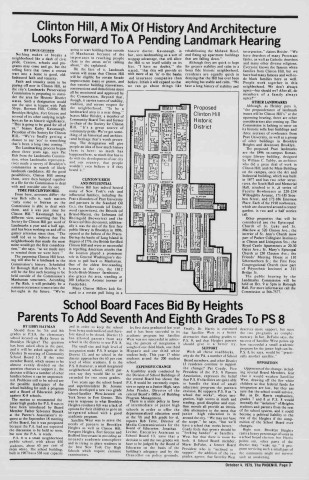
Clinton Hill, A Mix Of History And ArchitectureLooks Forward To A Pending Landmark HearingBY LINUS GELBEENothing makes or breaks a neighborhood like a dash of civic pride. Centers, schools and programs may come and go, but the telling force that turns a census tract into a home is good, oldfashioned faith and tenacity.Faith and tenacity seem to be paying off now in Clinton Hill, as the city%u2019s Landmarks Preservation Commission is preparing to consider the area for Historic District status. Such a designation would out (he spot in league with Park Slope, Boerum Hill, Cobble Hill Brooklyn Heights, Fort Greene and several of its other outlying neighbors as far as historic significance. %u201cThis is going to be good for all of us,%u201d beams Kathy Kavanaugh, President of the Society for Clinton Hill.. %u201c W e%u2019re finally getting a chance to say %u2018yes%u2019 to something that%u2019s been a long lime coming.%u201dThe Landmarking process began about three years ago, says Pat Rich from the Landmarks Commission, when Landmarks representatives made a survey of Brooklyn%u2019s communities in search of likely landmark candidates. All (he good possibilities, Clinton Hill among them, were then lumped together in a file for the Commission to deal with and consider one by one.TIME FOR CLINTON HILLFrom here, accounts differ: the way Rich tells it, such matters %u201conly come to fruition as the Commission is able to deal with them, and it was just time for Clinton Hill.%u201d Kavanaugh has a different view, asserting that The Society for Clinton Hill got word of Landmarks a year and a half ago, and has been working on and off to garner attention since then. %u201c The staff led us to believe that the neighborhoods that made the most noise would gel the first consideration,%u201d she says, %u201c so we made sure to remind them we were here.%u201dThe upcoming Clinton Hill hearing will also be a landmark in the Commission%u2019s history. Scheduled for Borough Hall on October 9, it will be the first such hearing to be held outside of the Commission%u2019s Manhattan structures. According to Pat Rich, it will probably be a common occurence to move into the boroughs in the future. %u201c We%u2019regoing to start holding them outside of Manhattan because of the importance in reaching people close to the areas we%u2019re talking about,%u201d she explained.On the face of it, Landmark status will mean that Clinton Hill will be eligible for certain facade improvement loans or grants, and that exterior building renovations, constructions and demolitions must all be monitored and approved by the Commission. Beyond that, though, it carries tones of stability, tradition, and serene respect for the neighborhood. %u201c To be a landmarkcd area is a neat thing,%u201d boasts Mike Hcisler, a member of Community Board Two and former co-chair of the Society for Clinton Hill. %u201c It%u2019s a great source of community pride: We%u2019ve got something of an historical and architectural heritage that%u2019s worth preserving. The designation will give people an idea of how much history there is here: so much has happened here, so much that has to do with the development of our city and our country, that people wouldn%u2019t even believe it if they heard it.%u201dCLINTON%u2019S RICHAND INFLUENTIALClinton Hill has indeed hosted many of New York%u2019s rich and influential families, including the Pratts (founders of Pratt University and partners in the Standard Oil Co.), the Underwoods (of Underwood typewriters), the Bristols (of Bristol-Myers), the Liebmans (of Rhcingold Breweries) and the Otises (of Otis elevators); additionally it was the site of the first free public library in Brooklyn in 1896, opened at the behest of the Pratts. During the battle of Long Island in August of 1776, the British fortified Clinton Hill and were so successful in repelling American attacks that the location played a prominent role in General Washington's decision to pull back to Manhattan. One of the oldest free-standing houses in the city, (he 1812 Sleclc-Brick-Skinncr farmhouse, also graces the area, standing at 200 Lafayette Avenue (corner of Vanderbilt).Many Clinton Hillers look forward to a certain pull living in ahistoric district. Kavanaugh, in fact, secs landmarking as a sort of stopgap advantage, that will allow the Hill to set itself solidly on its feet. %u201c I have no doubts,%u201d she stated, %u201c that this will provide us with more of an %u2018in%u2019 to the banks ind insurance companies than before. I think it will expand so that we can go about things likerehabilitating the Mohawk Hotel, and fixing up apartment buildings that are falling down.%u201dAlthough they are quick to hope for greater stability and calm in a bona fide historic neighborhood, residents are equally quick in denying that the Hill has ever been anything but stable and calm. %u201c We have a long history of stability andintegration,%u201d claims Heisler. %u201c We have churches of many Protestant faiths, as well as Catholic churches and many other diverse religions. Everyone knows the famous white families from Clinton Hill, but we have had many famous and well-todo black families here as well. People work together in this neighborhood. We don%u2019t always agree%u2014but should we? After all, do members of a family always agree?%u201dOTHER LANDMARKSAlthough, as Heisler puts it, %u201c the preponderance of landmark issues will be Clinton Hill%u2019s%u201d at the upcoming hearing, there are other considerations also coming up. The Commission is looking to enter on its historic rolls four buildings and three sections of rowhouses from Pratt University, as well as a group of other buildings in Brooklyn Heights and downtown Brooklyn.The proposed Pratt landmarks arc the 1896 on-campus Romanesque Library building, designed by William C. Tubby, an architect who did a great deal of work in Clinton Hill; and the Main Building on the campus, once the Art and Industrial building, which was built in 1877 and has two other structures, the South Hall and Memorial Hall, attached to it. A series of Faculty Rowhouses at 220-234 Willoughby Avenue, 171-185 Steuben Street, and 172-186 Emerson Place. Each of the 1910 rowhouses, which arc clustered around a center garden, is two and a half stories tall.Other properties that will be considered are the Episcopal Church of St. Luke and St. Matthew at 520 Clinton Ave.; the interior of St. Ann%u2019s Church (now part of Packer Collegiate Institute) at Clinton and Livingston Sts.; the Royal Castle Apartments at 20-30 Gates Ave.; St. Mary%u2019s Episcopal Church at 230 Classon Ave.; the Friends%u2019 Meeting House at 110 Schermerhorn St.; the First Free Congregational Church (now part of Polytechnic Institute) at 311 Bridge St.The public hearing by the Landmarks Commission will be held on Oct. 9 at 5pm in Borough Hall. For more information call the Commission at 566-7577.School Board Faces Bid By HeightsParents To Add Seventh And Eighth Grades To PS 8BY LIBBY HAYMAN and in order to keep the school Should there be 7th and 8th from being underutilized and there -grades at P.S.8, the elementary school located on Hicks Street in Brooklyn Heights? The question has been asked often in the past, and it will be asked again at the October 16 meeting of Community School Board 13. If the nine member Board, which seems to be almost evenly divided on the question chooses to support it, the decision will face a number of other hurdles before it can be tmplcmen ted. Problems still to be solved are the possible inadequacy of the school building for such a program and a Board of Education policy against K-8 schools.The motion to recommend the junior high grades for P.S. 8 was to have been introduced by Board Member Father Sylvester Benack at the Parent%u2019s Association's request at the September 18 meeting of the Board, but it was postponed because the P.A. had not expected the discussion to be held so soon, but now the P.A. is ready.P.S. 8 is a small neighborhood public school, with about 450 students, about 65 per cent of them white, lbe school building, built in 1907 has a 538 scat capacitylore slated to be closed, District 13 has allowed parents from any school in the district to use P.S. 8.The small size and high level of integration make P.S. 8 unique in District 13, and no school in the district approaches the 65 per cent level of white students. It is the P.S. 8 character, a small integrated neighborhood school, which parents say they would like to see extended for two extra grades.Two years ago the school board and superintendent Dr. Jerome Harris developed a new two grade school-Satellite West-located on York Street in Fort Greene. This was in response to what Brooklyn Heights residents felt was a lack of options for their children to go to an integrated school with a good academic program.Satellite West was to serve the needs of parents in Brooklyn Heights as well as Clinton Hill, Porspect Heights, Fort Greene and Bedford Stuvvesant in Drovidine an intensely academic atmosphere and in trying to place students in the best New York City High Schools which require entrance examinations.Its first class graduated last year and it has been succesful in its academic program but Satellite West was not successful in achieving the pattern of integration it sought of one third black, one third Hispanic and one third white student body. This year 17 white students attend the 200 student school.EXPENSIVE CHANGEA feasibility study conducted by the Division of School Buildings of the central Board has shown that P.S. 8 would be extremely expensive to equip as a Junior High, says John Pender, Director of the central Board's Office of Building Program Management.There is a state policy in favor of intermediate or junior high schools in order to offer the departmentalized education need at the 7th and 8th grade lev el, reports Bob Terte, Director of Media Communications for the Board of Education. Jonathan Levine, Executive Assistant to School Board 13, savs that a decision to add the two grades will have to be judged by the Board of Education on the basis of the building's adequacy and by the Chancellor on policy grounds.Finally, Dr. Harris is convinced that Satellite West is a better alternative than adding grades to P.S. 8. and that Heights parents should give it a better try.SUPPORTWith all these roadblocks, why do the PA, a number of SchoolBoard members, and other District 13 residents continue to support the change? Pat Coady, Vice President of the P.S. 8 Parents Association, expresses the belief that P.S. 8%u2018s facilities arc quite able to handle the kind of small adacemic program the parents envision. He supports P.S. 8 as %u201ca school that works%u201d , where integration, high scores in math and reading, good disepline and excellent morale all provide an irresistible alternative to the mess that junior high education is in around the city. %u201c We may not have the scope,%u201d he says, %u201c but we'll have a school that works better.\Coady feels that prents should be %u201c looking harder%u201d at Satellite West, but that there is room for both. A School Board member, Mario DcFalco, a former Board President who is %u201c inclined to support%u201d the addition of the two grades, agrees that Sattelite Westdeserves more support, but sees the two programs as complementary. In fact, DcFalco says, the success of Satellite West points up how successful a small academic program for the junior high can be. P.S. 8, he says, would be %u201c practically another satellite.%u201dOPPOSITIONOpponents of the change, including several Board Members, fear that it would weaken Satellite West, drawing off the few white children so that federal funds for integration are lost, but they are sure that the school would survive. But, as Dr. Harris emphasizes, grades 7 and 8 at P.S. 8 would intensify the %u201c isolation%u201d of Heights students and parents from the rest of the school system, and it could become a political liability to the rest of the Heights if the composition of the School Board ever changes.Right now, Brooklyn Heights casts a heavy percentage of votes in a school board election, bin Harris points out, other parts of the district may \gram servicing such a small part of the community might not survivesuch an awakening.October 4, 1979. The PHOENIX, Page 3


