


Page 411 - Demo
P. 411
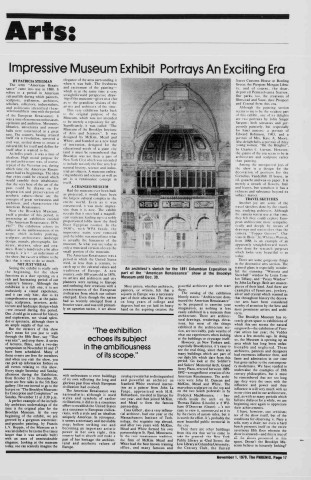
A rtsImpressive Museum Exhibit Portrays An Exciting EraBY PATRICIA STEGMANThe lerm %u201c American Renaissance%u201d came into use in 1880. Ii refers to a period in American cultural life during which painters, sculptors, craftsmen, architects, scholars, collectors, industrialists, and politicals identified themselvesandtheir time with theperiodof the European Renaissance. It was a timeofenormousenthusiasm, optimism and ambition. Museums, libraries, universites and concert halls were constructed at a great rate. Flic country, having created itself via a revolution, survived a civil war, settled down to create a cultural life for itself and define for itself what it wanted to be.As befits youth, it was a time of idealism. High moral purpose for art and architecture was, of course, typical of the Victorian era, during which time the American Renaissance had its beginnings. The idea that cities could be created which would ennoble their inhabitants; that the very best of the art of the past could be drawn on for inspiration and preservation of aesthetic values%u2014these are the concepts of great seriousness and ambition, and characterize the American Renaissance.Now the Brooklyn Museum, itself a product of this period, is presenting an exhibition entitled \1917%u201d . The exhibition echoes its subject in the ambitiousness of its scope, which includes painting, sculpture, architecture, landscape design, murals, photographs, furniture, interiors, silver and ceramics. If one%u2019s mind reels a bit after seeing it, it is %u25a0' %u2022 an indictment of the show, but raioer a tribute to the fact that it tries to do so much.NOT JUST VISUALSeeing the exhibit is really only the beginning, for the show functions as a door opening on a rich and fascinating period of our country%u2019s history. Although the exhibition is a rich one, it is not exclusively a visual experience, and it can only hint, due to its comprehensive scope, at the paintings, sculptures, interiors, architecture and landscape design which were created during this period. One should go in a mood for history and exploration, not visual splendor or spectacle, although there is an ample supply of that too.But the curators of this show don%u2019t mean for you just to walk through the fifth floor, say %u201c That was nice%u2019 %u2019 , and stop there. A series of lectures, films, and a two-day symposium on November 16 and 17 have been scheduled. Many of these events are free for members and when you visit the show, you can pick up information folders on all events relating to this show. Every single Saturday and Sunday afternoon during the Exhibition, from October 13 to December 30, there are free talks in the 5th floor gallery. I for one intend to go to the lecture on %u201c The Brooklyn Museum: Its Conception and Completion%u201d on Sunday, November 11 at 3:30 p.m.A perfect example of the incredibly ambitious undertakings of the time is the original plan for the Brooklyn Museum. At the very beginning of the exhibit, we are greeted by a gorgeous watercolorand-gouache painting, by Francis L.V. Hoppin, of the Museum as it was intended to be (some five times larger than it was actually built) with an aura of unmistakeable elegance. Looking at the museum today, one can scarcely imagine theelegance of the area surrounding it when it was built. The freshness and excitement of the painting%u2014 which is at the same time a very straightforward perspective drawing of the museum%u2014gives us a clue as to the grandiose visions of the artists and architects of the time.This very exhibition harks back to the original purpose of the Museum, which was not intended to be merely a repository for art. Significantly, it was called %u201c The Museum of the Brooklyn Institute of Arts and Sciences%u201d . It was designed by McKim, Mead and White, and founded as a new kind of institution, designed for the educational needs of a giant city (and it must be remembered that Brooklyn was not then a part of New York City) which was intended to include not only the fine arts b ut natural history, science and industrial art objects. A museum embracing industry and science as well as art is a renaissance concept in itself.A CHANGED MUSEUMHad the museum ever been built as projected, it would have been the largest cultural complex in the entire world. Even as it was constructed, it was more impressive than it is now. The exhibit reveals that it once had a magnificent staircase leading up to a nobly proportioned lobby (now the third floor Egyptian rooms). In the I930%u2019 s, with WPA funds, the impressive stairs were removed and the lobby was moved into what is actually the basement of the museum. So what you sec today is only a truncated version of even the small portion of the museum.The American Renaissance was a period in which the United States tried, in less than a century, to catch up to the cultural values and traditions of Europe. A new country, only 100 years old in 1876, its artists and architects and city planners were turning to Europe and embuing their creations with a consciousness o f the European civilization from which our culture emerged. Even though the nation had so recently emerged from a frontier state, and was still primarily an agrarian nation, it set aboutMost artists, whether architects, painters, or writers, felt that a sojourn in Europe was a necessary part of their education. The stress on long years o f college and degrees had not yet laid its heavy hand on the aspiring creator; the%u201cT h e e x h ib itio ne c h o e s its s u b je c tin t h e a m b itio u s n e s so f its s c o p e .%u201dwith enthusiasm to erect buildings of its own reflecting the long and glorious past from which European civilization had evolved.The American Renaissance was nationalistic; although it used styles and symbols o f earlier civilizations, it did so in a conscious effort to establish the United States as a successor to European civilizations, with a style and an idealism uniquely American. In retrospect, it seems a necessary and inevitable step; before striking out and becoming an important artistic power in her own right, this country had tn ahenrh and malrr apart of her heritage the architectural and aesthetic values of Europe.catalog revealsthat so distinguished and powerful an architect as Stanford White received instruction as a painter from John La Farge, apprenticed with H.H. Richardson, traveled in Europe for one year, and then joined McKim, and Mead to form the famous partnership.Cass Gilbert, also a very influential architect, had one year at the Massachusetts Institute of Technology, the requisite trip abroad, and after two years with McKim, Mead and White formed his own partnership in St. Paul, Minnesota.In ih p lriir %u00bb r p n o ic c a n p p (fS d !tiO nthe firm of McKim Mead and White had the best known training office, and many famous andpowerful architects got their start there.Die catalog of the exhibition bluntly states: %u201c Architecture dominated the American Renaissance%u201d so be prepared to exercise your imagination, as nothing is less easily exhibited in a museum than architecture. There are architectural drawings, renderings, elevations, but most of the things exhibited in the architecture section, are inevitably, pale wraiths of what one experiences when looking at the buildings or cityscape itself.However, as New Yorkers and, especially Brooklynites, it%u2019s easy to see the real thing, since there are many buildings which are part of our daily life which date from this period. Go look at the Soldier%u2019s and Sailors%u2019 Memorial Arch, Grand Army Plaza, erected between 1889- 1892%u2014a magnificent creation of the American Renaissance. The archi tects were John H. Duncan and McKim, Mead and White. The marvelous sculpture on the top and on the two South pedestals is byFrederick MacMonnies; t %u2022 basreliefs inside the arch .J * \, ; t l i S A i ' :tmmu n il*An architect's sketch for the 1891 Columbian Exposition ispart of the %u201c American Renaissance\Museum until Dec. 30.States Customs House at Bowling Green; the Picrpont Morgan Library. and of course, the dear, departed Pennsylvania Station. Our parks, too, the creations of Olmstcad and Vaux, date Prospect and Central from this era.Although the painting section seems to me to be the weakest part of this exhibit, one of its delights arc two portraits by John Singer Sargent; both sensuous and gorgeously painterly, but (especially for him) austere: a portrait of Edward Robinson, 1903, and a portrait of Mrs. Kate A. Moore. Also delightful is a portrait of three young women, \by Charles C. Curran. However, the giants of the era seem to be in architecture and sculpture rather than painting.Among the unexpected joys of the show is a design for the decoration of portiers for the Cornelius Vanderbilt II house, in oil. gouache and wax on paper. It is merely a wreath of flowers, fruit and leaves, but somehow it has a richness and substance beyond its subject matter.TRAVEL SKETCHESAnother joy arc some of the travel sketches done by the traveling, studying architects. Although the camera was in use at that time, they fell they could explore European architecture more sympathetically and deeply by means of drawings and watcrcolors than the camera. %u201c Copper Gutters%u201d , Chateau dc Blois%u201d . by Whitney Warren, from 1888, is an example of an apparently straightforward watercolor done for research purposes which looks very beautiful to us today.There arc some gorgeous things in the decorative arts section. The stained glass is especially wonderful: the stunning %u201c Wisteria and Snowball\fort Tiffany, and \by John La Farge. Both arc masterpieces of their kind. And there are examples of furniture, jewlery, silver and crystal which remind us that throughout history the decorative arts have been considered worthy of attention by the best and most prominent artists and architects.The Brooklyn Museum has recently given space to exhibitions of which this one seems the natural outgrowth%u2014the exhibition of Victorian artists last year; the Vedder show a few months ago. In doing so, the Museum is opening up an area which has long been unfashionable and neglected. These architects, painters and designers had enormous influence then, and fame and admiration in our time has gone rather to the contemporary modernists. We have tended to undervalue the examples of 19th century philosophies, but it must be remembered that not too long ago they were the ones with the influence and power and their influence is still very much with us in our cities and in our architecture, and, as with so many periods which fall into disfavor for a while, we are beginning once again to appreciate their achievements.I have, however, one criticism; not of the show itself, but of the conditions for observing it. Nary a sofa, nary a chair; not even a hard bench presents itself on the entire cavernous fifth floor wherein the show is situated%u2014and this is true of- 1 1 .tU ~ _ L ______ ____________. _ J %u2022 ? u n m e i> u u %u00ab a p i c a u a c u m m ospace. Doesn%u2019t the Brooklyn Museum believe in leisurely looking?November 1, 1979, The PHOENIX, Page 17


